
Demand for $XRP is weakening across several key market indicators, testing whether the $XRP Ledger’s (XRPL) growing institutional pipeline can translate into sustained investor and network activity.
US spot $XRP exchange-traded funds recorded about $7.2 million in net outflows in the week ended July 10, according to SoSoValue. The withdrawals ended a nine-week inflow streak that brought nearly $200 million into the products.
The weekly outflow ranked among the five largest for $XRP funds this year, though it represented only a modest reversal in the broader trend. The products have attracted cumulative net inflows of $1.48 billion, while their combined assets approached $1 billion at the end of the week.
Still, the shift coincided with a decline in futures exposure and some of the weakest XRPL user activity recorded in 2026, suggesting that demand is cooling across both regulated investment products and the wider market.
$XRP open interest falls as bullish traders pay more
That cooling in fund demand is also showing up in the leveraged market, where traders are cutting exposure.
Global open interest in $XRP futures fell from nearly $3 billion in June to about $2.3 billion by mid-July, according to CoinGlass.
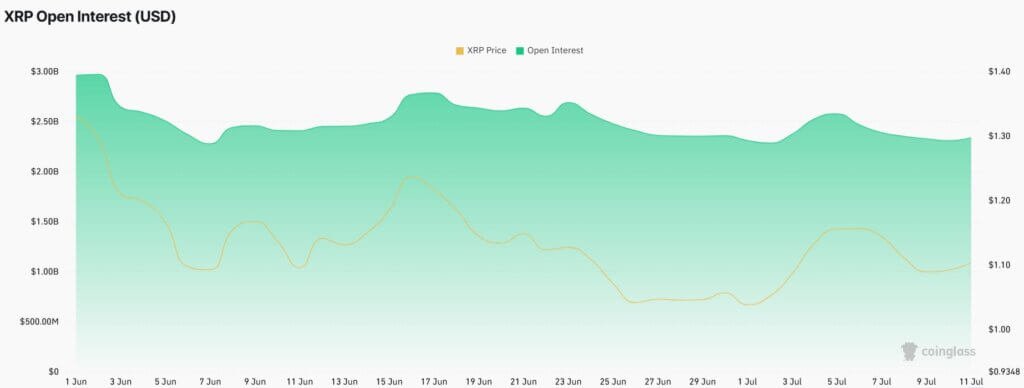
The decline was most evident on Binance, where open interest fell from over $500 million in mid-June to $399 million by July 10, according to CryptoQuant data. Long liquidations rose 94% from the previous week and stood 172% above their three-month average, while short liquidations fell by more than half.
Meanwhile, $XRP funding rates moved in the opposite direction. Binance’s $XRP funding rate increased 266% over the week despite a shrinking pool of open positions and elevated long liquidations.
The divergence suggests that the remaining bullish traders are paying higher premiums to maintain exposure in a contracting derivatives market.
That structure could leave $XRP vulnerable to another funding reset if prices weaken and additional long positions are forced to close.
XRPL activity concentrates as wallet growth stalls
The retreat from leveraged trading is also evident in XRPL, where fewer wallets are participating even as established services generate more activity.
Blockchain analysis platform Santiment reported that XRPL experienced its second-quietest day of the year this week, logging only 25,350 active wallets.
The pipeline of new participants has similarly dried up, with new wallet creation plummeting to 2,130. This is the lowest level recorded since November 2024.
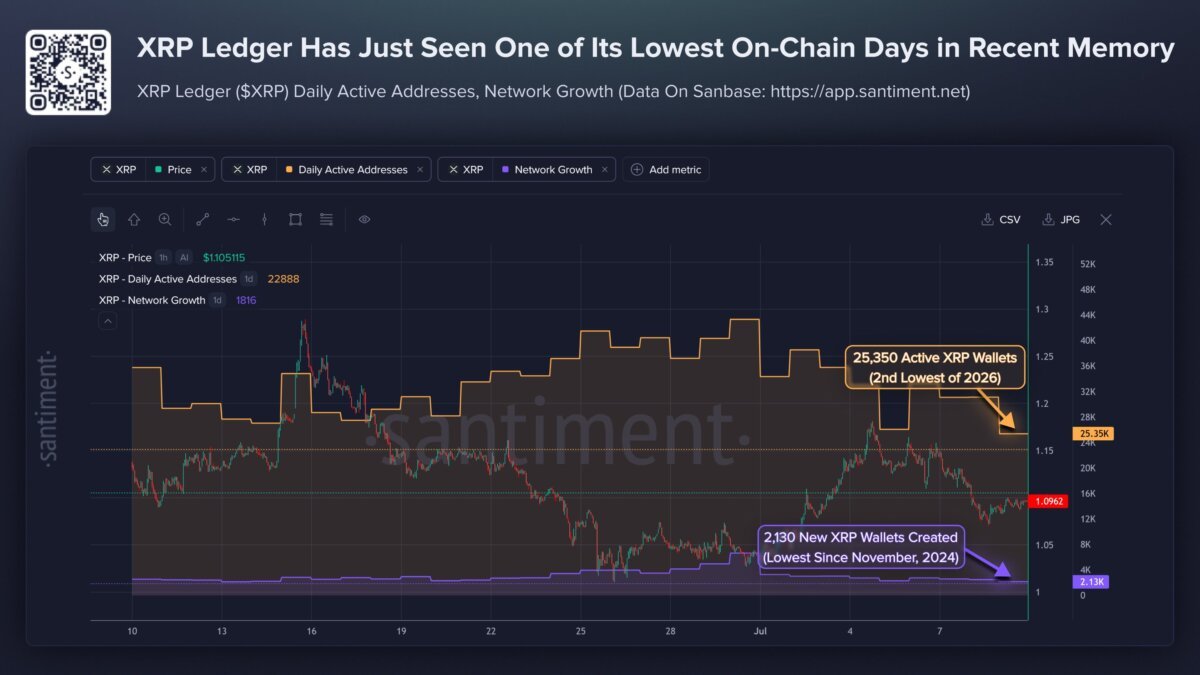
The slowdown followed a brief increase in dip-buying activity in late June. Since then, both active wallet numbers and new wallet creation have fallen back, with no clearer price or network catalyst.
However, other indicators suggest that network activity has become more concentrated among existing users and applications rather than disappearing altogether.
Vet, an $XRP Ledger validator, said transactions containing source tags rose 28.6%, while the number of source tags increased 13%. The tags are commonly used by exchanges, payment providers, and other services to identify transactions linked to customers who use shared accounts.
The increase points to greater activity from service-based applications, but it does not necessarily signal broader adoption. A smaller group of established platforms can generate more transactions even as the number of active and newly created wallets declines.
CryptoQuant data showed the same divide. Transaction counts increased about 3% to 4% over the previous week and month, but remained roughly 21% below their three-month average. Active addresses were also 11% below their three-month baseline.
The network-value-to-transactions ratio eased over the period, suggesting utilization may be stabilizing after an earlier decline.
However, the improvement remains limited, as transaction volumes and user participation continue to trail their longer-term averages.
Can XRPL’s institutional growth revive demand for $XRP?
$XRP’s weakening market position has increased the importance of the institutional activity developing on XRPL.
Data from CryptoSlate shows that the token has fallen about 5% over the past week to roughly $1.11, as ETF outflows, declining futures exposure and weaker wallet growth point to reduced demand across several parts of the market.
At the same time, institutions are making greater use of XRPL for tokenized assets and settlement. Evernorth, an $XRP-focused digital-asset treasury company, said about $4 billion of tokenized real-world assets associated with the network now span more than 500 products.
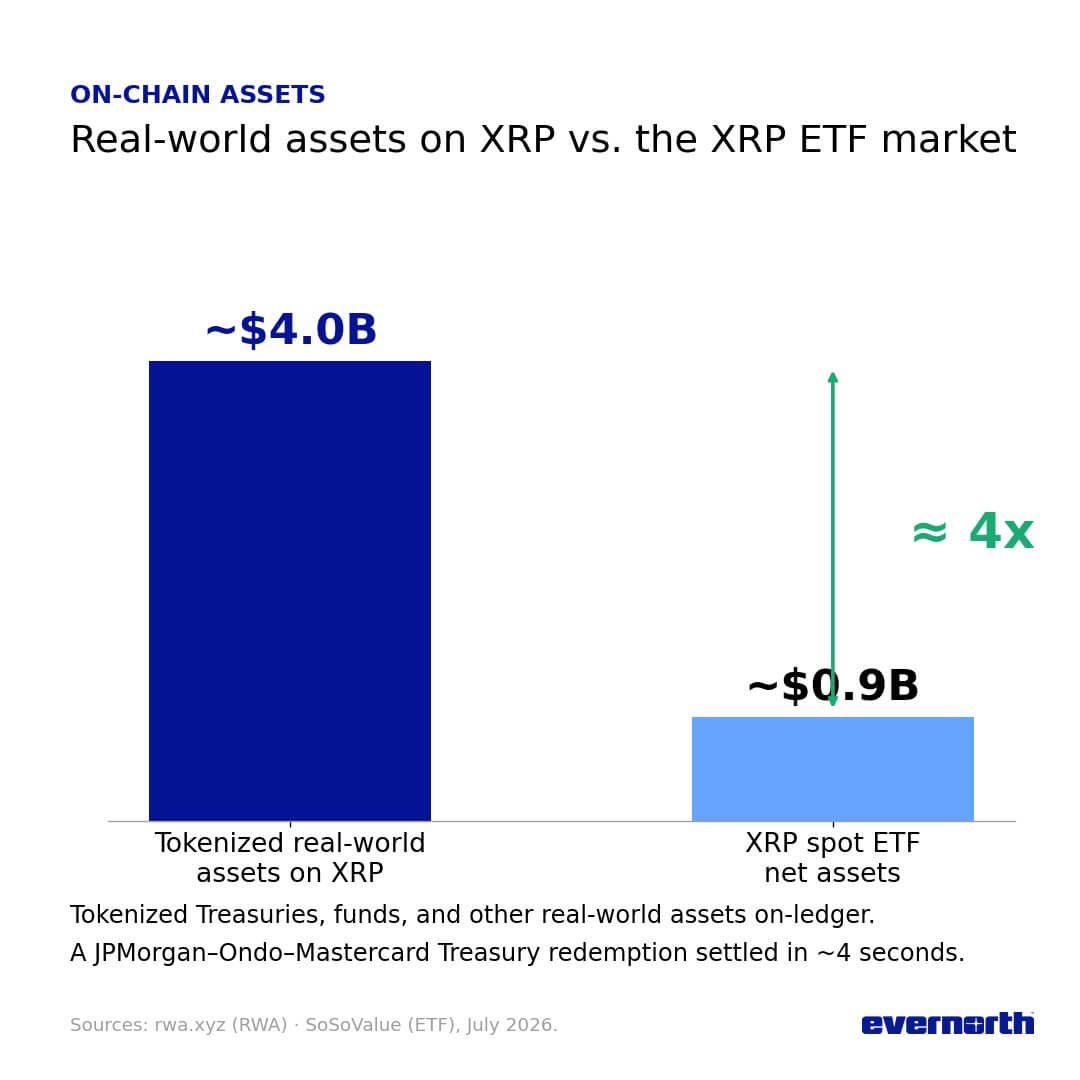
That growth gives developers an incentive to make the ledger more suitable for banks, asset managers and other financial companies. Their latest effort focuses on privacy, one of the main features institutions often require before moving sensitive financial activity onto public blockchains.
The proposed XLS-96 standard would introduce confidential transfers for Multi-Purpose Tokens. It would use encryption and zero-knowledge proofs to hide individual balances and transfer amounts while still allowing validators to verify that transactions comply with the ledger’s supply rules.
The proposal would also allow selective disclosure, enabling issuers to provide transaction information to regulators and auditors without making it publicly available. Controls such as freezing and clawback functions would remain available for confidential assets.
Those features could make XRPL more attractive to institutions that do not want competitors or outside observers monitoring their collateral movements, settlement amounts or trading positions in real time.
Institutional interest in the network is already producing practical use cases. In May, Ondo Finance, Ripple, Mastercard and JPMorgan’s Kinexys platform completed a cross-border redemption involving Ondo’s tokenized US Treasury product.
The tokenized asset portion was processed on XRPL in less than five seconds, while the corresponding dollar payment moved through Kinexys and JPMorgan’s banking network. The transaction showed how assets recorded on the ledger could interact with traditional financial infrastructure.
Adding confidential transfers could help expand that activity by removing a key obstacle to institutional adoption. More tokenized assets, settlement transactions, and financial products on XRPL could, in turn, strengthen demand for $XRP if the token is used for liquidity, transaction fees, collateral, or settlement.