
Pump.fun’s [$PUMP] rally gained support as Jupiter accumulated 1.6 billion tokens, worth $5 million, while its rising revenue strengthened protocol-funded buyback demand.
Reportedly, the protocol’s initial $1 million capital originated from Backpack before the accumulation continued across the period.
The wallet eventually held around 0.242% of $PUMP’s total supply and was the 35th largest $PUMP holder.
Thus, Jupiter’s consistent buying activity added large-holder demand, rather than any one isolated transaction.
Its accumulation also preceded the rapid increase in $PUMP price while coinciding with the recovery framework as a whole. The wallet held firm, as $PUMP continued to make higher resistance attempts.
This progressive accumulation reduced the amount of tokens that were immediately available for selling as Jupiter kept its buying orders outside the selling channel.
More importantly, protocol-funded purchases added another demand source alongside Jupiter’s growing position.
Revenue growth strengthens $PUMP’s buyback engine
Pump.fun’s financial performance added a fundamental layer behind the most recent price expansion. Across the protocol, the revenue generated from the platform amounted to around $1.16 million in 24 hours.
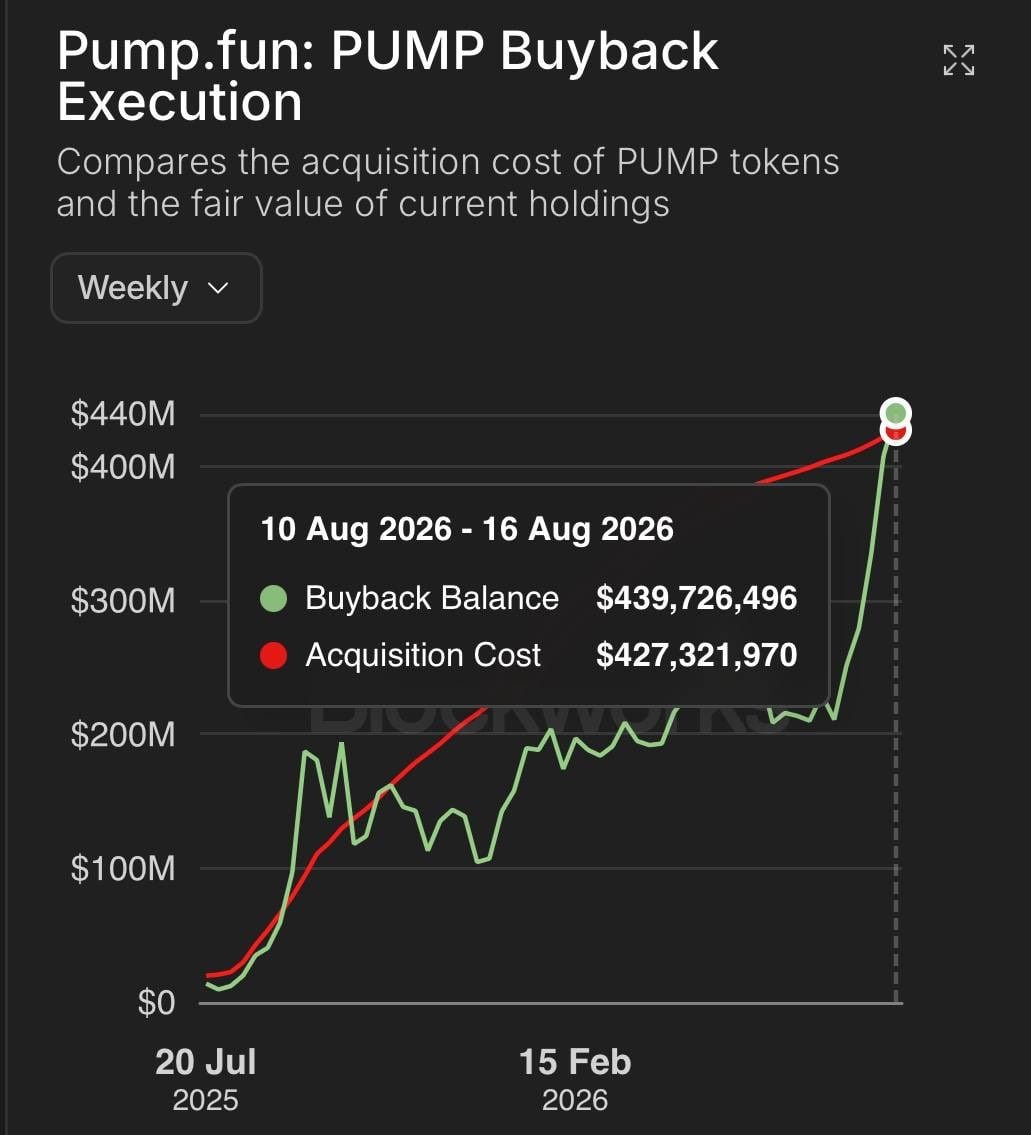
Additionally, the seven-day revenue growth was about 15% faster than its 30-day revenue growth. This stronger revenue was important since the Pump.fun Protocol spent 50% of its net revenue purchasing and burning $PUMP tokens.
The buybacks amounted to more than $430 million while more than 16% of total supply was burned.
The mechanism worked, leading to repeated buying and selling as revenues grew, without necessarily pushing the market heavily into speculation.
Jupiter’s accumulation was thus complementary to another protocol mechanism that was vying for $PUMP supply.
Sustained revenue strength would expand buyback capacity and help bolster scarcity during periods of sustained demand.
Spot outflows tightened exchange-side supply further
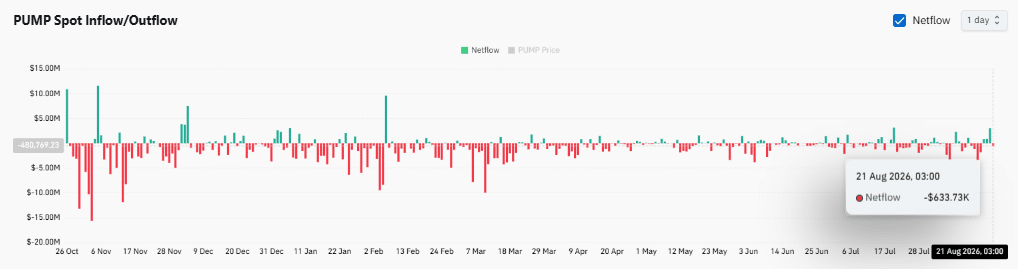
Exchange flows added another supportive component as $PUMP’s rally developed. On August 21, $PUMP had a negative spot netflow of ~$633.73K, reflecting the larger outflow trend.
A negative Netflow signified tokens leaving exchanges rather than entering them over the period of time. Hence, there were fewer tokens immediately available to the market for selling.
The flow structure worked well with Jupiter’s accumulation, and both were negative on the supply side as buybacks were a positive on the demand side.
Importantly, outflows were not a measure of outright buying pressure, but rather a measure of the availability of exchange-side buyers.
Combined with permanent burns, reduced exchange balances could amplify price reactions when demand remain elevated.
An increase of positive Netflows, however, would temper that supply backdrop as more $PUMP would flow back toward potential trading activity.
Can $0.003698 survive an overheated breakout?
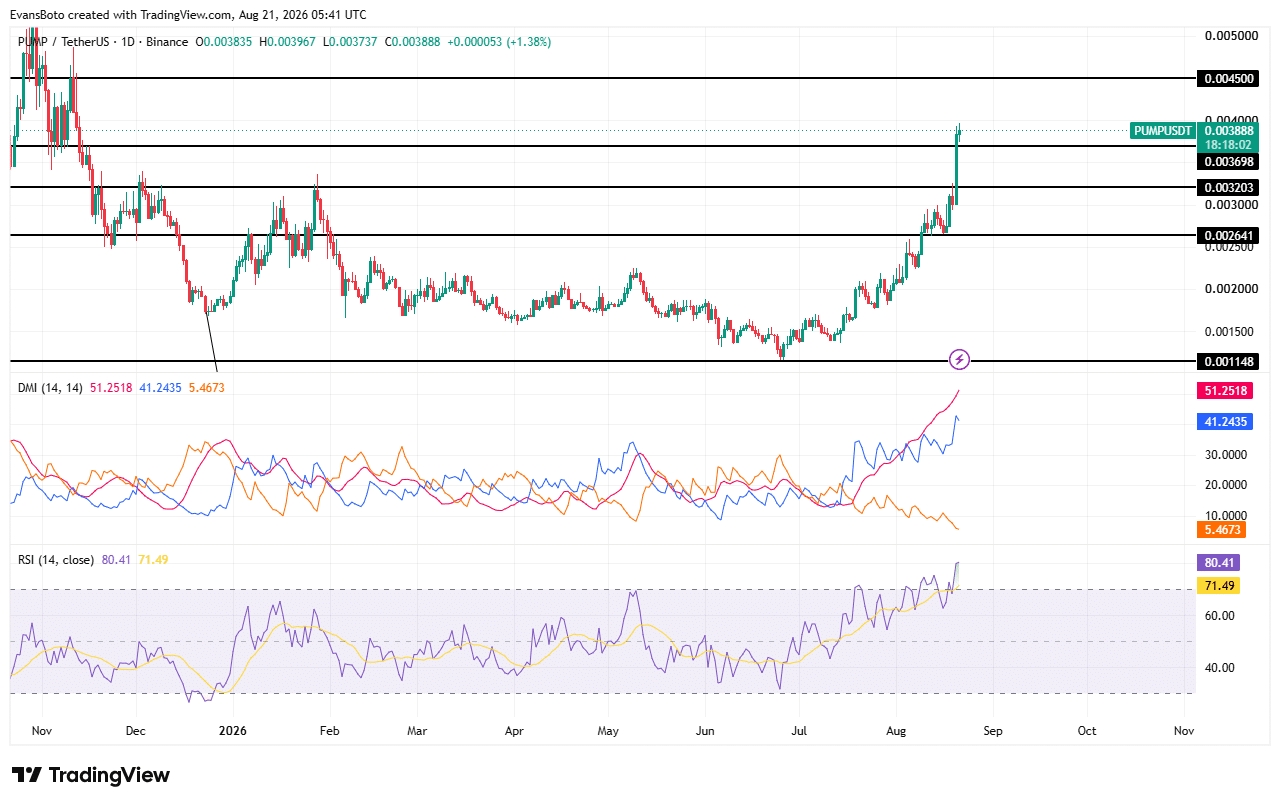
Pump.fun broke through $0.003203 before clearing $0.003698, extending its recovery toward the next major resistance near $0.004500.
At the time of writing, price traded around $0.003888, placing the former $0.003698 resistance beneath the token’s latest price breakout.
However, the RSI stood at 80.41, well into the overbought territory. These conditions increased the possibility of short-term cooling despite the underlying demand and supply improvements.
Notably, trend strength remained substantial, with the ADX reaching 51.25 as the rally accelerated.
Additionally, the buyer dominance also remained elevated as +DI signal stood at 41.24, above the the -D at only 5.47.
Therefore, $0.003698 was a key level to watch to see if buyers could maintain the breakout.
Ultimately, holding that level would keep $0.004500 reachable, while losing it could expose $0.003203 during a broader market reset.
Final Summary
- Jupiter’s 1.6 billion $PUMP accumulation strengthened demand as protocol buybacks continued reducing supply.
- $PUMP cleared $0.003698, although an overbought RSI increased the risk of short-term cooling.