
Strategy’s STRC preferred stock has become the largest holding in three major U.S. preferred stock ETFs, which collectively own $756 million of the security even as its price remains about 13% below its $100 par value.
Michael Saylor, Strategy’s co-founder and executive chairman, disclosed that STRC now leads the portfolios of BlackRock’s iShares Preferred and Income Securities ETF (PFF), Virtus InfraCap’s U.S. Preferred Stock ETF (PFFA), and VanEck’s Preferred Securities ex Financials ETF (PFXF). In a July 24 X post, Saylor described the placements as evidence that Strategy’s “digital credit” products are entering institutional portfolios.
Digital Credit is entering the institutional mainstream. $STRC is now the largest holding in three leading U.S. preferred stock ETFs, with $756 million held across BlackRock’s $PFF, Virtus InfraCap’s $PFFA, and VanEck’s $PFXF. pic.twitter.com/IoYwl2D360
— Michael Saylor (@saylor) July 24, 2026
The three funds give investors indirect exposure to STRC alongside preferred securities issued by established U.S. companies. According to Saylor’s figures, their combined STRC position has reached $756 million, making the security the largest individual holding in each portfolio.
Although ETF demand has increased, STRC closed at $86.89 on July 24, gaining 2.29% during the session before rising to $87.14 in after-hours trading, according to market data shown by Yahoo Finance. Its closing price left the stock 13.11% below the $100 level Strategy designed it to track.
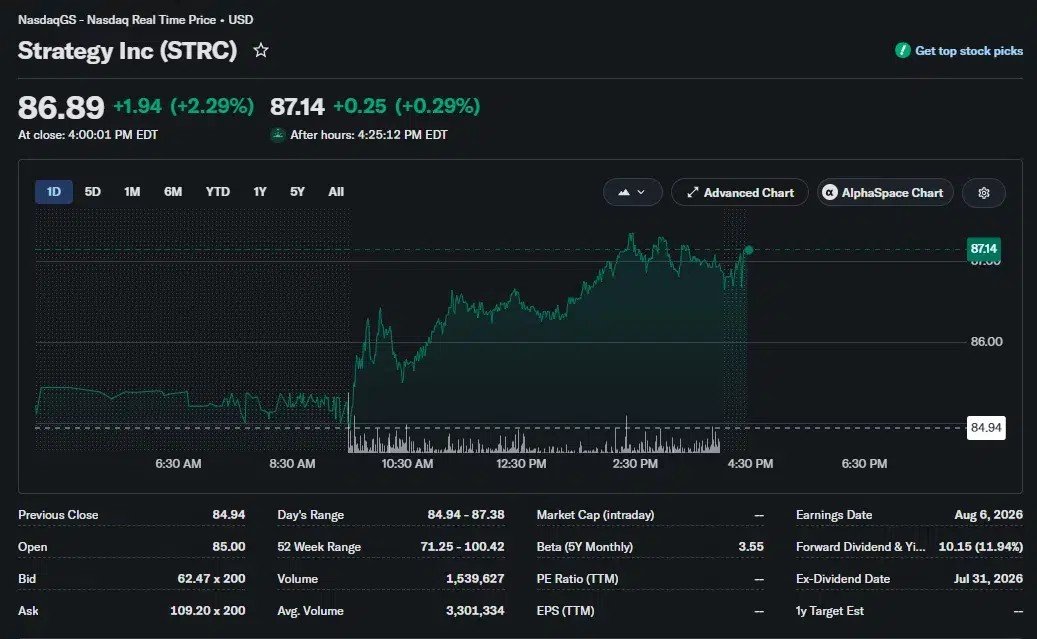
Trading below par has become an important constraint for Strategy because the company uses STRC sales to raise money for Bitcoin purchases. Strategy can issue additional preferred shares near or above $100 and direct the proceeds into Bitcoin, but selling new stock at a large discount would secure less capital per share and weaken the economics of the transaction.
ETF demand has lifted institutional ownership
Strategy CEO Phong Le reported that the average STRC position held by institutions climbed 105% to $3.5 million between March and July. Over the same period, retail investors’ share of ownership fell from 78% to 71%, according to figures Le published on X.
“The institutions are coming,” Le wrote.
Yes, but that means retail investors sold for a loss. My guess is the institutional buyers bought in for a short-term trade only. Or maybe they shorted MSTR and bought STRC as a spread trade. Maybe they bought STRC and shorted Bitcoin. None of those trades are bullish bets.
— Peter Schiff (@PeterSchiff) July 24, 2026
His figures correct reports describing the increase in average institutional holdings as 10%. Le’s post placed the increase at 105%, indicating that the average position more than doubled during the four-month period.
Institutional participation does not prove that every buyer expects either STRC or Bitcoin to rise, according to Bitcoin critic Peter Schiff. Responding to Le, Schiff argued that retail investors may have sold their positions at a loss while professional investors entered trades designed to profit from differences between Strategy’s securities.
Schiff suggested that some funds could have purchased STRC while shorting Strategy’s common stock, MSTR, as a spread trade. Other buyers may have paired long STRC positions with short Bitcoin exposure, he added.
“None of those trades are bullish bets,” Schiff wrote in his response.
Strategy currently pays STRC holders a 12% annual dividend in cash through two payments each month. The company’s STRC information page states that management adjusts the dividend rate monthly to encourage the stock to trade around its $100 par value and reduce price volatility.
The preferred stock’s high payout has not yet closed the discount. STRC’s 52-week range spans $71.25 to $100.42, while its July 24 closing price remained closer to the lower end of that range than to par.
The $100 level controls Strategy’s Bitcoin funding
Le has directly linked further STRC issuance and Bitcoin purchases to a recovery in the preferred stock. During a July interview, the Strategy CEO said the company would resume issuing more STRC once it returned to par.
“We’ll continue to build that. And yeah, when Stretch gets back to par, we’ll issue more. We’ll buy more Bitcoin,” Le said.
Under this funding model, a return to $100 would allow Strategy to sell new STRC shares on more favorable terms and use the proceeds to add Bitcoin. Until the discount closes, Le’s comments indicate that the company has less incentive to expand the program.
Strategy has already demonstrated how pressure on its preferred securities can affect its Bitcoin treasury. A July 6 filing showed that the company sold 3,588 $BTC for $216 million to fund dividends on its digital-credit securities and maintain liquidity. Following the sale, Saylor reported that Strategy held 843,775 $BTC and had increased its U.S. dollar reserves to $2.55 billion.
Also on July 6, Binance Stocks added STRC for spot trading, according to the exchange’s announcement reported by crypto.news. The listing followed the introduction of STRC-linked perpetual futures and gave Binance users another route to trade the preferred security.
Binance stated that fully paid securities lending would become available after stock transactions had settled completely. While the listing added another distribution channel for STRC, the stock’s continued discount shows that ETF accumulation and additional trading access have not yet restored the $100 level needed to restart Strategy’s preferred-share-funded Bitcoin purchases.