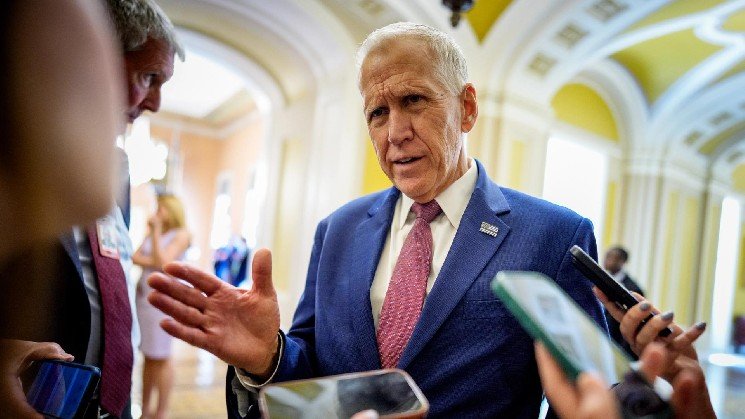
The crypto market structure bill's future could depend on the reception of legislative language hashed out by Senators Thom Tillis and Ruben Gallego, according to people briefed on the effort who say the initial job is done to revamp the part of the bill that would limit government officials from direct ties to cryptocurrency projects.
It's unclear who has seen the latest effort from the bipartisan duo that's been trying to negotiate a final acceptable compromise, but it would need to get approval from the White House and buy-in from a lot of Democrats before the Digital Asset Market Clarity Act can knock down its final dominoes and get to a vote in the U.S. Senate.
The ethics piece has President Donald Trump's crypto business empire squarely in mind as it seeks to ban senior government officials from direct ties to the industry. Trump recently agreed to accept a narrow version of this concept, surprising some crypto insiders with his willingness, and the White House hailed it as an unprecedented ethics constraint that directly affects the president. But Democratic opponents argued it's structured in such a way that Trump won't have to do much — if anything — to comply, and that he won't have enforcement worries from a Department of Justice led by his appointed loyalists.
Republican Tillis and Democrat Gallego agreed to try bridging the gap, and the people said the lawmakers indicated they've struck new common ground, though they didn't share any details. Crypto industry lobbyists are eagerly watching the result, because time is running out before the Senate breaks for its August recess, and they contend that finishing the government conflicts-of-interest section is likely to provide momentum to knock out the rest.
Spokespeople for the senators and White House didn't immediately respond to requests for comment on the status of the ethics negotiation.
Hit after hit
Though the Clarity Act has taken hit after hit in congressional deliberations, it's still moving, like the John Wick of legislation. But it's reached its climactic scene as the Senate heads toward its final week of business before its summer break.
While the government conflicts-of-interest section has drawn the brightest spotlight, the insistence among DeFi advocates that the bill shield developers from being treated as regulated money transmitters remains a point of debate. Some law enforcement groups have backed off of their earlier opposition on that point, though Democrat Senator Catherine Cortez Masto has continued to try to strengthen the illicit finance protections.
Patrick Witt, the White House's crypto adviser, hasn't been concealing his frustration, posting on social media that his side has "made our position abundantly clear to Senator Cortez Masto for weeks."
And the American Bankers Association has been lobbying again on the stablecoin yield topic that was the first major dispute to derail the Clarity Act's progress at the start of the year. The bankers still insist that the compromise version (meant to stop stablecoin issuers from offering rewards that look like interest on bank deposits) didn't get the job done. They want the final bill "to ensure that the prohibition on stablecoin interest and yield cannot be evaded through rewards, incentives, or other arrangements that are substantially similar to interest payments," according to a Tuesday letter to the Senate leadership.
Witt countered in a Wednesday post on X that the negotiation had already answered that concern."Make it make sense," he concluded in frustration.
When Thune predicted the Clarity Act wasn't likely to pass the Senate by next week, Witt argued that there was still time to make it happen in the closing days until August 7 (which in grocery terms is akin to Clarity's sell-by date, after which its success becomes rapidly less certain.) But many in the industry are quietly shifting their hopes to September.
"Clear rules are almost here," said Coinbase CEO Brian Armstrong in a Wednesday post on X. "We're at the one yard line."
If Clarity doesn't pass in September it's a longshot that anything happens in the so-called lame duck session sandwiched between the elections and the next congressional session. If Democrats win the U.S. House of Representatives majority — and potentially the Senate, though that's a tougher goal — they're not likely to accept the Clarity work largely driven by Republicans. So the bill could return to the drawing board.
Read More: U.S. Senate puts off crypto Clarity Act for now as it focuses limited bandwidth elsewhere
 Latest Crypto News
- 1 Robinhood slides 4% despite earnings beat as crypto revenue cools2 hours ago
- 2 As crypto perpetual futures boom, Ethereum’s role is shifting5 hours ago
- 3 Fed holds rates steady, extending pause as markets await Kevin Warsh's policy roadmap5 hours ago
- 4 The traditional 9-to-5 banking day is officially dying, says Morgan Stanley execs7 hours ago
- 5 Stablecoin firm Brale says new protocol can remove a major hurdle to scaling custom tokens8 hours ago
- 6 Coinbase hit by spot trading slump: Wall Street trims expectations ahead of earnings8 hours ago
- 7 Crypto Long & Short: What this year's $972 million crypto hacks actually tell us about security8 hours ago
- 8 Ethereum Foundation names pcaversaccio to board amid leadership changes9 hours ago
- 9 The inside story of how a hike in Hong Kong changed crypto trading forever9 hours ago
- 10 About $80 million ZEC crosses into Zcash's new Ironwood pool in the first day9 hours ago
 Latest Research
Anvil: The Missing Collateral Layer

Anvil: The Missing Collateral Layer
Anvil is a shared on-chain collateral layer built on a programmable letter of credit: reserve assets as a guarantee -no loan, no interest, keep custody & yield.
By CoinDesk Research 9 hours ago Commissioned byAnvilAnvil is a shared on-chain collateral layer built on a programmable letter of credit: reserve assets as a guarantee -no loan, no interest, keep custody & yield.
Why it matters:
Anvil is a shared on-chain collateral layer built on a programmable letter of credit: reserve assets as a guarantee -no loan, no interest, keep custody & yield.
View Full Report More From Policy
Russia charges Telegram founder Pavel Durov with aiding terrorism

Coinbase wants to be Canada’s ‘everything exchange,’ but says clearer rules are needed first