
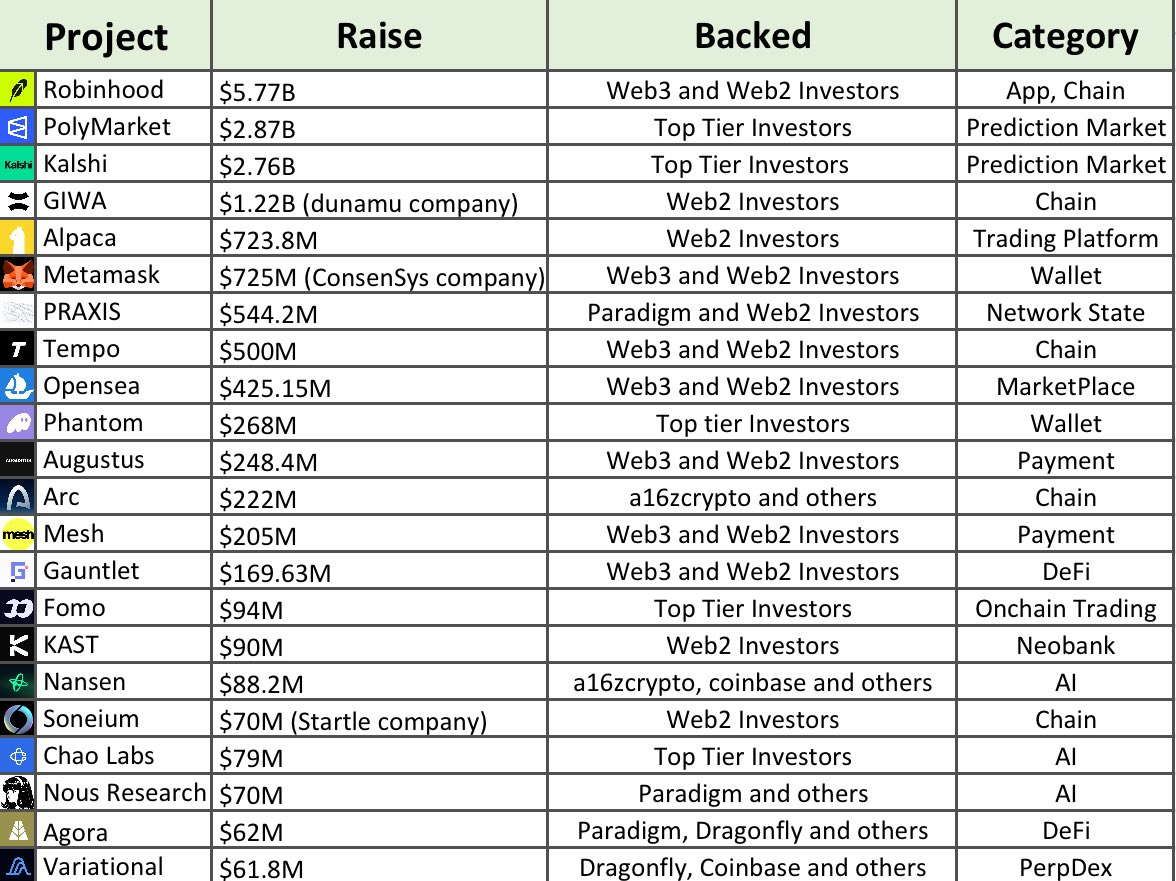
A funding table from researcher 0xviet shows billions concentrating around platforms linking digital assets with mainstream finance. The ranking places Robinhood first at $5.77 billion, followed by Polymarket at $2.87 billion and Kalshi at $2.76 billion.
Across 22 entries, the graphic lists about $17.27 billion for exchanges, wallets, payments, prediction markets, AI, and blockchain infrastructure. However, those totals combine equity rounds, corporate backing, structured facilities, and conditional commitments, complicating direct comparisons.
Prediction Markets Secure the Largest Strategic Capital Deals
Prediction markets account for two of the chart’s three largest totals, highlighting the substantial capital directed toward event-based platforms. In October 2025, for instance, Intercontinental Exchange agreed to invest up to $2 billion in Polymarket at an estimated pre-investment valuation of $8 billion.
Kalshi followed a similar trajectory through several major rounds. The company secured $300 million at a $5 billion valuation in October 2025 before completing a $1 billion Series E in December.
That round valued Kalshi at $11 billion. Five months later, the company announced a $1 billion Series F that doubled its valuation to $22 billion.
Coatue led the latest financing, while Sequoia Capital, Andreessen Horowitz, and Morgan Stanley also participated. Kalshi separately reported an 800% rise in institutional volume over six months.
The 2026 FIFA World Cup later demonstrated the scale of activity across both platforms. Kalshi recorded approximately $27 billion in tournament-related volume and attracted around three million users. Combined World Cup contracts on Kalshi and Polymarket generated more than $29 billion in volume.
Corporate Funding Distorts Comparisons Across Crypto Projects
Meanwhile, Robinhood’s leading figure requires a different interpretation considering that Robinhood Chain is a company-built product, not an independently financed blockchain startup. The network entered public testnet in February 2026 and uses Arbitrum technology for tokenized assets, decentralized finance, and AI applications.
Therefore, the $5.77 billion figure appears to reflect Robinhood financing rather than capital assigned solely to the chain. Similar distinctions apply to MetaMask within Consensys and GIWA, developed by Upbit operator Dunamu.
Other entries also mix funding types. Praxis received a $525 million package dominated by milestone-based commitments, while OpenSea’s reported cumulative backing reached $425.15 million.
Alpaca announced $150 million in January 2026 and another $135 million in July. Yet its disclosed total remained below the chart’s $723.8 million figure.
Related: What Prediction Markets are Getting the Most Volume Today?