
For quite some time, Michael Saylor has robustly advertised himself around Bitcoin, which has built his strongest image of Bitcoin advocate that revolved around one simple strategy that is to buy as many BTC as possible and don’t look back. That’s what everyone knew until he decided to do things a bit differently in the past 2 months of 2026.
Lately, his focus is more on STRC, as he shows institutional adoption is accelerating as Wall Street steadily replaces retail investors, signaling that digital credit products are beginning to find a place inside traditional portfolios.
Wall Street Quietly Builds STRC Exposure
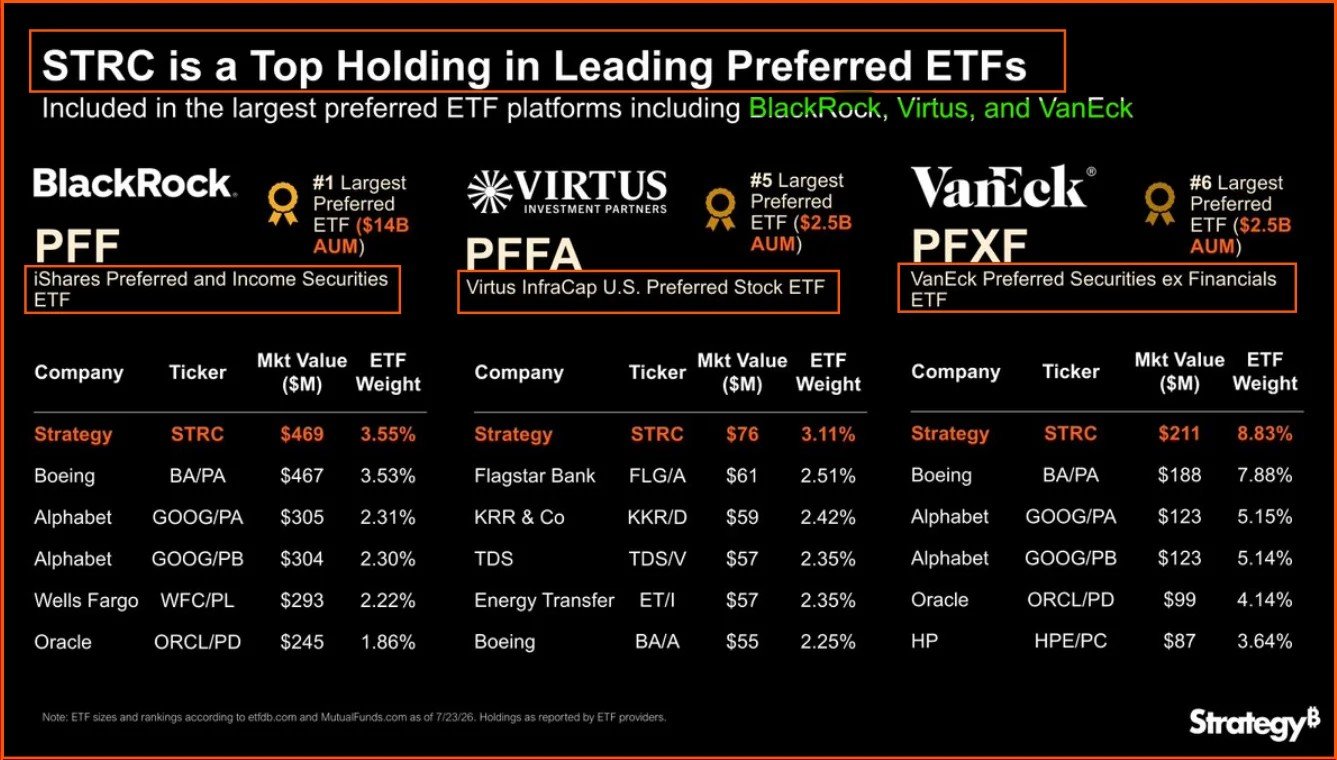
The shift isn’t driven by social media hype or speculative trading. Instead, it’s unfolding inside established financial products. According to recent data shared by Saylor, STRC has become the largest holding across three major US preferred stock ETFs: BlackRock’s iShares Preferred and Income Securities ETF (PPF), Virtus Infracap US Preferred Stock ETF (PFFA), and VanEck Preferred Securities ex Financials ETF (PFXF).
Combined, these funds now hold approximately $756 million worth of STRC, highlighting growing institutional participation through conventional investment vehicles rather than direct crypto exposure.
Retail Steps Back as Institutions Expand
The ownership trend tells an equally notable story. Data recently recirculated by Loading profile preview from MicroStrategy CEO Phong Le shows retail ownership declined from 78% in March to 71% by July.
At the same time, institutional participation moved in the opposite direction. Average institutional allocations climbed 105%, reaching roughly $3.5 million per position. Rather than short-term speculation, the numbers suggest larger investors are gradually building strategic exposure as retail dominance fades.
Digital Credit Finds Institutional Acceptance
The latest ownership shift reflects more than changing investor demographics. It points toward growing acceptance of digital credit products within traditional financial markets.
If STRC institutional adoption continues at the current pace, its evolution could increasingly resemble a mature institutional asset rather than one driven primarily by retail participation. For now, the data suggests Wall Street isn’t merely watching this segment develop but it is steadily becoming part of it.
Loading article prices