
Is the theory showing what the technicals aren’t?
On the chart, the metals sector looks bearish. On a quarterly basis, gold is up by 8%, and silver is up more than 10%, but compared with Bitcoin’s 30% ROI, this looks like investors have been allocating the safe-haven narrative to BTC.
And in this vein, the risk assets are looking more resilient, heading into the Federal Open Market Committee (FOMC).
However, can this divergence flip soon?
Based on where investors are currently positioned, this thesis doesn’t seem so far-fetched.
Why is gold rising with yields?
Interestingly, an analyst observed that the traditional relationship between gold and Treasury yields has flipped this quarter, suggesting that gold is no longer reacting to rising yields.
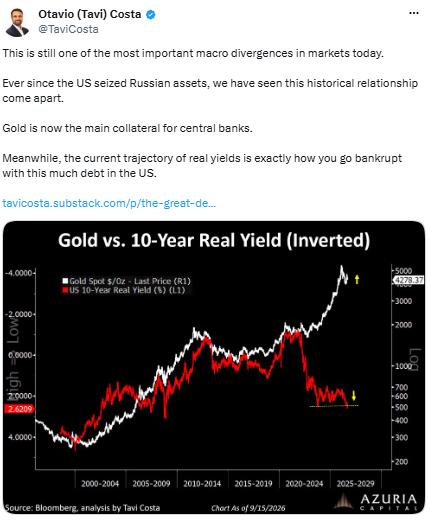
Notably, the main driver of the divergence appears to be a strong demand for gold from central banks, which is shifting the precious metal’s yield-sensitive dynamics and providing support to the metal despite high yields. The timing of the divergence is also worth mentioning.
TradingEconomics data showed the 10-year U.S. Treasury Yield had jumped almost 20% since late June. Gold advanced nearly 15% during the same period.
Central bank demand appeared to support gold despite higher yields, weakening the metal’s usual rate sensitivity. This divergence suggested structural demand may now outweigh gold’s sensitivity to monetary expectations.
That also explained growing positioning around metals, with over $500 billion reportedly entering gold and silver.
The unresolved question is whether metals are attracting new capital or pulling it from risk assets.
Gold demand shows what the price chart doesn’t
Another key metric is highlighting what the technicals are not.
As discussed above, gold’s resilience to rising yields is not so evident on the chart compared with his crypto-cousin Bitcoin. That being said, hard market data suggests that demand for the metal remains robust.
As per the chart below, Chinese gold ETFs added 11 tonnes in August, meaning two consecutive monthly increases and taking the total to 293 tonnes, the highest since April and third highest on record.
Year-to-date, the ETFs have acquired 45 tonnes of gold, indicating robust demand, and early September data suggests that the accumulation is continuing as yields fall and equities are weak domestically.
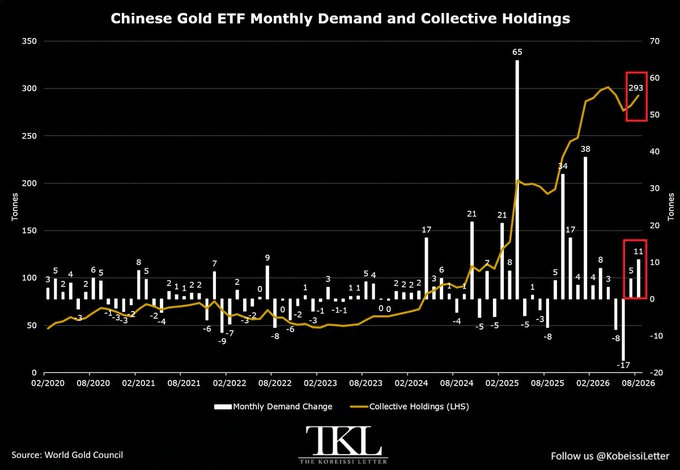
In this regard, the divergence in the gold-10-year Treasury yield relationship becomes even more relevant.
With the FOMC approaching, investors are already positioning around gold, having seen more than $500 billion flowing into metals, supported by strong on-chain demand. This makes the move look less like a short-term trade and more like a strategic hedge against potential Fed-driven yield volatility.
So, if the yields stay elevated while the dollar weakens, gold could continue attracting capital, potentially creating additional pressure on risk assets such as crypto.
Final Summary
- Gold demand remains strong despite higher yields.
- More money flowing into gold could put pressure on crypto.