Compound, one of the first protocols to make crypto lending work without a bank, has approved a record $52 million development budget and rebuilt its leadership around traditional-finance veterans.
It is also wagering its next chapter on institutions, which is seen as a move away from retail yield-chasers who once drove DeFi. Its native token, $COMP, seems to have received a boost as a result of the announcement, as it has gone up by over 10% in 24 hours.
Projects that grew up serving retail now court banks, asset managers, and compliance departments to find their footing again, and Compound seems to be moving in that direction.
Compound’s foundation wrote on X that the protocol is “entering its next era.”
From $12 billion to $1.2 billion
The total value locked (TVL) on Compound has fallen to around $1.2 billion, which is a decline of around 90% from the $12 billion the protocol held at its September 2021 peak per DeFillama.
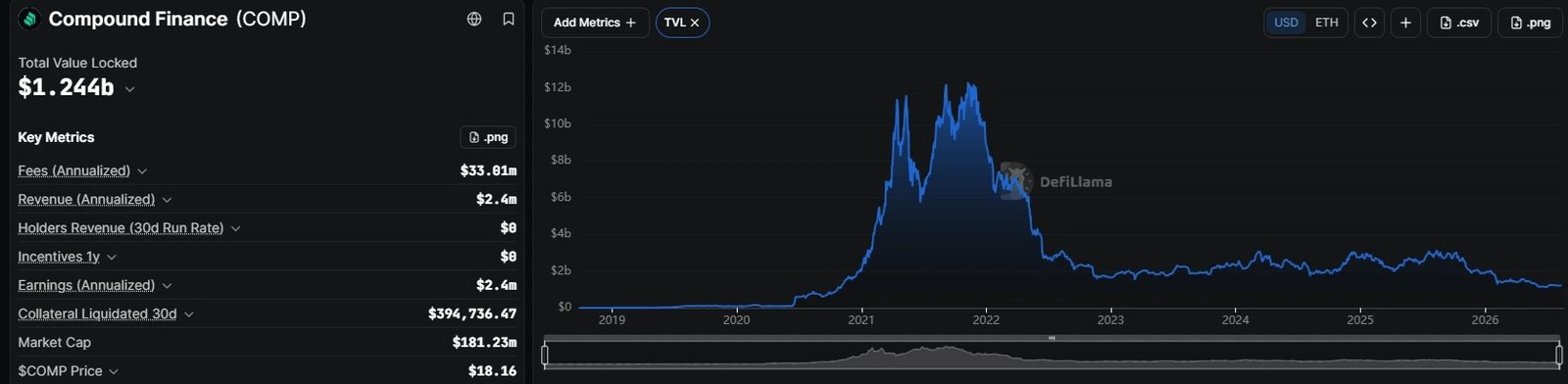
The vast majority of the TVL is on Ethereum, with Arbitrum coming a distant second.
Compound’s figures are a far cry from Aave’s, which is the leading protocol in the DeFi lending space with a TVL of over $14.6 billion.
Ironically, Compound helped invent this category when it launched in 2018 and, by its own accounting, has processed around $480 billion in deposits and borrowing since.
However, the protocol’s growth stalled following the end of the incentive programs that helped to push up its metrics.
While $COMP received a boost, it still trades far below its glory days. It currently trades around $18; however, it is still down by 98% from its 2021 record.
How does Compound plan on spending its $52 million?
The budget passed through the Compound DAO, and $14 million is cleared for immediate use. The rest unlocks in tranches tied to milestones, a structure that keeps the development team on a performance leash funded by the treasury.
The money splits roughly in two, with about $28 million for operations and the engineering behind a new protocol version, Compound V4, and $24 million for growth. Of that growth pool, $8 million to $10 million is earmarked for institutional partnerships rather than the old playbook of paying liquidity providers to boost headline numbers.
V4’s centerpiece is a “hub-and-spoke” design, which routes capital through a central hub instead of walling it off in separate markets, an approach meant to give professional counterparties tighter risk controls. Compound stated that more than 10 partners have committed, with over 20 more in talks.
A bench built from traditional finance
The leadership overhaul reads as a statement of intent. The new team includes Chief Operating Officer Christopher Donovan, previously COO at the Near Foundation, and Chief Product Officer Steven Liu, who grew Maple Finance’s assets from $500 million to $5 billion.
Aaron Schnarch, former CEO of Coinbase Custody, joins as an executive director, with other hires drawn from Anchorage Digital, HSBC, Broadridge Financial, and Maple.
In a statement, Schnarch said, “DeFi is a remarkable innovation; however, it has achieved limited institutional adoption.” He added that current products “fall short of meeting the traditional finance bar.”
However, not everyone is sold on credentials alone, and one of them is Himanshu Sahay of Arch Lending, who said that the budget and bench amount to “a serious move” but warned that institutions “aren’t underwriting teams, they’re underwriting structures.”
Why is everyone now chasing institutions?
Compound is late to a race it once could have led. Across crypto this year, the institutional turn has become the default survival strategy. In July, former Ethereum Foundation staff launched Ethereum Institutional, a non-profit “front door” for banks and asset managers backed by Bitmine, SharpLink, and Joseph Lubin, Cryptopolitan reported.
Tokenized real-world assets climbed to about $65 billion by May, and more than 2,000 institutions disclosed Bitcoin holdings through spot ETFs in Q1.
Ran Hammer of Orbs said, “Retail participation is a fraction of what it was,” as the chain “quietly become a venue for settlement, execution and interaction between financial institutions.” Standard Chartered projects the DeFi sector could reach $2.7 trillion by 2030.