
The crypto market has yet to shake off the turbulence that has rattled it for weeks. The signals also failed to rule out a further decline in the coming weeks.
Capital flow drove much of that weakness, particularly as stablecoin supply kept falling short of demand.
Global M2 supply, another major market lever, climbed steadily without delivering the growth many had priced in.
Can Global M2 supply lift crypto?
Alphractal recently reported that Global M2 money supply jumped by roughly $1 trillion in a single week.
China accounted for roughly 80% of that increase, or $800 billion. Other economies accounted for the remainder.
Global M2 supply captures cash and liquid deposits across the world. It acts as a primary liquidity source for risk assets. Expanding M2 can push money into stocks, crypto, and real estate. Contracting M2 typically weighs on those same assets.
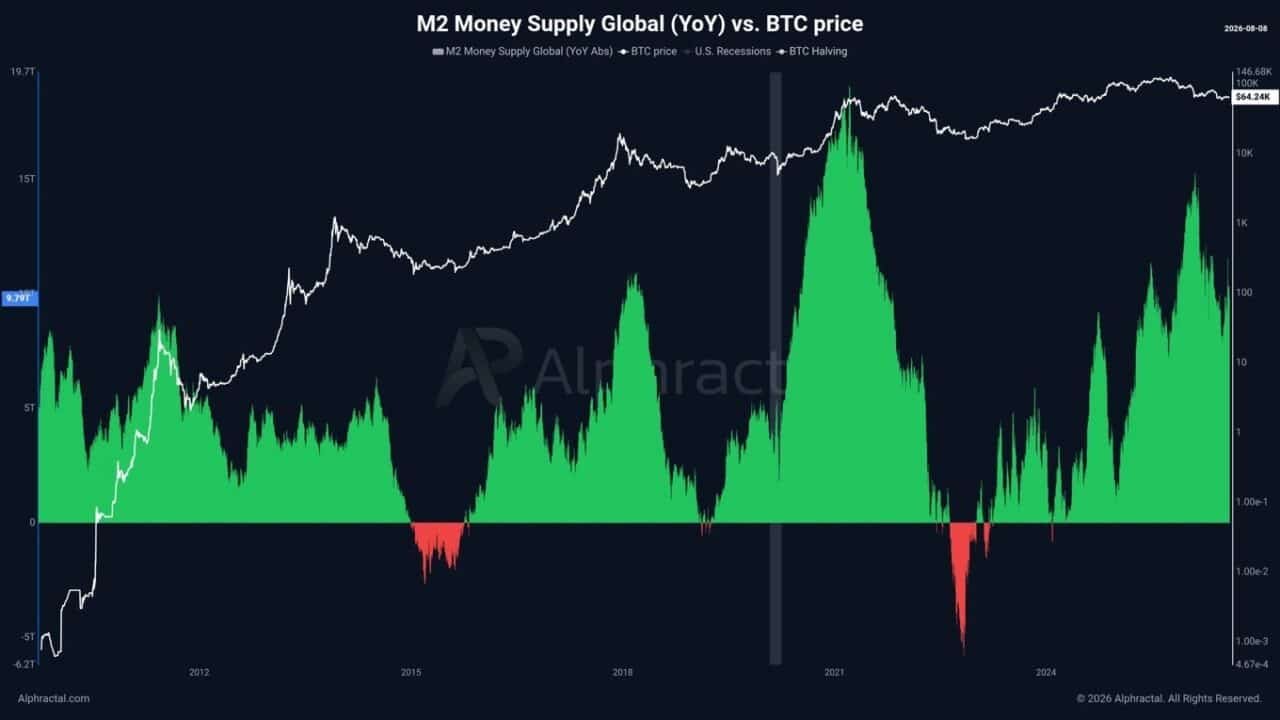
Setting M2 supply against Bitcoin’s [$BTC] performance sharpens the picture.
Historically, declines in Global M2’s year-over-year growth marked Bitcoin price bottoms. Those periods also opened the door for broader rallies. However, YoY M2 growth remained positive, with no clear move into negative territory.
That suggested Bitcoin and altcoins could still slide lower before a reversal emerges.
Can China’s liquidity move Bitcoin?
China led the recent Global M2 surge as one of its largest contributors. Yet, it had limited exposure to Bitcoin, crypto’s largest risk asset.
Hong Kong Bitcoin spot exchange-traded funds (ETFs) absorbed just 48.1 $BTC since August began. That was worth roughly $3.057 million.
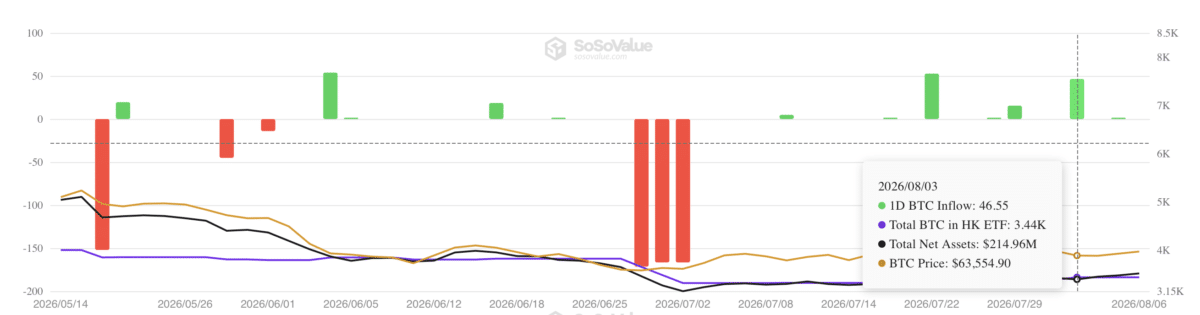
Hong Kong capital has historically reached Bitcoin through official channels, including ETF providers, in thin amounts. That pointed to a limited Bitcoin impact from China’s M2-driven liquidity surge.
Mainland China remained hostile to cryptocurrency and largely banned the asset class. This further limited potential flows from the region.
Why do U.S. inflows matter most?
U.S. flow remained the key factor to watch for Bitcoin. The country’s money supply kept expanding against M2 readings from other economies. TradingView placed the latest U.S. money-supply figure at $23.16 trillion.
The Global M2 surge may have helped U.S. crypto ETFs record their strongest weekly inflow since 17th April 2026.
Weekly inflows across crypto ETFs reached roughly $1.10 billion.
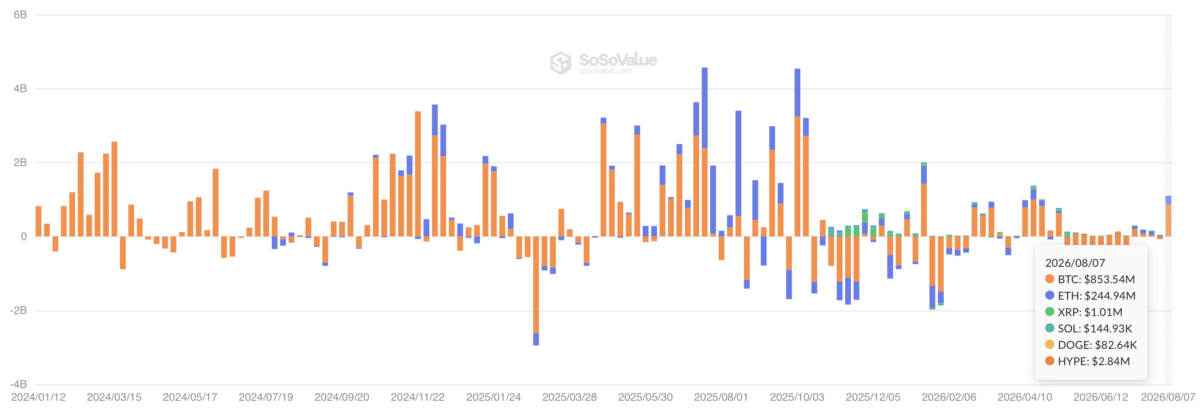
That same surge also supported a calmer market mood. Quieter Middle East war headlines helped ease pressure in recent weeks.
The inflow could filter through Bitcoin and select altcoins in the near term.
Final Summary
- Global M2 supply jumped roughly $1 trillion in a week. China drove 80% of the rise, though its Bitcoin exposure remained thin.
- U.S. crypto ETF inflows reached $1.10 billion as the U.S. money supply climbed to $23.16 trillion.