Bitcoin $BTC$79,394.02 may be a better hard asset than gold, according to a correlation study.
Both have been rising recently, just as concerns about the fiscal health of advanced-economy governments have come to dominate market sentiment, pushing bond yields, or market-implied borrowing costs, higher.
As of today, the 90-day correlation coefficient between $BTC and gold’s daily returns stands at 0.59, according to data from TradingView and CoinDesk. That’s the highest since 2020, when central banks and governments were printing truckloads of money to cushion the economy and markets during the pandemic.
While both are viewed as hard assets that stand to benefit from fiscal worries and the prospect of financial repression, bitcoin seems to have a slight edge.
The reason lies in its relationship with the U.S. 10-year Treasury yield, the benchmark borrowing cost that influences credit conditions across the economy (check Today’s Signal). An increasing bond yield is typically seen as a headwind for assets like gold and bitcoin, which just sit in investors’ portfolios without generating any new cash.
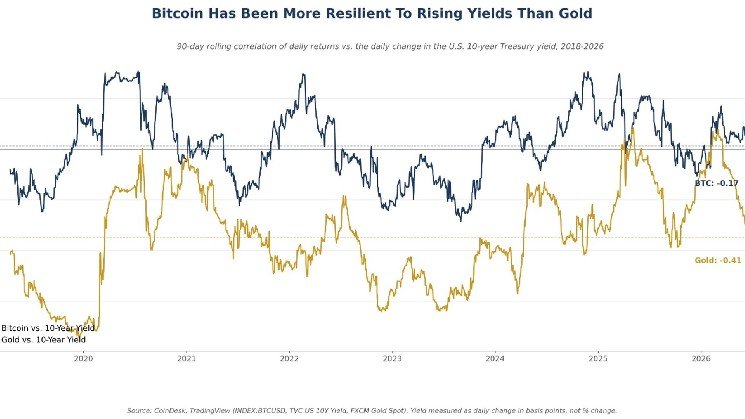
Bitcoin’s correlation with the 10-year yield is negligibly negative, and notably weaker than gold’s.
As of today, the 90-day correlation coefficient between BTCUSD and the 10-year yield is just -0.17. It means that a rising bond yield barely has a negative impact on bitcoin.
In contrast, the correlation between gold and the 10-year yield is -0.41, indicating a slightly more meaningful negative relationship.
The takeaway is that bitcoin is less tethered to bond-market forces.
That doesn’t make it completely safe, but it does suggest $BTC may be better positioned to decouple from traditional yield-driven headwinds. Stay alert!
Read more: For analysis of today's activity in altcoins and derivatives, see Crypto Markets Today . For a comprehensive list of events this week, see CoinDesk's "Crypto Week Ahead."
What’s trending
- Bitcoin struggles at $83,000 sell wall as whales distribution flip into net selling (CoinDesk): Bitcoin investors pivoted to sales as the $83,000 resistance level held solid. The market, on aggregate, entered a period of distribution, or net selling, for the first time since early June.
- Bitcoin network used by exchanges hit by $320 million exploit. Hackers claim they're the 'good guys' (CoinDesk): Bitcoin worth millions of dollars was withdrawn from a settlement network used by crypto exchanges. The alleged "white hat hacker" is reportedly attempting to act ethically by offering to return the stolen funds once a node-level vulnerability is fixed.
- No, Friday's jobs report hasn't materially boosted Fed rate hike odds (CoinDesk): Traders currently assign a 58% probability that the Fed will raise its benchmark borrowing cost by 25 basis points, according to the CME FedWatch Tool, effectively the same as a week ago.
- Stocks rattled by inflation risk from rising oil, dicey geopolitics (Reuters): Rising oil prices, conflict in the Middle East and political uncertainty in Europe kept investors on edge on Monday, leaving stocks to drift lower ahead of critical U.S. inflation data later this week.