Privacy coins are back in the spotlight. $ZEC is up more than 8% over the past 24 hours, trading near $503 and holding above the closely watched $500 level. The move caps a strong week for Zcash and has traders asking whether this is the start of a bigger breakout or just another burst of volatility in a notoriously high-beta asset. Here is what is actually driving the zcash price and where analysts think it goes from here.
What Is the Zcash Price Today?
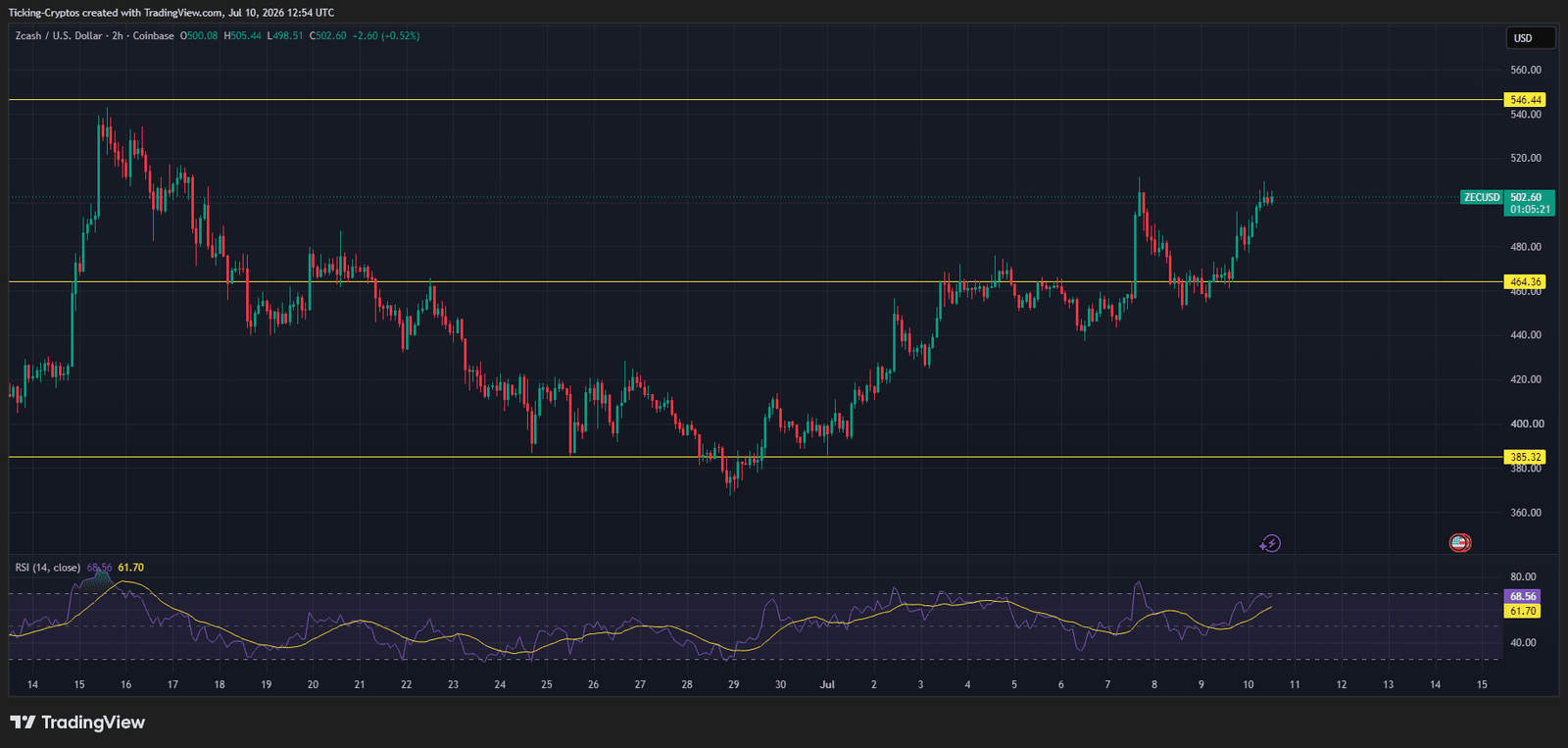
The zec price today sits at roughly $503, up about 8% on the day, with an intraday high near $505. That keeps $ZEC comfortably above the $500 psychological level and well clear of the $464 mid-range pivot on the chart. On the 2-hour timeframe, the token is pressing toward overhead resistance near $546, with $385 marking the base of the recent range.
The context matters: this is not an isolated one-day pop. $ZEC has been climbing for over a week, having reclaimed $500 for the first time since early June after a brutal stretch. The privacy coin lost more than 40% of its value in early June, crashing from around $624 toward the $300s in under 48 hours after a critical bug was disclosed in its Orchard shielded pool. Today's strength is best understood as a continued recovery from that shock rather than a reaction to a single fresh headline.
Why Is Zcash Pumping Today?
There is no single news catalyst behind today's specific 8% move — it is a mix of a strengthening fundamental narrative and classic trading-day dynamics.
The dominant driver is the upcoming Ironwood upgrade, expected to activate in late July. Ironwood replaces the vulnerable Orchard shielded pool with a formally verified version, mathematically designed to prevent the kind of undetectable counterfeiting flaw that spooked the market in June. It also introduces a "turnstile" migration mechanism to enforce Zcash's fixed supply and harden its shielded pool. For a privacy coin whose entire value proposition rests on verifiable, private money, that directly addresses the trust damage from the bug — which is why the market is treating it as a genuine catalyst, not just hype.
Layered on top is momentum from social sentiment and derivatives. Zcash's social activity has spiked sharply, with its AltRank climbing into the top tier of coins and the large majority of tracked sentiment reading bullish. That has fed a feedback loop: the fundamental upgrade story sparked a technical breakout, which drew in momentum traders and triggered short liquidations — with over $7.6 million in short positions wiped out during one recent leg higher. In other words, today's 8% is part fundamental conviction, part leveraged short squeeze, and part broad altcoin-rotation beta.
Is This a Real Breakout or Just a Trading-Day Effect?
Honestly, it is both — and that is the key thing to understand before chasing it. The Ironwood narrative gives the rally a real fundamental anchor, which separates it from a purely speculative spike. But the mechanics of the move are heavily leverage-driven. Futures volume has dwarfed spot volume during this rally (recent readings showed $ZEC futures turnover well above $1 billion against roughly $115 million in spot), and elevated open interest means the price can reverse just as sharply as it rose. High-beta privacy coins are famous for explosive moves on good fundamental news, followed by volatile pullbacks as speculative capital rotates out.
What Are the $ZEC Price Predictions From Here?
On the technical side, the immediate battle is at resistance. As long as $ZEC holds above $500, the bullish case points toward the $546 zone next, with a decisive break potentially opening a run toward the $620–$650 liquidity area that several analysts have flagged. A clean breakout above that region is what bulls would need to talk about higher targets. On the downside, losing $500 would likely shift momentum back to sellers, with support around $464, then $450, and the $385 range floor below that.
Longer-term zec price prediction models are cautiously constructive but wide-ranging, reflecting how much hinges on Ironwood landing cleanly. Third-party forecasting sites put the 2026 average trading price somewhere in the $460–$505 band, with monthly peaks stretching toward the $570–$580 area in a bullish scenario, and some multi-year models projecting a return toward four-digit territory only in later years if privacy-coin demand sustains. These are algorithmic projections, not guarantees, and privacy coins carry outsized regulatory and technical risk — so they are best treated as rough scenarios rather than price targets.
The realistic near-term picture: a successful, verified Ironwood activation in late July could provide the next leg higher, while any delay or technical hiccup would likely trigger a deeper consolidation. Bitcoin's stability and broader altcoin sentiment will also heavily influence where $ZEC trades, given how tightly it moves with overall market risk appetite.