A viral social media post claiming Ethereum controls 87% of the global stablecoin supply has sparked debate within the $XRP community.
However, the chart behind the claim excluded Tron, one of the largest stablecoin networks. The discussion comes as stablecoin activity reaches new highs. At the same time, Ripple’s $RLUSD continues to gain traction on the $XRP Ledger.
Ethereum and Tron Control 81% of the Market
Notably, a crypto user shared Artemis data claiming Ethereum now controls 87% of the stablecoin supply. Longtime $XRP critic on X, @ScamDetective5, used the post to further criticize $XRP, saying, “The $XRP Ledger is not even on the map.”
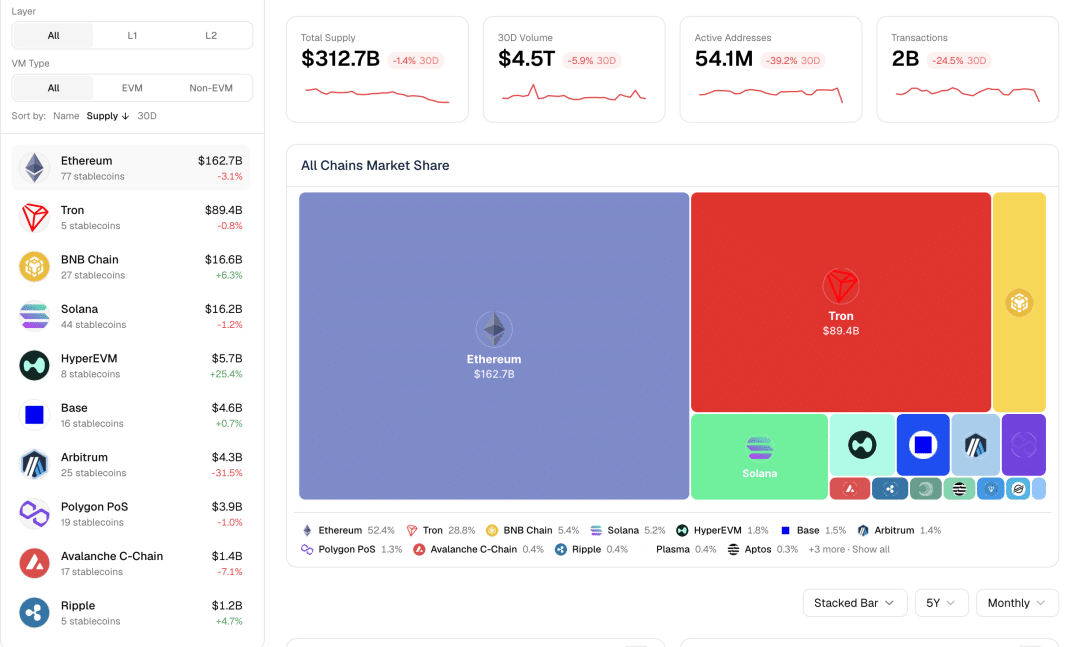
However, an Artemis dashboard that includes all major blockchains tells a different story. Ethereum remains the largest stablecoin network, with $162.7 billion in circulating supply. This gives it a 52.4% market share, not 87%.
Tron ranks second with $89.4 billion in circulating supply, accounting for 28.8% of the market. Together, Ethereum and Tron host more than 81% of the global stablecoin supply.
Other major networks include:
- BNB Chain: $16.6 billion (5.4%)
- Solana: $16.2 billion (5.2%)
- HyperEVM: $5.7 billion (1.8%)
- Base: $4.6 billion (1.5%)
- Arbitrum: $4.3 billion (1.4%)
- Polygon PoS: $3.9 billion (1.3%)
- $XRP Ledger: Approximately $1.2 billion (0.4%)
The dashboard puts the total stablecoin supply at $312.7 billion.
Stablecoin Transaction Volume Reaches New High
Notably, the market share debate comes as stablecoin adoption continues to grow. According to Visa’s Allium-powered analytics, adjusted stablecoin transaction volume hit a record $1.79 trillion in June. That was up 63% from May and 125% compared with the same month last year.
Visa’s methodology removes bot activity, treasury rebalancing, and repetitive smart contract transactions. The goal is to better measure genuine economic activity.
USDC led June’s transaction volume at $1.21 trillion, accounting for about 67% of the total. USDT followed with $576 billion, or roughly 32%. PYUSD processed another $2.42 billion.
Among blockchains, Base narrowly led June’s transaction volume at $565 billion. Ethereum followed closely with $562 billion, while Tron processed about $320 billion.
The data suggests stablecoins are seeing increased use for payments, decentralized finance, and cross-border transfers despite broader market uncertainty.
$RLUSD Gains Ground on the $XRP Ledger
While the $XRP Ledger remains a small player in the broader stablecoin market, Ripple’s $RLUSD recently reached an important milestone.
In late June, $RLUSD’s circulating supply on the $XRP Ledger surpassed its supply on Ethereum for the first time. That made XRPL the largest network hosting Ripple’s stablecoin.
Current figures from the $RLUSD Tracker show that the $XRP Ledger holds about $848 million in $RLUSD. Ethereum holds a far lower figure at $727 million.
Across both networks, $RLUSD’s circulating supply has grown to nearly $1.6 billion. The figures indicate growing adoption within Ripple’s ecosystem, even as Ethereum and Tron continue to dominate the overall stablecoin market.