
Hyperliquid is reportedly testing a KYC (Know Your Customer) feature with an allowlist, raising questions about the decentralized exchange’s (DEX) plans.
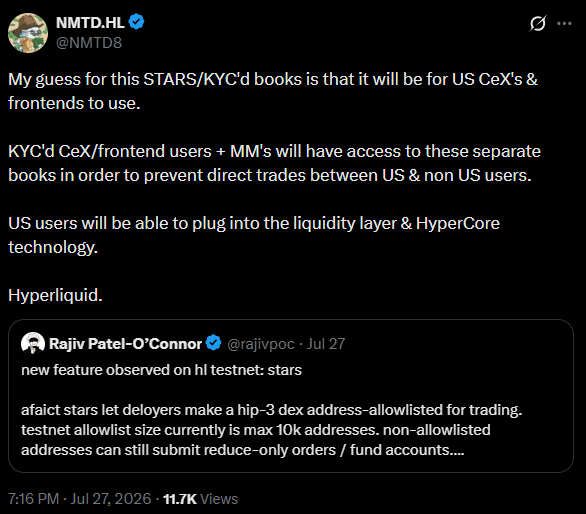
According to analyst Rajiv Patel, the platform pushed a new feature, dubbed Stars, that allows deployers to make a HIP-3 (commodity futures) allowlist for trading. The allowlist can have up to 10K addresses; those not included can only fund their accounts but not trade. Sounds like a centralized exchange (CEX), right? Most analysts speculated that the move could be a push to activate a front-end for U.S. users, calling it a ‘Hyperliquid U.S.’ In fact, crypto investor McKenna also shared a similar stance and added,
Clearly the conversation with Hyperliquid Labs, HPC and TradeXYZ with the SEC/CFTC have been productive. Building the infrastructure to onboard into the United States.
Another analyst added that the move was likely to segment U.S. users and market makers (MMs) to separate orderbooks (liquidity pools) from Hyperliquid’s massive offshore segment.
Is Hyperliquid following Uniswap’s steps?
AMBCrypto shares a similar outlook, but the trend is not unique to Hyperliquid. Last week, Uniswap unveiled its first ‘permissioned pools’ with the same allowlist feature. According to Uniswap CEO Hayden Adams, the move was aimed at ensuring trading of “regulated tokens and tokenized assets.”
Now that Hyperliquid is the second DEX exploring a similar KYC feature, the move is likely designed to ensure tokenized assets trading meets U.S. compliance checks.
Worth pointing out that Hyperliquid became the first DEX to start screening and blocking addresses linked to the sanctioned HTX exchange (formerly Huobi Global, owned by Justin Sun).
The move comes amid increased engagement with the U.S. regulators on how the U.S. markets can access Hyperliquid in a regulated way.
Currently, the U.S. does not have any clear DeFi regulatory framework. But Hyperliquid Labs, Hyperliquid Policy Center, and TradeXYZ (top issuers of pre-IPO and commodity futures on the DEX) recently met with the U.S. SEC. Part of the agenda was to explore viable ways of accessing on-chain trading within regulatory bounds. The KYC feature may be just one of the steps towards regulated trading in DeFi.
Some viewed the move as short-term bearish for the $HYPE, Hyperliquid’s native token. Separately, HIP-3 daily volume has hit about 60% of the total Hyperliquid volume and is dominated by TradeXYZ (99%).
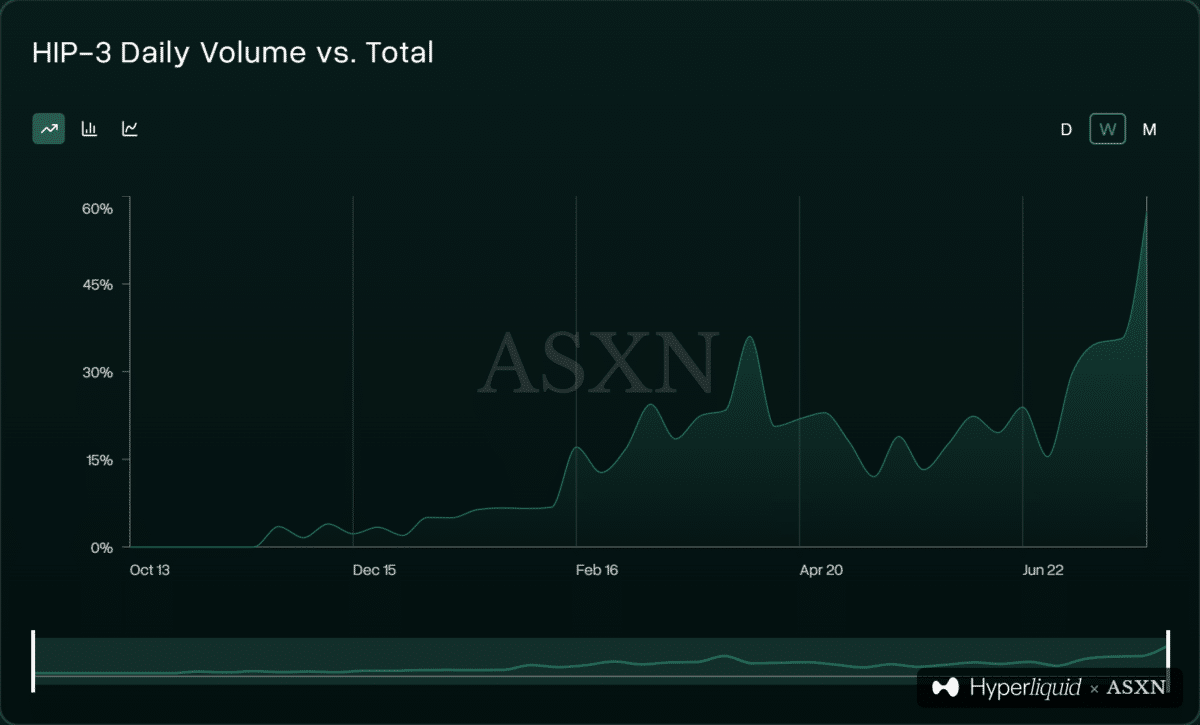
Critics view this as a dominance risk for the DEX, especially if TradeXYZ is hacked or decides to build its own platform.
However, TradeXYZ’s CEO Collins Belton downplayed the fears. He noted that ‘there is no reason to leave,’ citing Hyperliquid’s connected ecosystem, including crypto, commodities, options, and prediction markets.
Meanwhile, $HYPE traded at $55, extending July losses to 25% from the monthly peak of $73.
Final Summary
- Like Uniswap, Hyperliquid is reportedly exploring a KYC-based front-end for regulated tokenized asset trading.
- TradeXYZ dismissed plans of leaving the Hyperliquid ecosystem amid rising dominance risk.