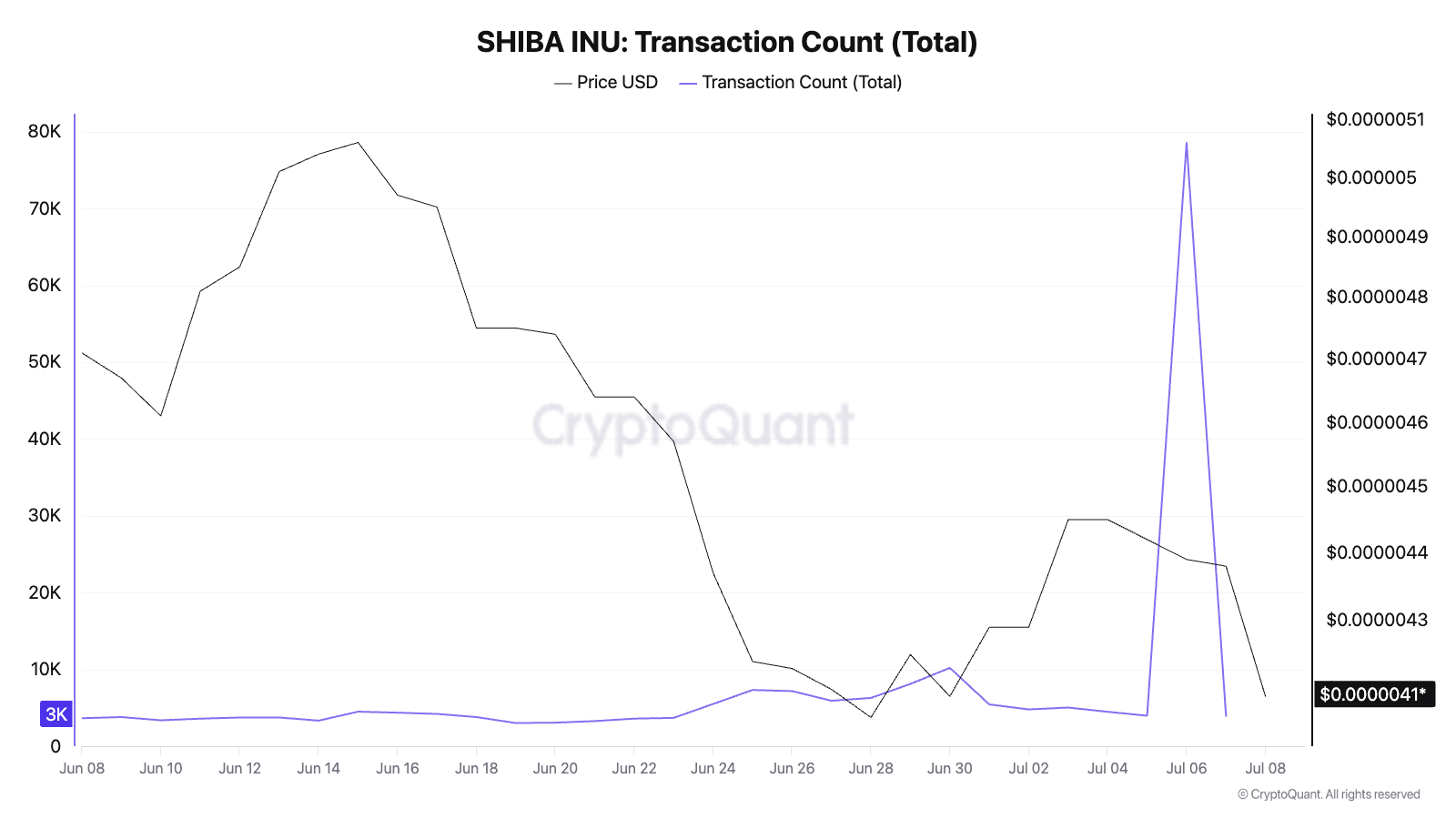
A strange statistical glitch has been recorded with the Shiba Inu ($SHIB) coin. In just one day, the number of on-chain transactions collapsed by 95% — from a peak of 78,558 transfers to a modest 3,922, according to CryptoQuant.
This powerful spike on July 6 became the largest for $SHIB since last October. However, the speed with which the metrics returned to normal turned the situation into a real on-chain detective story.
Usually, such jumps happen when a major crypto exchange is cleaning up its wallets and massively moving client funds into secure cold storage. But this time, that logic failed, as on-chain data from the analytics platform Arkham showed that on July 6, exchange flow charts were completely empty.
The theory that inflows and outflows simply matched each other perfectly and canceled each other out does not hold, because Arkham counts the total volume of operations, and if exchanges had been moving funds, giant bars would have appeared on the chart. Instead, the liquidity curve of trading platforms literally froze.
What really triggered the activity collapse
While the transaction counter was going crazy, the $SHIB token itself behaved remarkably calmly. Its price did not even flinch, remaining in its usual narrow range near $0.0000042.
If ordinary traders had made those 78,000 transfers, the market would have immediately been shaken by volatility. The fact that the price completely ignored the burst of activity proves one thing — the large amounts of $SHIB being moved were fully isolated from exchange order books and had no impact on trading.
Ordinary users cannot coordinate and stop transferring cryptocurrency in one second. An instant 95% collapse in activity means only one thing: someone launched an automated script that ran thousands of transactions and switched it off immediately after completing its task.
Since exchanges are officially ruled out, only two options remain:
- A large whale's maneuver: Some fund or early investor was redistributing holdings strictly between personal private wallets, deliberately bypassing exchanges for secrecy.
- Technical tests: Developers of some crypto project or bridge were stress-testing their smart contracts directly on the live Ethereum network.
In the end, there is no conspiracy or market panic behind this sudden collapse in metrics. The entire "anomaly" is merely the digital trace of one isolated automated script, after which the network simply "exhaled" and instantly returned to its usual organic routine.