AMC CEO Adam Aron called Robinhood's tokenized AMC shares a "quasi-fake market" and threatened legal action. Robinhood’s Vlad Tenev pushed back, saying a public company does not get to approve every product built on its stock.
In the wake of their social media dust-up, an argument over which kind of token is legitimate has ensued: a wrapped token, which is a claim on the underlying share, or an issuer-sponsored token registered with the transfer agent. The SEC issued a view on Sept. 17, granting a five-year exemption that lets tokenized U.S. stock trade onchain in the U.S. only where the token carries the same dividends, votes and class rights as the share. Synthetic exposure like Robinhood’s tokenized stock is excluded.
The AMC token on Robinhood
Across seven sessions between August 31 and September 9, Robinhood’s AMC token closed within 0.87% of AMC’s NYSE close price at the median, and 2.71% at the widest, as measured in the Uniswap pool that carries around 95% of its trading. While the underlying market is open, the price remains largely aligned.
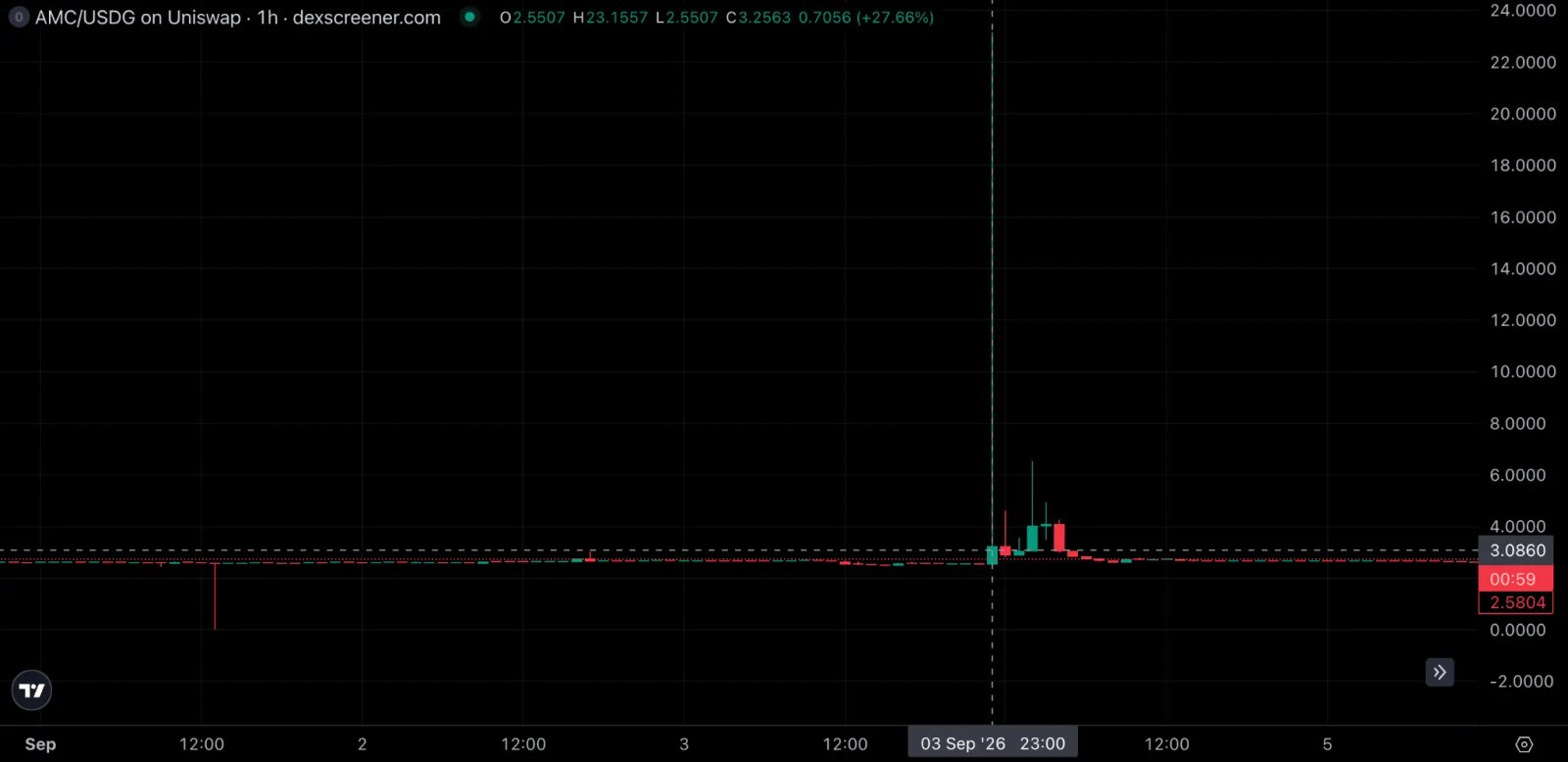
However, a different picture emerges when the underlying market is closed. Leading up to midnight on Thursday, September 3, Robinhood’s AMC token went from $2.55 to as high as $23.16, which is nine times the $2.54 AMC had closed on NYSE seven hours earlier, before coming back down to $3.26 within the same hour. Volume through the pool during the hour was $10.5 million.
Wrapped tokens such as Robinhood’s AMC are often structured as claims against offshore issuers, which collateralize the tokens with the underlying shares. Theoretically, if the issuer ensures that underlying stock positions and the claims are matched 1:1, the price should align, but in practice, the two instruments are traded separately and can thus diverge. Arbitrageurs, such as high-frequency trading firms and market-making desks, step in to keep markets in line, lock in arbitrage profits, and close any dislocations. The same mechanism keeps depositary receipts aligned with their underlying shares, and ETFs with their net asset value.
In Robinhood’s case, however, the Jersey issuer names only one authorized participant able to create and redeem. The spike fell well inside the hours when it was permitted to do so, but the participant did not mint or burn any tokens at the time. Onchain data shows 47 mints on Friday, Sept. 4, every one between noon and 7 p.m. ET, comfortably inside the cash session, half a day after the token had depegged and recovered.
The issuer-sponsored token serves the regulated market; the wrapped token gives exposure to those outside it. Run both at once, and both benefit. The wrapper market gets the two things it lacked at 11 p.m.: a live price reference, and an instrument a market maker can arbitrage against. The issuer-sponsored market gets flow from arbitrageurs holding the tokens as inventory to make markets in wrapped tokens. Collateralize the wrapped token with an IST, and the creation and redemption sit on the same rail, settling in seconds, no longer depending on the cash market to source shares. That is when the two stop trading as separate markets and start being parts of the same infrastructure, serving different use cases.
The conversation should now focus on how to narrow spreads for market participants trading at 3 a.m., how to shorten the conversion between different instruments, how to clear a continuous market, and who builds the plumbing in between.
No one firm can build the entire infrastructure needed. Exchanges, brokers, fund managers, market makers, transfer agents and clearinghouses each hold one piece, and none holds enough alone. Getting them into the same room to build a market is the key objective industry groups like the IST Coalition are trying to achieve.
Note: The views expressed in this column are those of the author and do not necessarily reflect those of CoinDesk, Inc. or its owners and affiliates.
 Latest Crypto News
- 1 Bullish, Alpaca and Apex Fintech form coalition to push issuer-backed tokenized stocks7 minutes ago
- 2 U.S. commodities firms can invest in tokenized assets, use blockchain records: CFTC8 minutes ago
- 3 Bitcoin just topped a key long-term moving average. Here's what it might mean1 hour ago
- 4 Crypto casino Duelbits goes offline after $7 million hot wallet hack4 hours ago
- 5 Bitcoin’s bear markets are getting milder. Bull markets may be next4 hours ago
- 6 UK’s largest banks complete world’s first interbank transactions using tokenized deposits 5 hours ago
- 7 Crypto for Advisors:The hidden costs of holding your own bitcoin5 hours ago
- 8 European stablecoin issuer Qivalis sees transformation of global trade finance5 hours ago
- 9 Cathie Wood's ARK teams with Securitize to tokenize venture fund with OpenAI, Anthropic stakes7 hours ago
- 10 Solana Foundation hires Binance, Polygon veterans as it ramps up tokenized finance push7 hours ago
 Latest Research
The Definitive Stablecoin Landscape Series: Asia Pacific

The Definitive Stablecoin Landscape Series: Asia Pacific
As stablecoins move into regulated finance, APAC is becoming a key proving ground. This report maps the region’s rules, use cases, and $RLUSD’s role.
By CoinDesk Research Sep 15, 2026 Commissioned byRippleAs stablecoins move into regulated finance, APAC is becoming a key proving ground. This report maps the region’s rules, use cases, and $RLUSD’s role.
Why it matters:
As stablecoins move into regulated finance, APAC is becoming a key proving ground. This report maps the region’s rules, use cases, and $RLUSD’s role.
View Full Report More From Opinion
DHS’s predictive policing is unconstitutional, un-American and should be stopped

A stolen coin can be returned. A leaked identity cannot.