According to a September 1 post from BitcoinTreasuries.NET, Strive’s preferred stock has raised enough money to fund Bitcoin ($BTC) purchases for nine days in a row, most recently buying 104 $BTC on Tuesday. It is noteworthy that while corporate balance sheets have become essential for Bitcoin demand, the number of buyers has sharply decreased. Thus, Strive’s purchases are among the few regular bids for the cryptocurrency at approximately $77,000.
The amount of $77,000 refers to the spot market price, rather than Strive’s acquisition cost. According to BitcoinTreasuries.NET, the live dashboard put $BTC at $77,100, whereas Strive paid $79,431, in fees and costs included, between August 24 and August 28.
A lone bid in a market that lost its buyers
The timing of this trend is important. According to the Glassnode Strategy Watch Report on August 27, it was reported that Bitcoin treasury vehicles were net purchasers in July, even if the corporate buying had dropped as the spot ETF demand returned. The amounts held in these treasuries ranged from 2,300 Bitcoins to 7,600 Bitcoins, meanwhile, the flows for ETFs changed from -70,400 Bitcoins at the beginning of July to +5,400 Bitcoins by the end of July. Glassnode explained that this was a sign of growth of regulated demand and the decrease in balance sheet activity.
Galaxy Research had warned about recent strains on the digital asset treasury model and advised that a significant drop in equity premiums could make the new issuances of shares become more dilutive.
However, the situation with Strive is different. BitcoinTreasuries.NET noted the ongoing issuance of SATA that has not been accompanied by any buyback activities. This makes the nine-day $BTC buying streak a good illustration of the real demand for the preferred stock.
What SATA actually is
SATA is not a subsidiary; instead, it is a ticker symbol for Strive’s Variable Rate Series A Perpetual Preferred Stock that is traded at Nasdaq together with Strive’s Class A common stock, ASST. In May, it was announced that SATA would pay dividends every business day beginning June 16 at an annual rate of 13.00%.
Strive CEO Matthew Cole called SATA “a true zero-to-one innovation” and said it is “the first listed security in the history of U.S. capital markets to pay cash dividends every single Business Day.”
That structure is the driving force behind the strategy. The March article by NYDIG’s Greg Cipolaro described SATA and the STRC of Strategy as:
“actively managed, capital markets–dependent liability structures backed by a reserve asset, bitcoin.” — Greg Cipolaro, NYDIG
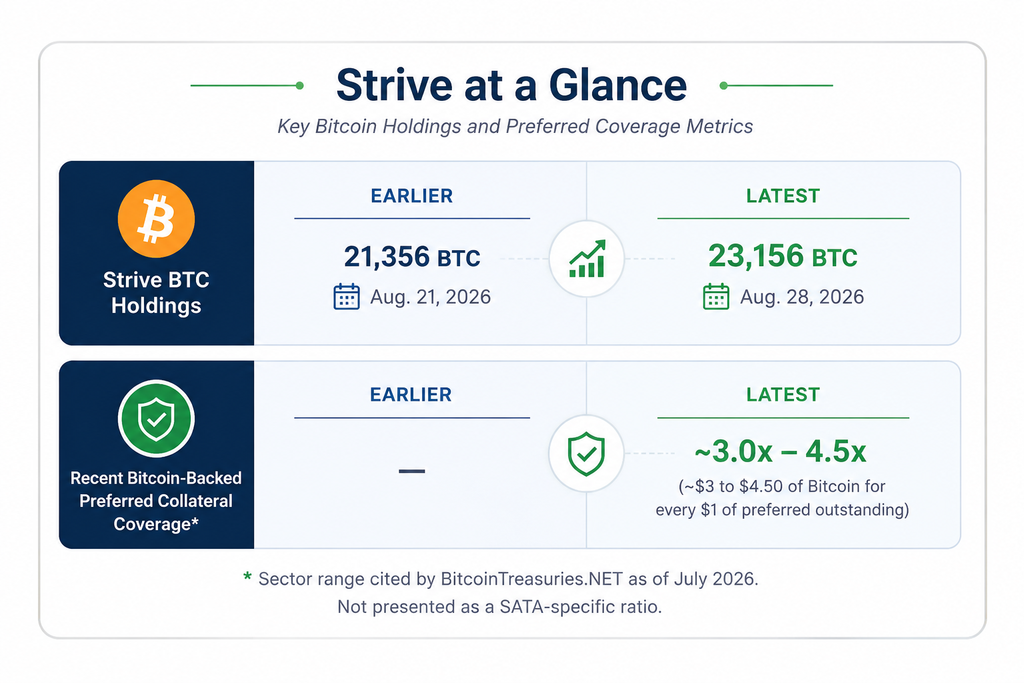
The Digital Credit report for July published by BitcoinTreasuries.NET explains why investors find this approach appealing: preferred equity enables them to raise permanent capital without incurring any dilution of common shares or running debt refinancing risks, and converts Bitcoin collateral into a yield-generating investment. In the last round of funding in this sector, preferred equity was leveraged 3x-4.5x, or $3-$4.5 of Bitcoin for every $1 of preferred stock issued.
The purchases behind the streak
Strive has been ramping up its acquisitions for weeks. Its Form 8-K dated August 31 showed that it bought 1,800 $BTC in the period from August 24 to 28, at an average price of $79,431, thus raising its total holdings from 21,356 $BTC to 23,156 $BTC.
According to Cryptopolitan, the approximately $143 million acquisition raised Strive’s position to the fifth place among the largest public holders of Bitcoin, whereas its weekly pace of acquisitions sped up from 20 $BTC at the end of July, through 1,110 $BTC to 1,800 $BTC.
According to the research note published on August 31 by TD Cowen, the company raised its price target for ASST from $28 to $32 and expects Strive to reach nearly 4,300 $BTC in acquisitions for the third quarter.
The 8-K document also sheds light on the manner of financing achieved for this acquisition, showing the growth of outstanding shares in SATA from 8.27 million to 9.07 million and in Class A common shares from 79.89 million to 83.47 million. BitcoinTreasuries.NET calculated that these two ATM programs raised around $154.6 million combined — approximately $80.3 million from SATA and $74.3 million from common shares — and $143 million went to Bitcoin.
Why the flywheel cuts both ways
The same reflexivity that powers the strategy can work in reverse. Cipolaro warned the loop:
“can abruptly halt if market confidence falters.” — Greg Cipolaro, NYDIG
Galaxy documented drawdowns exceeding 98% at Nakamoto and steep losses across DAT equities as premiums turned into discounts. Cryptopolitan noted that Strive itself booked a $257.6 million GAAP net loss in the second quarter, including $234 million tied to fair-value declines on Bitcoin and Strategy preferred holdings.
For the wider market, the signal is narrow but meaningful. With corporate Bitcoin demand increasingly concentrated among firms that can still tap capital markets, Strive’s ability to keep selling SATA and converting those proceeds into Bitcoin offers a clear test of how long this financing flywheel can keep supporting demand.