
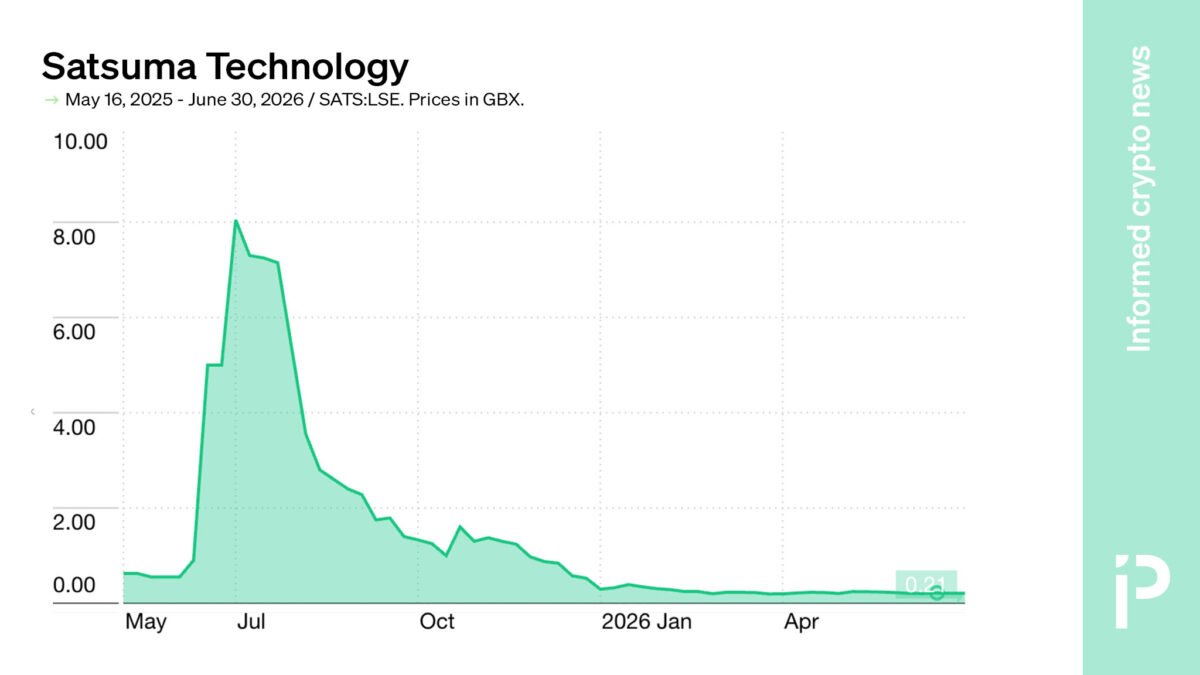
British Strategy copycat, Satsuma Technology, which raised £168.9 million ($227.6 million) from noteholders at the height of the 2025 $BTC treasury boom, has crashed 99% from its 2025 peak, sold all 669 of its $BTC, and suspended trading.
On Monday, the company attempted to postpone its own delisting while it hunts for a new trading venue. It’s also under High Court of Justice procedures to disburse £30.7 million ($41.4 million) to shareholders by the end of September.
However, its Chief Bitcoin Strategist, Mark Moss, explained in an interview that, according to UK regulations, “We can’t give the investors back their $BTC. We have to give them the dollar amount of the bitcoin when they accepted it.”
The company was worth over £120 million ($162 million) as recently as June 24, 2025.
What is Satsuma?
Incorporated in March 2021 as Streaks Gaming, it pivoted to AI as StreaksAI before hopping on the crypto bandwagon as Tao Alpha. Finally, it channeled the “sats” denomination of $BTC as Satsuma Technology.
Interestingly, Strategy founder Saylor apparently encouraged the proliferation of copycats, saying, “There’s room for 400 million companies to buy $BTC.”
Unfortunately, the $BTC treasury bubble popped in early summer 2025, and the performance of most of those stocks are overwhelming negative since their initial purchases.
Sequans dumps bitcoin treasury after less than a year
‘The next MSTR’ wasn’t
Moss, as chief Bitcoin strategist, was supposed to raise non-dilutive capital and generate yield from the company’s self-described “treasury” that it’s now liquidated in full.
When he was appointed, Moss gushed, “Satsuma $SATS.L is entering the UK markets with a better model: Balance sheets backed by pristine collateral ($BTC), not empty promises.”
He also promoted the stock to his followers. Hopefully they ignored him.
Money followed the initial hype. In July 2025, Satsuma closed a £163.6 million ($220 million) convertible note round with ParaFi Capital as lead investor.
Pantera Capital, Digital Currency Group, and Kraken contributed capital and subscribed. Some investors excitedly paid in $BTC; the company accepted 1,097 $BTC in lieu of £96.9 million ($130.6 million) in cash.
The first rupture came in December, when Satsuma sold 579 of its 1,199 coins for about £40 million ($54 million). The proceeds were earmarked to repay £78 million ($105 million) of notes maturing at the end of December.
Who could have imagined Broke companies CAN’T afford to HODL https://t.co/MBErUIyUNt
— DarkClownSuitCoinicarus (@Coinicarus) September 14, 2026
Fleeing executives and the strategy ends
The boardroom soon began to empty.
CFO Andrew Smith quit on February 18, after shareholders requisitioned a general meeting about his performance, while CEO Henry Elder resigned on March 6 after seven months on the job.
Backers also turned their backs. By April, Bloomberg was reporting that Pantera was among the investors pushing Satsuma to dump its remaining $BTC.
Pantera’s DAT Opportunity Fund held 6.7% equity at the time, and the company’s market value had fallen below the value of its coins.
Satsuma admitted an embarrassingly high average purchase price of £84,026 ($113,000) per $BTC.
Directors dug in anyway. Four of the six board members wanted the strategy to continue. The company insisted in July, “For the avoidance of doubt, the board’s recommendation is that shareholders VOTE AGAINST the resolutions to return capital and to delist.”
Shareholders ignored that boardroom advice, however, and voted more than 90% in favor of a wind-down on July 20, 2026.
Between July 24 and 31, Satsuma netted £31.9 million ($43 million) for its last 669.49 $BTC. Its average sale price was £47,667 ($64,272) per coin, 43% below what it paid.