Not significant in quantity terms, but notable as a trend in itself, an on-chain maneuver has been recorded in the Shiba Inu market, as a large investor broke an eight-month silence to begin quietly and systematically buying $SHIB tokens, data by Arkham confirms.
While most retail $SHIB holders are realizing losses en masse due to the absence of explosive growth, this wallet is selectively taking advantage of the deep market discount by using the biggest liquidity pool for the token — Binance.
Strategic buyers target multi-year Shiba Inu coin lows
According to data from TradingView, by the end of July 2025, the $SHIB price had compressed to multi-year lows near $0.000004142, effectively returning to the key support zones of late 2022 and completely losing the speculative momentum seen in early 2024.
The wallet's behavior clearly reflects a strategy of absorbing the local bottom. In this context, the current status of the portfolio indicates that the address has accumulated more than 50.25 billion $SHIB tokens, which make up the absolute majority of its holdings and are worth approximately $209,200.
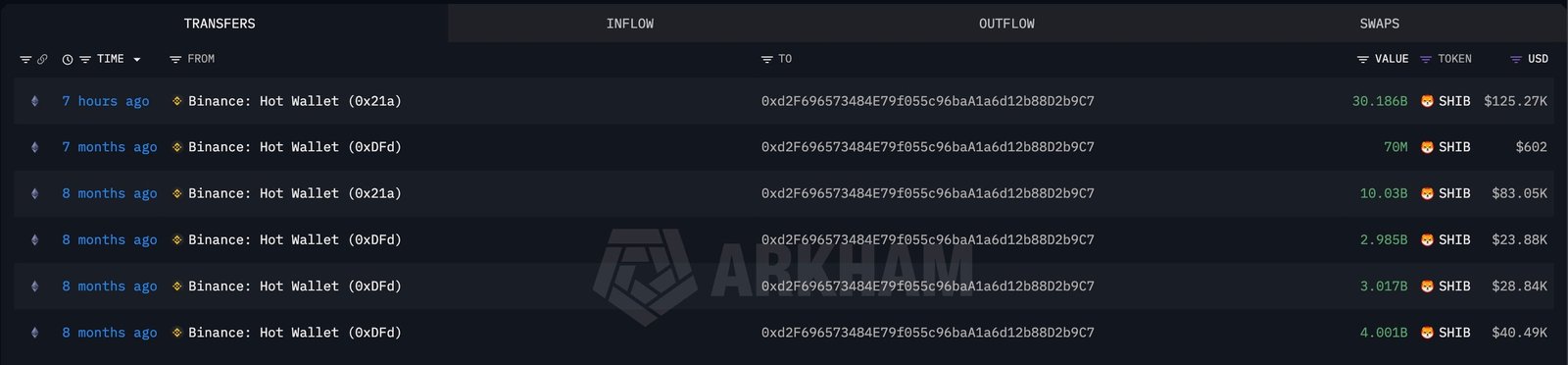
At the same time, the nature of the transactions and the history of transfers from Binance hot wallets completely refute the hypothesis of an accidental purchase, confirming that the large player is systematically withdrawing $SHIB into personal custody after a prolonged pause.
The next direction for the coin now depends on whether its price can hold the current historical threshold of $0.0000041. For the accumulation to develop into a full-scale trend reversal, buyers need to form a dense order wall in the Binance order book and prevent a breakdown below this level, which could automatically trigger retail traders' stop-loss orders.
The main indicator of an imminent move will be a breakout from the current narrow volatility range. This would require large exchange volume to accompany the withdrawal of tokens to cold wallets, confirming a phase of full-scale accumulation and preparing the ground for Shiba Inu coin's first attempt in two years to challenge local price resistance.