Several catalysts, including Shibarium and burns, that were once expected to drive Shiba Inu higher have failed to generate meaningful price momentum.
Despite years of ecosystem development and community initiatives, Shiba Inu continues to trade near a multi-year low of around $0.0000042.
Shiba Inu On-Chain Activity Wanes
Meanwhile, on-chain metrics paint a similarly weak picture. Both $SHIB’s burn rate and blockchain activity have dropped sharply, providing little support for a sustained price recovery.
Low Shibarium Activity
Shiba Inu’s Layer-2 blockchain, Shibarium, launched in August 2023 to give the ecosystem greater utility and reduce reliance on speculation. However, network activity has slowed considerably in recent months.
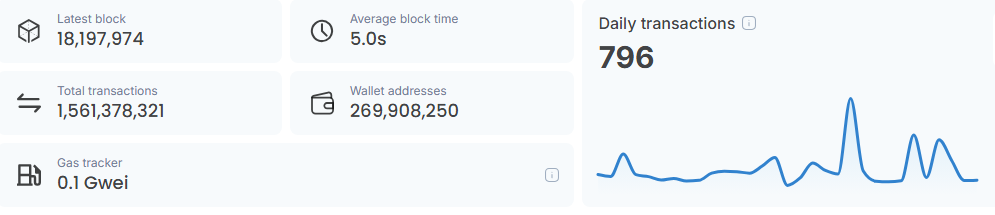
According to the latest data from Shibariumscan, Shibarium processed only 796 transactions over the past 24 hours, while total transactions over the past seven days remain below 15,000. These figures mark a dramatic decline from the network’s early days, when it regularly handled millions of daily transactions.
The slowdown stands in stark contrast to Shibarium’s lifetime statistics, which include approximately 1.56 billion cumulative transactions and nearly 269.9 million wallet addresses.
$SHIB Burn Rate Continues to Lose Momentum
Shiba Inu’s token burn mechanism has also lost much of its impact.
Over the past day, the community burned just 21.79 million $SHIB, while the seven-day total reached 61.48 million tokens. Although these burns still amount to tens of millions of tokens, they remain insignificant compared to $SHIB’s enormous circulating supply of 589.15 trillion tokens.
The current burn activity also represents a steep decline from 2024 and 2025, when the community routinely removed billions of $SHIB from circulation each day.
Moreover, recent on-chain analysis has raised questions about Shiba Inu’s reported holder growth. An analyst recently claimed that contract-generated addresses artificially inflated the token’s holder count earlier this month. According to the report, WoofSwap allegedly used an automated contract that created more than 70,000 additional wallet addresses during the first few days of July, making the growth appear stronger than it actually was.
Ecosystem Updates Fail to Inspire Investors
At the same time, $SHIB investors have received few meaningful ecosystem developments capable of reversing the token’s downward trend.
Even Rakuten’s announcement regarding the development of a physical $SHIB product in Japan failed to generate positive market momentum. Furthermore, leading ecosystem figures, including Lucie and Shytoshi Kusama, have remained silent on social media, leaving the community without significant updates or visible leadership.
Meme Sector Recovery Could Be Shiba Inu’s Only Hope
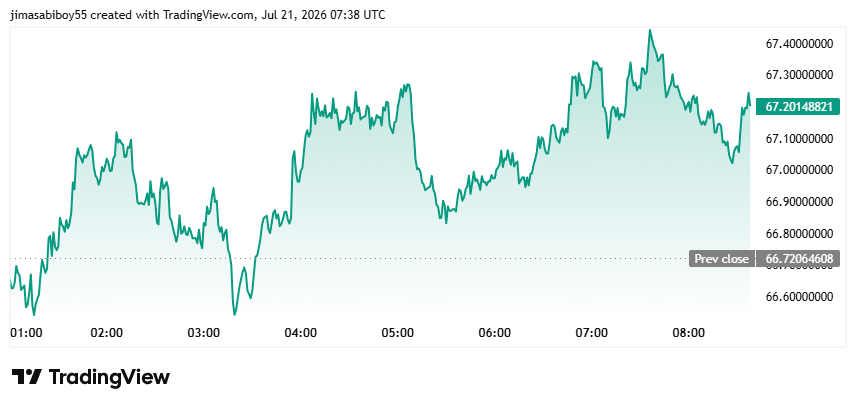
Rather than reflecting project-specific issues alone, Shiba Inu’s prolonged weakness appears closely tied to the broader meme coin market. The GMCI Meme Index, which tracks the performance of major meme cryptocurrencies, dropped from a peak near 160 in January 2026 to 66 this week.
The index has since recovered only slightly to around 67.2, according to TradingView data. Throughout that decline, $SHIB has closely mirrored the sector’s overall performance.
As a high-beta meme asset, Shiba Inu’s next significant rally may depend more on renewed enthusiasm across the meme coin sector than on project-specific catalysts.
Previous meme coin rallies have demonstrated this relationship. For example, Dogecoin’s double-digit gains earlier in 2026 helped lift $SHIB alongside other meme tokens. However, market sentiment remains cautious today.
The Altcoin Season Index currently stands at 53, suggesting that investor appetite for higher-risk altcoins remains limited. Until broader market conditions improve, $SHIB could continue struggling to attract sustained buying interest despite its ecosystem developments.
Currently, Shiba Inu trades at $0.000004282, giving the token a market cap of $2.52 billion. Despite the broader bearish trend, $SHIB has gained 3.44% over the past 24 hours and 2.81% over the last seven days.