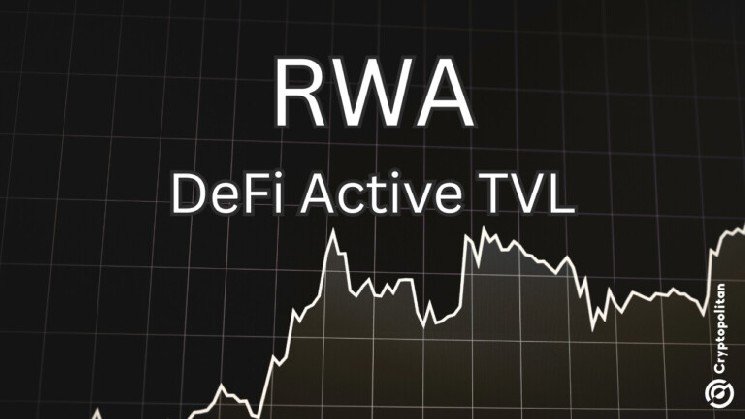
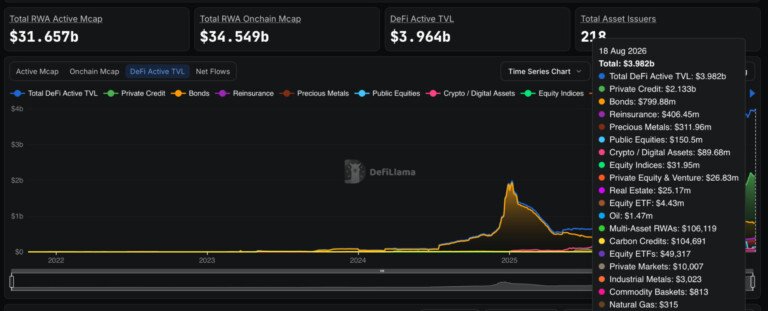
Real World Assets that are actively deployed inside DeFi protocols are on the verge of reaching $4 billion. As of August 18, DefiLlama shows this number is at $3.98 billion. This same number stood at $650.88 million just a year ago and around $12 million three years ago. That is a 6x in twelve months and a staggering over 300x in three years.
Source: DefiLlama
What makes this number useful is actually what it excludes. DefiLlama only counts a tokenized asset here when it is put to use onchain. Collateral posted in a lending market qualifies. So does liquidity in a DEX pool or a deposit locked in a vault. Whereas tokens in a wallet that are simply earning fund yield do not.
Total tokenized issuance across the sector is at $34.55 billion. When doing the math here, that equates to about 11.5% of the total RWA space being put to work onchain.
Tokenized Treasuries Lead Issuance and Then Sit Still
BlackRock’s BUIDL has $2.74 billion issued and around $18 million of it is showing up in DeFi. That is a utilization rate of 0.66% as of today. Meanwhile, Franklin Templeton’s BENJI product has a utilization rate of zero. Now between these two products, there is well over $3 billion of tokenized money market exposure that never actually touches a lending pool.
The design of these funds explains why the onchain utilization percentages are low. These funds were built for institutional cash management with whitelisted transfers with the buyers holding them wanting the T-bill yield rather than any sort of borrowing power. Tokenization basically gave them much faster settlement but it did not turn them into collateral.
Private Credit and Reinsurance Are Where the Collateral Actually Moves
Private credit accounts for $2.13 billion of the $3.98 billion active total, more than half on its own. Bonds contribute $799.88 million and reinsurance another $406.45 million.
Janus Henderson’s Anemoy AAA CLO fund runs at 97.53% utilization on $421.88 million. Re Protocol’s reUSD sits at 97.03% on $184.67 million. Maple’s syrupUSDT is at 91%. Syrup USDG tops the entire rankings table at 153.37% utilization on $181.32 million of DeFi TVL, which points to the same token being counted across multiple venues as it gets lent, borrowed and redeposited.
These are assets that DeFi lenders will price and accept. A CLO fund with a defined credit rating and a reinsurance token with a yield stream both fit into existing collateral frameworks in a way that a whitelisted treasury fund does not.
Further down the list, the smaller categories look experimental rather than structural. Precious metals hold $311.96 million in active TVL, public equities $150.5 million and equity indices $31.95 million. Oil registers $1.42 million. Natural gas comes in at $315.
Utilization Is the Number to Watch as Issuance Scales
Issuance headlines have driven RWA coverage for two years, and $34.55 billion is a real figure. The question now is whether the next $34 billion behaves like BUIDL or like JAAA.
If issuance doubles while utilization holds near 11.5%, tokenization mostly delivered better custody rails for institutions that were already buying treasuries. If utilization climbs alongside issuance, RWAs turn into working collateral inside crypto credit markets, and the $4 billion mark stops being the ceiling it currently looks like.