South Korea's largest crypto exchange, Upbit, carried out a large-scale transfer of 864 billion $SHIB tokens, worth about $4 million, between its addresses. Previously, such a reorganization of Shiba Inu tokens on the exchange would hardly have attracted attention, but the events of last Sunday are forcing market participants to examine such movements much more closely.
The sudden wallet activity was recorded in the aftermath of the 36% rally that was entirely driven by strong local demand.
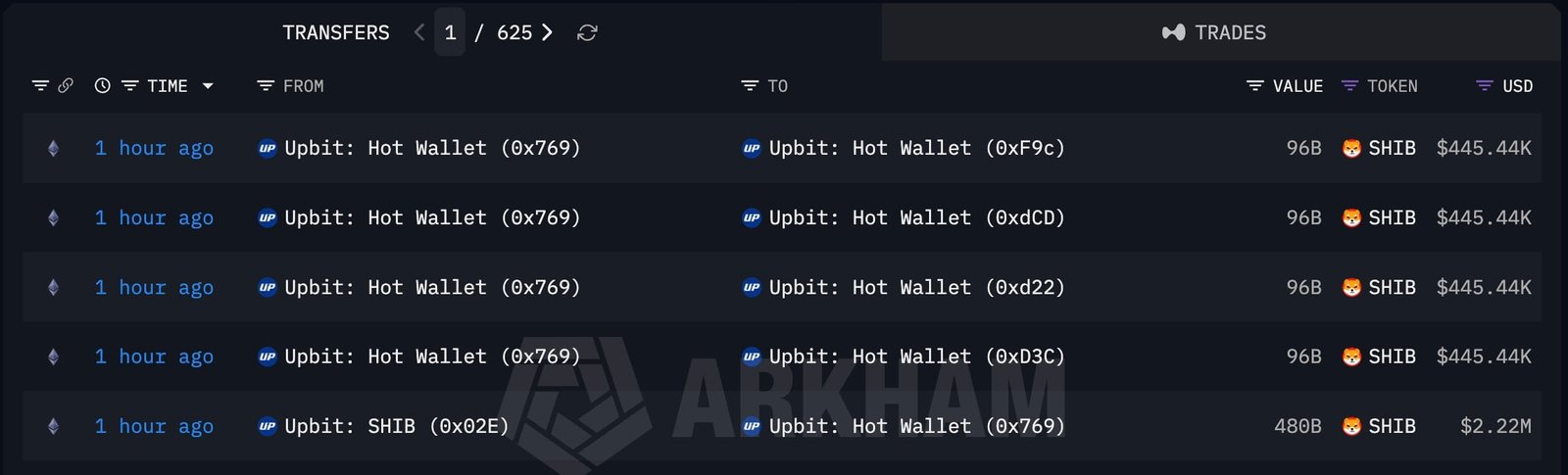
This time, according to data from the Arkham platform, the movement of funds between the exchange's wallets took place in two stages:
- From Upbit's hot wallet, "0x769", a total of 384 billion $SHIB was transferred to related platform addresses in four equal transactions of 96 billion $SHIB each.
- Almost simultaneously, the official Upbit: $SHIB wallet transferred 480 billion tokens back to the original "0x769" address.
Such an on-chain structure may indicate routine technical liquidity rebalancing designed to ensure the uninterrupted processing of orders.
However, the transfer of hundreds of billions of tokens immediately after a rapid price surge leaves open the question of whether the exchange may be preparing for another wave of market activity with $SHIB.
Korean factor: $SHIB volumes remain near peak levels
Attention to Upbit's operations is linked to the fact that South Korea is currently acting as the key driver of $SHIB trading. Upbit's local Korean won pair, $SHIB/KRW, continues to lead by trading volume, accounting for more than 5% of all global activity in the token and surpassing Binance's $SHIB/USDT pair by turnover, according to CoinMarketCap data.
At the same time, the token is trading on Upbit at around $0.0000046, almost matching prices on Binance and OKX. Sunday's speculative overheating, known as the "kimchi premium," has subsided, and the market is showing signs of consolidation.
Nevertheless, maintaining global leadership in trading volume requires the exchange to preserve high liquidity across its hot wallets, which may explain the current Shiba Inu transfers.
In a situation where South Korea's retail market has already demonstrated its ability to move the price on its own, such large-scale transfers are forcing traders to remain on heightened alert.