
Pump.fun price is trading close to $0.0020 after rallying nearly 50% from its recent swing low, recovering despite the largest investor and team token unlock in the project’s history. Instead of triggering heavy selling pressure, the unlock has been met with strong buying interest, pushing the token toward a major long-term descending resistance.
The move has shifted traders’ attention from the token unlock itself to whether buyers can sustain the momentum and confirm a breakout. With price testing a critical technical level while new supply enters circulation, the coming sessions could determine whether $PUMP price extends its recovery or faces another rejection.
Token Vesting: Supply Risk Enters the Market
One of the biggest events currently influencing $PUMP is its token vesting schedule. Around mid-July, the first tranche of investor and team allocations begins unlocking. According to the vesting schedule, 25% of the existing investors’ allocation (32.5 billion $PUMP) and 25% of the team’s allocation (50 billion $PUMP) have now become eligible for release, with the remaining tokens set to unlock linearly over the next 36 months.
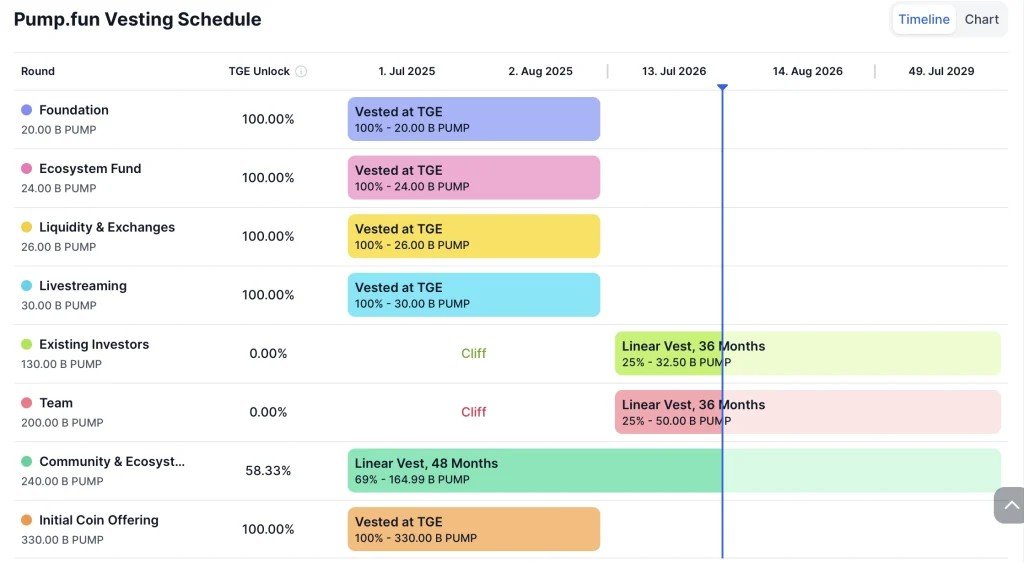
On paper, this represents a significant increase in potential circulating supply. Large token unlocks are typically viewed as bearish because early investors and team members gain the ability to realize profits, increasing the risk of selling pressure.
However, the market’s reaction has been notably different. Rather than declining after the unlock, the $PUMP price has rallied sharply and is now testing a key long-term resistance level. This suggests that buyers have, at least so far, absorbed the newly unlocked supply without triggering a sustained sell-off.
$PUMP Tests Key Resistance as Momentum Improves
$PUMP is trading around $0.0020, extending its recovery from the recent low near $0.0013, a gain of roughly 50%. The rally has brought the price to the upper boundary of its long-term descending channel, a resistance zone that has rejected every recovery attempt over the past several months. Meanwhile, the derivative data paints a cautious outlook, raising concern about the next price action.
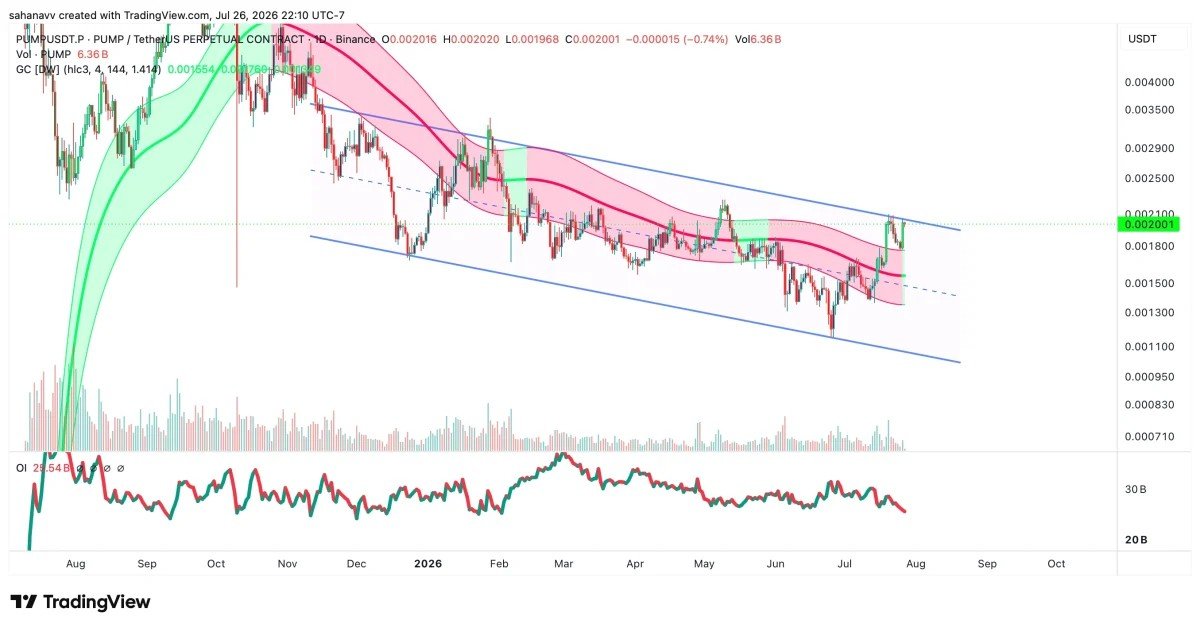
The Supertrend indicator has flipped bullish, confirming a short-term trend reversal. Price is also trading above the Guppy EMA cluster, suggesting buyers have regained control of near-term momentum. Besides, Open Interest (OI) has been trending lower. This divergence indicates that aggressive new leveraged long positions are not driving the rally.
A rising price with declining OI suggests traders are closing positions while spot demand absorbs supply. Such rallies can remain healthy, but they often require continued spot buying to sustain momentum. Volume has also expanded during the recovery, lending credibility to the move. However, the latest candle shows sellers responding near the descending trendline, making the current zone the most important technical hurdle for bulls.
Key Levels to Monitor
Where Does the $PUMP Price Go From Here?
Pump.fun price has entered a decisive phase after absorbing one of its largest token unlocks without a meaningful breakdown. The bullish Supertrend, improving volume, and strong recovery from recent lows indicate that buyers remain in control of short-term momentum. However, the token is now testing a major long-term resistance while Open Interest continues to decline, suggesting the rally has yet to attract fresh leveraged participation.
Bullish Scenario: If $PUMP price holds above $0.00185 and breaks $0.00210–$0.00215 on rising volume and improving Open Interest, the current recovery is likely to extend into a broader trend reversal.
Bearish Scenario: A rejection at the descending trendline, coupled with continued weakness in Open Interest and selling from vested holders, could send $PUMP back toward the $0.00160 support zone.
Overall Bias: Cautiously Bullish. Buyers have successfully absorbed the initial vesting-related supply, but a confirmed breakout above long-term resistance is still required before the broader trend can be considered bullish.