Prediction market traders are increasingly betting that a Tesla (NASDAQ: TSLA) and SpaceX (NASDAQ: SPCX) merger could happen in the first half of 2027.
Data from Kalshi shows traders have assigned a 51% probability that Tesla and SpaceX will announce a definitive merger or combination before May 1, 2027.
The probability stands at 46% before April 1, 2027, and 42% before March 1, 2027. Looking further ahead, the market assigns a 73% chance that the two Elon Musk-led companies will combine before 2028.
The prediction market has attracted more than $705,000 in trading volume, highlighting sustained investor interest in the possibility of a merger between Musk’s electric vehicle giant and his aerospace company.
Market pricing suggests traders view a merger as unlikely in the near term but increasingly probable as 2027 approaches.
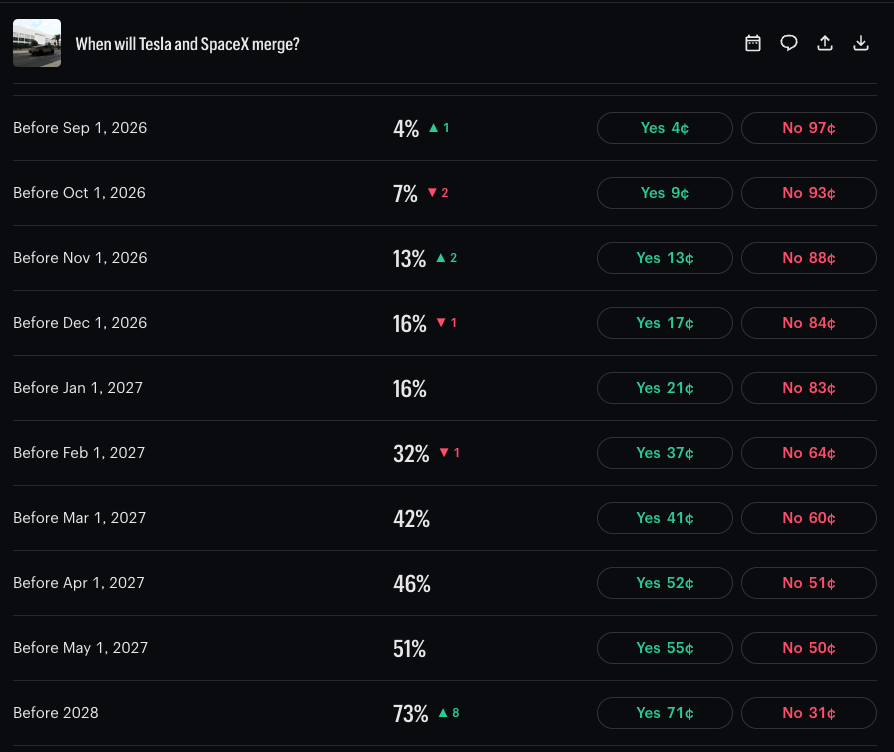
Kalshi contracts currently imply just a 4% chance of a deal before September 1, 2026. The probability rises to 7% before October 1, 2026, 13% before November 1, 2026, and 16% before both December 1, 2026, and January 1, 2027.
By February 1, 2027, the odds increase to 32%, before climbing to 42% for March, 46% for April, and 51% for May.
The gradual increase suggests traders expect any transaction to require months of negotiations, due diligence, shareholder approvals, and regulatory review following SpaceX’s public market debut earlier this year.
Speculation on Tesla-SpaceX merger
Speculation about a Tesla-SpaceX merger has persisted for years due to the close ties between the companies and Musk’s leadership role at both firms.
The companies already collaborate across several areas, including energy products, manufacturing initiatives, semiconductor development, artificial intelligence, robotics, and advanced engineering projects.
SpaceX has also purchased Tesla vehicles and energy systems, while both companies share long-term ambitions in automation and advanced technology.
Interest in a potential merger increased after SpaceX completed its record-breaking initial public offering in June 2026. Additional attention followed reports surrounding Musk’s Tesla compensation arrangements, including provisions linked to a potential change-of-control event.
Some analysts argue a merger would create a unified technology platform spanning electric vehicles, energy storage, artificial intelligence, satellite communications, and space exploration.
Supporters believe combining engineering talent, infrastructure, and manufacturing capabilities could strengthen both companies’ competitive positions.
Opposition to Musk’s companies merger
Despite growing speculation, significant hurdles remain. A Tesla-SpaceX merger would likely face regulatory scrutiny due to the companies’ size, strategic importance, and government ties.
Investors have also raised concerns about valuation differences, shareholder dilution, governance issues, and potential conflicts of interest stemming from Musk’s influence over both firms.
Some investors may prefer separate exposure to Tesla or SpaceX rather than a combined company, while shareholder lawsuits could arise depending on the structure and terms of any deal.
Featured image via Shutterstock