
Postquant Labs announces the upcoming launch of QuipSwap, a bridgeless protocol designed for secure cross-chain asset swaps.
Postquant Labs, the developer behind quantum computing protocol quip.network, has announced the imminent public launch of QuipSwap, its Bridgeless Swap Protocol.
QuickSwap is aimed at addressing the dual challenges of cross-chain security vulnerabilities and the looming threat to current cryptographic standards posed by its own quantum computing network.
The protocol represents the first solution to enable trustless cross-chain transactions without bridges, oracles, or wrapped assets, components that have historically been the primary vectors for billions of dollars in losses from hacks and exploits.
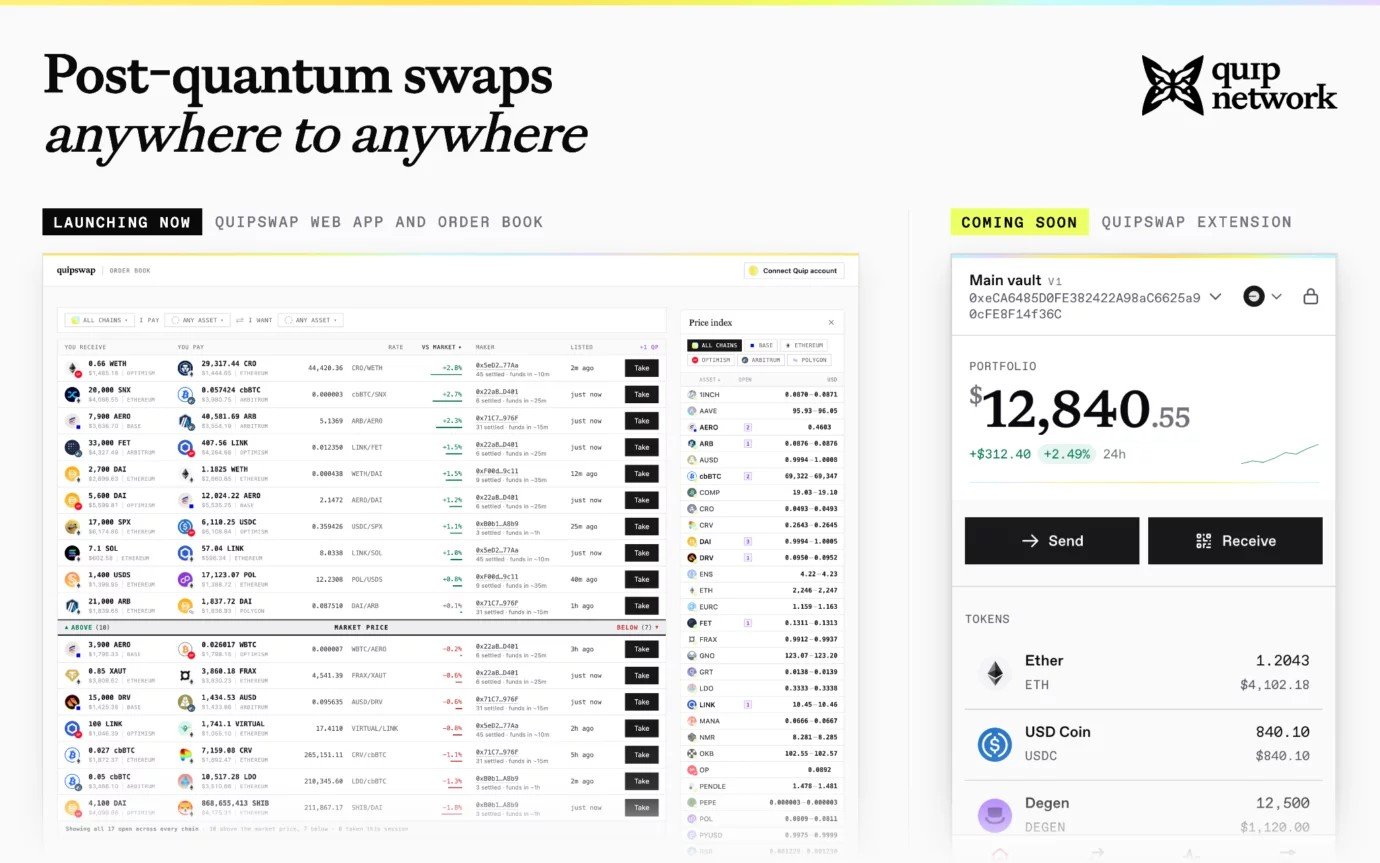
Where traditional cross-chain solutions rely on centralized intermediaries or smart contract bridges to move assets between blockchains, Quip’s new protocol utilizes a peer-to-peer (P2P) mechanism that completely upsets the previous paradigm. The protocol enables two parties to agree to a swap and effectively exchange wallet access across chains in a synchronized, trustless manner.
Colton Dillion, CEO and co-founder of Postquant Labs, said the company’s approach to cross-chain trading could help users participate in the Quip ecosystem without relying on intermediaries, bridges or oracles.
“If one party claims their side of the trade, the counterparty immediately receives their claim key too — no take-backs,” Dillion said. “You can be on any chain and treat it like a P2P swap.”
The timing of this launch addresses a key, often-overlooked vulnerability: quantum resistance. As quantum computing advances, the cryptographic foundations of current blockchains are becoming open to exploitation. The Quip team argues that simply upgrading a single chain is insufficient since, for a transaction to be truly quantum-resistant, every layer it traverses must also be immune to quantum attacks.
Commenting on the matter, Dr. Richard Carback, Chief Technology Officer and co-founder of Postquant Labs, said the company’s approach to quantum computing infrastructure is designed to address security challenges that arise when distributed networks rely on cryptographic systems vulnerable to quantum attacks.
“You can’t run a distributed computation network where your own miners can break your cryptography,” Carback said. “No chain supports quantum computation, so we had to build our own,” he added.
Following a successful demonstration of the live claim process at ETHDenver in February, the Quip team has completed the core codebase. The protocol has undergone rigorous testing and a formal security audit conducted by Oak Security, with results announced as part of today’s public launch.
Alongside QuipSwap, quip.network has successfully deployed quantum-resistant wallets across Bitcoin, Ethereum, and Solana, currently in beta testing, hardening blockchain infrastructure against the quantum threat before it arrives. All research underpinning quip.network is open-source, built with the goal of establishing a global quantum computing standard for the industry.