
Brent crude futures reached $91.42 on July 20, their highest level since June 11, then eased to $88.28 as mediators floated a 10-day US-Iran ceasefire proposal.
Bitcoin traded above $65,000 earlier in the session, registering an intraday high at $65,666 and a low at $63,100. As of press time, Bitcoin has now reached $66,313, while Brent crude futures held near $90.
Bitcoin’s current behavior preserves the oil-inflation-rate relationship and assigns a short duration to the latest energy premium. Traders appear to expect diplomacy, restored tanker traffic or additional supply to pull Brent lower before the move forces a larger repricing in inflation, Treasury yields and Federal Reserve policy.
Oil enters consumer prices through gasoline, diesel, jet fuel and heating costs, then reaches freight, food and manufacturing through transport and power bills.
The first-round effect lands in headline inflation, and central banks focus on persistence because repeated energy costs can reach wages, services and inflation expectations, giving the shock a route into underlying inflation.
Federal Reserve research estimates that a persistent 10% real oil-price increase adds about 0.15% to US headline inflation over four quarters and 0.06 point to core inflation.
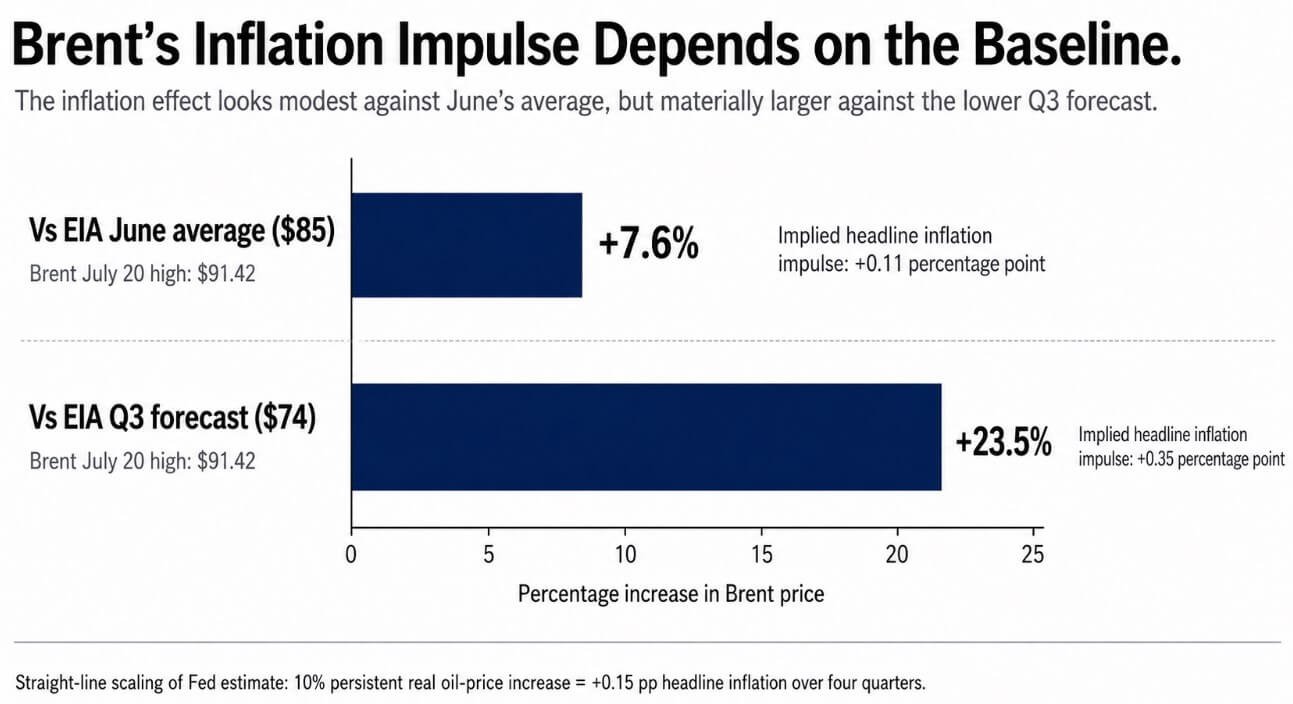
Using the Energy Information Administration’s (EIA) $85 June Brent average, the $91.42 high represented a 7.6% increase. A straight-line scaling of the Fed estimate produces an inflation impulse near 0.11 percentage point when oil holds that level for a year.
The calculation looks more threatening against the EIA’s July forecast for Brent to average $74 in the third quarter, as the July 20 high sat 23.5% above that baseline, which scales to roughly 0.35 percentage point of headline inflation under the same simplified method.
The Fed model uses a persistent real-price shock, so duration carries more policy weight than one intraday candle.
How oil reaches Bitcoin
The Fed’s July Monetary Policy Report described that energy costs helped push 12-month PCE inflation to 4.1% in May, with core PCE at 3.4%. Investors also priced in a higher federal funds rate path starting in 2026, lifting real interest rates and Treasury yields, while the FOMC has kept its target range at 3.5% to 3.75%.
This setup normally weighs on Bitcoin because cash and Treasury securities pay more when interest rates climb, and Bitcoin yields zero.
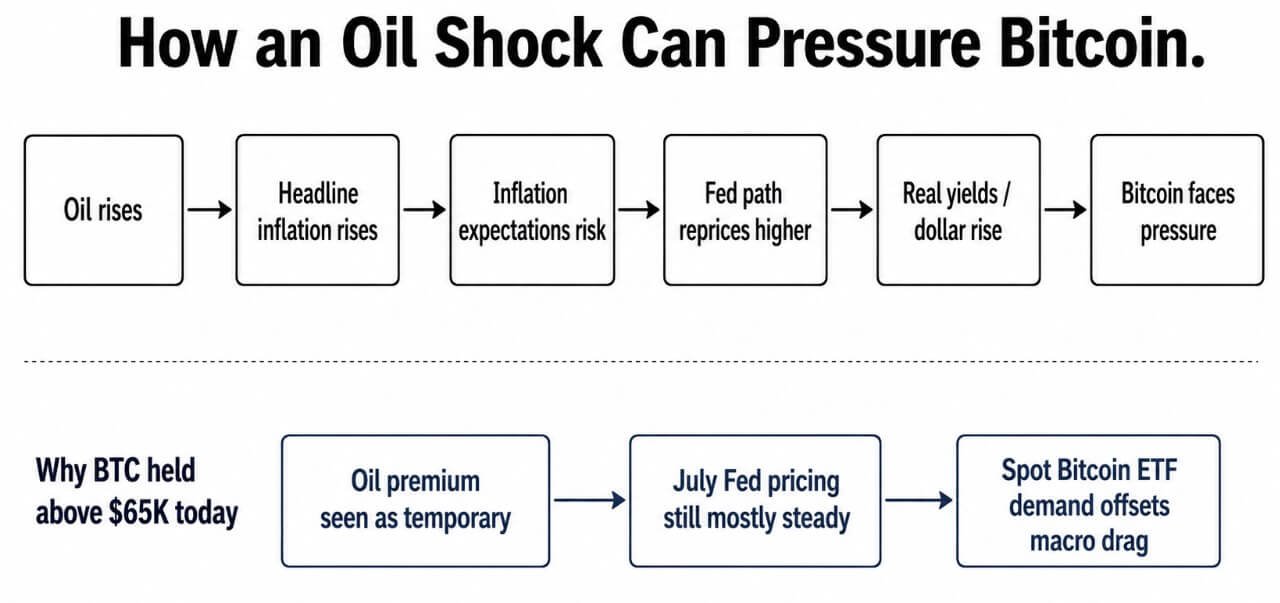
Higher real rates, a firmer dollar, and tighter financing reduce the compensation investors receive for owning volatile assets.
One study found Bitcoin fell 24 basis points for each one-standard-deviation inflation surprise, and a 2026 paper found hawkish Fed communication produced negative Bitcoin price responses.
Futures assigned the July 29 Fed meeting an 83.4% probability of steady rates and a 16.6% probability of a quarter-point increase. September pricing carried a 60.3% probability of at least one increase, showing a firmer medium-term path alongside limited urgency around July.
Bond and currency markets offered partial confirmation: the 10-year Treasury yield traded near 4.56%, up about 2 basis points, and the dollar index eased 0.1% to 100.69 in Asian trading.
Crypto demand supplied a second buffer as Farside Investors recorded a $424.7 million spot Bitcoin ETF outflow on July 13, then four positive sessions totaling over $500 million from July 14 through July 17.
The EIA’s July outlook forecasts Brent at $74 during the third quarter and $65 in 2027 as production, trade routes and inventories recover. The retreat from $91.42 toward $88 as ceasefire diplomacy surfaced shows how quickly a geopolitical premium can compress.
Reports tied the risk case to tanker incidents near the Strait of Hormuz, reduced traffic through a route that carries around 20% of global oil supplies, and a Houthi naval blockade threat against Saudi Arabia.
Each additional disruption can extend the shock and turn a temporary premium into a multiweek inflation input.
The $90 persistence test
In the bull case, diplomacy improves, tanker traffic recovers, and Brent retreats below $80 or toward the EIA’s $74 third-quarter average. The Fed keeps rates steady in July, September hike odds recede, the dollar loses ground, and ETF inflows stay positive.
Under those conditions, Bitcoin’s defense of the $65,000 area becomes a macro duration trade, and direct institutional demand supports it.
Scenario Oil condition Rate/dollar signal Bitcoin implication Bull case Brent retreats below $80 or toward EIA’s $74 Q3 forecast July Fed hold, September hike odds recede, DXY weakens $65,000 hold looks like a duration trade supported by ETF demand Base case Brent stays volatile but does not average above $90 Yields drift but no major Fed repricing $BTC can remain around $65,000 if ETF flows stay positive Bear case Brent averages above $90 for several weeks 2-year yield above ~4.30%, DXY above 101-102, hike pricing firms Oil shock becomes a financial-conditions shock; $65,000 support weakens Stress case Hormuz/tanker disruption extends, and inventories tighten Dollar and real yields rise sharply $BTC likely trades as a liquidity-sensitive asset, not a clean inflation hedgeIn the bear case, Brent averages above $90 for several weeks as shipping disruptions drain inventories and delay supply restoration. A two-year Treasury yield above roughly 4.30%, a dollar index above 101 to 102, and firmer Fed hike pricing would convert the energy shock into a financial-conditions shock.
Sustained ETF redemptions would remove Bitcoin’s clearest local support, exposing $65,000 to the full oil-inflation-rate chain.
Persistence converts an oil shock into a rate shock: Bitcoin can absorb a $91.42 intraday Brent high when traders expect diplomacy, supply recovery and ETF buying to contain the macro effect. A multiweek Brent average above $90 plus higher short-term yields and a stronger dollar would remove that protection.
Holding $65,000 through that package would constitute genuinely unusual resilience. For now, Bitcoin is pricing the oil shock’s expiration date.