
The group of Bitcoin miners that have stopped hashing entirely to focus on something else, in most cases, AI, continues to receive more entrants.
To them, power is now worth more AI tenants than whatever is coming from the Bitcoin Network.
Keel hits zero, Core Scientific pays to quit
The clearest sign of a full exit came from Keel (NASDAQ: KEEL), the operator formerly known as Bitfarms. It switched off its last mining sites, Panther Creek, Scrubgrass and Sharon, on June 29, after shutting Moses Lake in April, and will book no mining revenue at all in the third quarter, according to CoinShares’ Q2 2026 mining report.
This makes it the first listed miner to reach zero. The cost of winding down hit the miner’s gross margin, taking it to a negative 285% for the quarter as retired rigs were depreciated at speed. Keel also sold 1,085 $BTC for around $75 million at an average of $69,100, and said it plans to liquidate its remaining 1,861 coins before year-end.
Others are paying to exit the market. Core Scientific (NASDAQ: CORZ) reportedly handed Block’s Proto division $41.9 million to cancel about 15 exahashes per second of next-generation 3nm mining chips. The hardware is reported as the most efficient ever built.
The gross margin from self-mining was down by 56%. The management said it runs its remaining machines only to cover power contracts while it converts sites.
Cipher Digital (NASDAQ: CIFR), which was once known as Cipher Mining, told investors it will not be spending on mining capex and that it expects to be out of the business by the end of 2027.
Hyperscale flips a working Michigan mine
Hyperscale Data (NYSE American: GPUS) cut power to the Bitcoin miners at its Dowagiac, Michigan facility on September 1 to ready it for an AI colocation tenant.
The 20-megawatt deal with an unnamed California neocloud provider is worth more than $1.2 billion over ten years, and it could go as high as $3 billion if the customer takes an option on another 32 megawatts.
CEO William Horne said that the move to shut down Bitcoin mining allows the company to focus the site’s power and infrastructure on the incoming customer.
Average monthly hashrate fell from about 1,066 EH/s in the first quarter to 1,004 EH/s in the second and 940 EH/s in the third, a 6.3% quarterly decline and roughly 12% below the December 2025 peak, per Hashrate Index.
Speaking on the trend, Ethan Vera, COO, Luxor, said, “This is a structural shift, not just a cyclical low,” while adding that “Miners everywhere are being revalued as energy and AI infrastructure.”
The economics stopped working
According to CoinShares, the weighted-average ex-tax cash cost to mine one Bitcoin was about $75,500 in the second quarter, while Bitcoin ended the period at $58,400, less than half its October 2025 record.
In the fourth quarter of 2025, the mining cost was around $79,995. Bitcoin was priced between $68,000 and $70,000, leaving operators down around $19,000 a coin. More than 15,000 $BTC have been sold by public miners since their treasuries peaked.
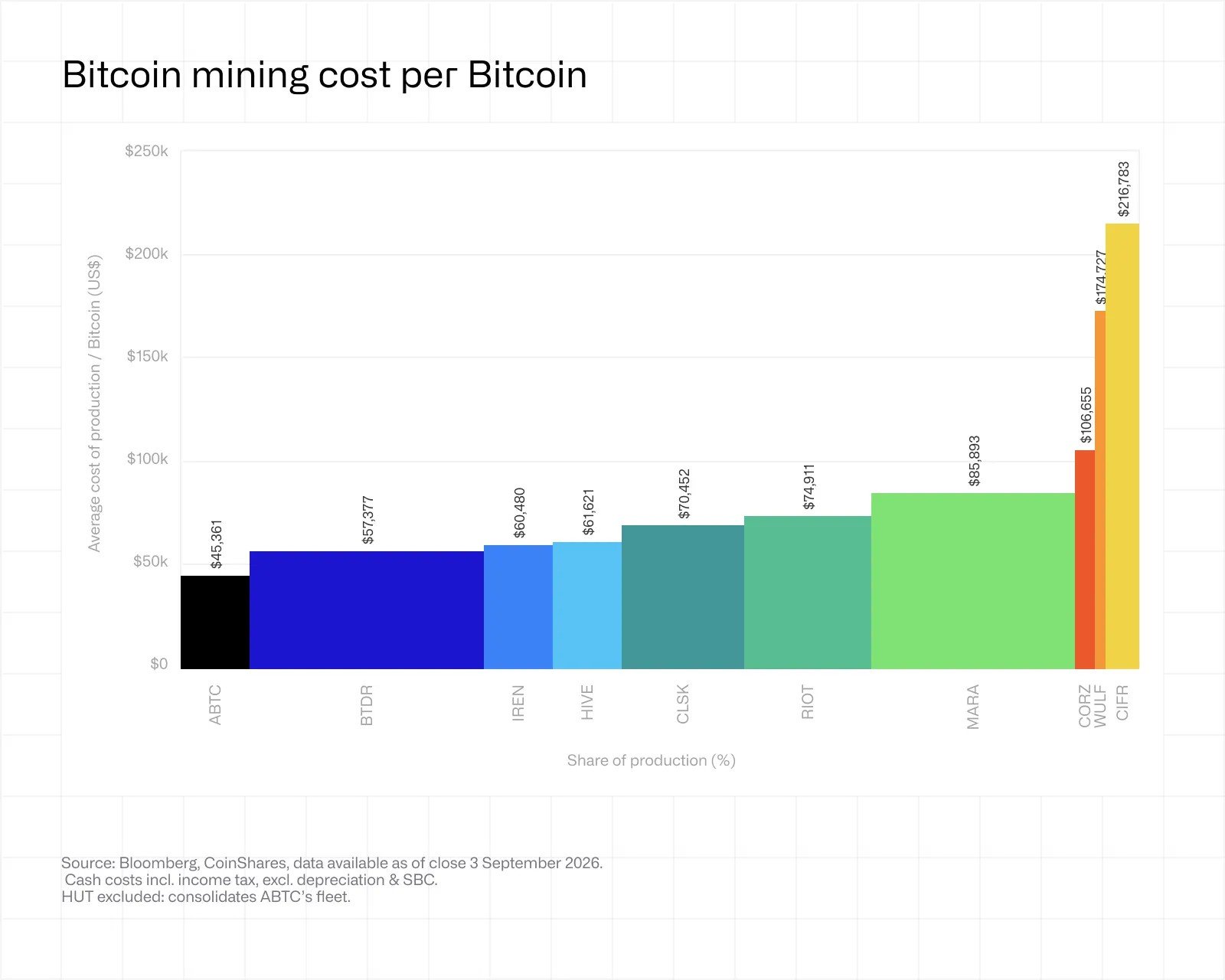
While miners are bleeding money as a result of mining, AI money has been flowing in to the rescue.
More than $70 billion has been announced in AI and HPC contracts across the sector. This includes IREN’s $9.7 billion Microsoft deal, TeraWulf’s roughly $19 billion Anthropic agreement, and Core Scientific’s $14 billion-plus in expected contract revenue.
Gold advocate and long-term crypto skeptic, Peter Schiff wrote on X that AI is not a tailwind for Bitcoin but a rival, competing for the same capital, electricity and data center space.
Why there is no turning back
Once a site flips, it tends to stay flipped. Wolfie Zhao of The Energy Mag said, “Once that multi-gigawatt power infrastructure has been retrofitted to AI or HPC colocation, there is no turning back.” Zhao added that he expects public miners to keep winding down hashing in coming quarters.
Regulation is deepening the moat, with CoinShares reporting that there are now at least 225 moratoriums or restrictions on data-center development across 30 states, 151 still in force, with New York enacting the first statewide pause on July 14, 2026.
That scarcity is priced into equities. Miners with contracted AI or HPC capacity trade at an average of 12.9 times forward sales, against 3.7 times for those without, even though more than $100 billion of disclosed backlog is currently generating only about $1.1 billion of annualized revenue.
However, not every miner has given up on mining, with Bitdeer’s chief strategy officer Haris Basit saying that the company will keep mining alongside a 16-year Anthropic compute deal, betting on a dual-purpose model in which flexible mining fills the gaps around contracted AI load.