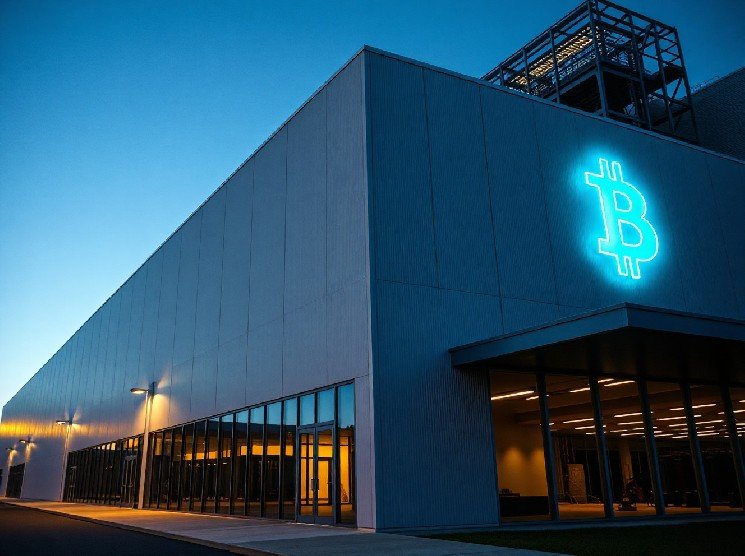
Hyperscale Data, a U.S.-listed Bitcoin treasury company trading under the ticker DAT, has secured a $30 million Bitcoin-backed loan through the decentralized finance (DeFi) lending protocol Morpho. The funds are earmarked for expanding its AI data center in Michigan, according to a report by The Block.
The move underscores a growing trend among Bitcoin-accumulating companies to leverage their digital assets as collateral for operational funding, rather than selling tokens outright. Hyperscale Data also revealed that it sold approximately 100 $BTC last week, while simultaneously establishing a $BTC-backed credit facility to support its AI infrastructure investment strategy.
Strategic Use of Bitcoin Holdings
Hyperscale Data’s decision to borrow against its Bitcoin reserves reflects a broader shift in corporate treasury management. By using $BTC as collateral, the company can access liquidity without permanently reducing its Bitcoin position, a strategy that has gained traction among public companies seeking to preserve long-term upside exposure.
The loan, facilitated via Morpho—a decentralized lending platform built on Ethereum—highlights the increasing integration of traditional corporate finance with DeFi infrastructure. This approach allows for faster, more flexible borrowing terms compared to conventional bank loans, which often involve lengthy approval processes and stricter collateral requirements.
The company’s simultaneous sale of 100 $BTC, while establishing the credit facility, suggests a deliberate balancing act: generating immediate cash flow while maintaining a substantial Bitcoin reserve. This dual strategy may appeal to investors who value both operational growth and digital asset exposure.
AI Data Center Expansion and Market Implications
The expansion of the Michigan AI data center aligns with the broader industry push toward high-performance computing infrastructure, driven by the surging demand for AI training and inference capabilities. Hyperscale Data’s investment comes at a time when data center operators are racing to secure power, land, and computing resources to meet the needs of AI-driven workloads.
For the cryptocurrency market, this development signals a maturing ecosystem where Bitcoin is increasingly used as a financial instrument beyond mere speculation. The use of DeFi protocols for corporate borrowing also demonstrates the growing legitimacy of decentralized lending platforms in mainstream finance.
Why This Matters
For investors and industry observers, Hyperscale Data’s move is a notable example of how companies are creatively managing their Bitcoin holdings. It also raises questions about the risks associated with using volatile assets as collateral, particularly in a market where $BTC prices can fluctuate significantly.
Moreover, the convergence of AI and cryptocurrency infrastructure represents a strategic intersection that could shape the next phase of digital asset adoption. As more companies explore similar financing structures, the lines between traditional corporate finance, DeFi, and emerging technology sectors are likely to blur further.
Conclusion
Hyperscale Data’s $30 million Bitcoin-backed loan via Morpho marks a significant step in the integration of DeFi into corporate treasury operations. By leveraging its $BTC holdings to fund AI infrastructure, the company is demonstrating a forward-thinking approach to asset management that could influence other Bitcoin-rich firms. While the strategy carries inherent market risks, it also highlights the growing utility of Bitcoin beyond a store of value.
FAQs
Q1: What is a Bitcoin-backed loan?
A Bitcoin-backed loan is a type of secured borrowing where Bitcoin is used as collateral. The borrower receives fiat or stablecoin funds while retaining ownership of the $BTC, subject to loan-to-value (LTV) ratios and liquidation risks if the collateral value drops.
Q2: How does Morpho facilitate such loans?
Morpho is a decentralized lending protocol that allows users to borrow and lend digital assets directly through smart contracts. It matches lenders and borrowers efficiently, offering competitive rates and flexible terms without intermediaries.
Q3: What are the risks of using Bitcoin as collateral?
The primary risk is price volatility. If Bitcoin’s value falls below a certain threshold, the borrower may face margin calls or liquidation of collateral. Additionally, smart contract risks and regulatory uncertainties in DeFi remain concerns for corporate borrowers.
Related Reading
- Hyperscale Data Establishes Bitcoin-Backed DeFi Financing Program Through Morpho Protocol; Current Borrowings Approximately $30 Million at 4.9% to Support Michigan AI Data Center Expansion
- Bitcoin Price Drops as ETF Outflows Resume and Coldcard Wallet Attack Stirs Security Fears
- Bitcoin’s Unrealized Loss Share Dips Below 40% Stress Threshold: What It Signals
- Crypto fundraising surges to $2.2B in July, led by CeFi deals: RootData
- Bitcoin Price Forecast: Chart Masters Split Evenly on Weekly Direction