
The next crypto cycle’s biggest threat may not come from reasons most would expect. Regulatory uncertainty, code exploits, or Bitcoin’s internal mechanics are valid concerns, but the real threat may come from Wall Street’s obsession with artificial intelligence. For years, the digital asset ecosystem has welcomed institutional capital. But as Wall Street has embraced both tech and token, an invisible connection has grown between them. Therefore, if the AI bubble pops, crypto will realize how closely it has linked itself to the same institutional capital that powered the Silicon Valley tech boom.
As Alphabet CEO Sundar Pichai warned, should an AI bubble burst, “No company is going to be immune.”
So, if AI is indeed facing its dot-com moment, what could happen to crypto?
The interconnected “triple bubble”
The global economy is trying to balance what the World Economic Forum is calling an interconnected “triple bubble” of artificial intelligence, cryptocurrencies, and rising sovereign debt.
According to the IMF’s 2026 Global Financial Stability Report, the ties between global non-bank financial intermediaries (NBFIs) and digital asset markets have increased significantly. Institutional asset managers have launched a range of crypto products, and many entities now hold exposure through crypto-sensitive securities.
In QCP Group’s Q3 2026 Digital Assets Market Outlook, analysts observed this dynamic and noted,
$BTC remains what it has always been: a high-beta liquidity asset, institutionally adopted, but still hostage to real yields, ETF flows and risk appetite
However, in Q1 2026, U.S. institutional capital moved away from crypto and into the artificial intelligence equities. Notably, even during the U.S.-Iran war, equity remained concentrated in AI, semiconductors, and computer-linked infrastructure while Bitcoin failed to reclaim a durable trend.
For example, the big Four AI capex guidance has surged from $725 billion to nearly $800 billion. Notably, the re-opened IPO window has favored AI-related stocks as the key event was SpaceX’s June listing. SPCX was valued at an approximate market valuation of $1.77 trillion and garnered about $75 billion.
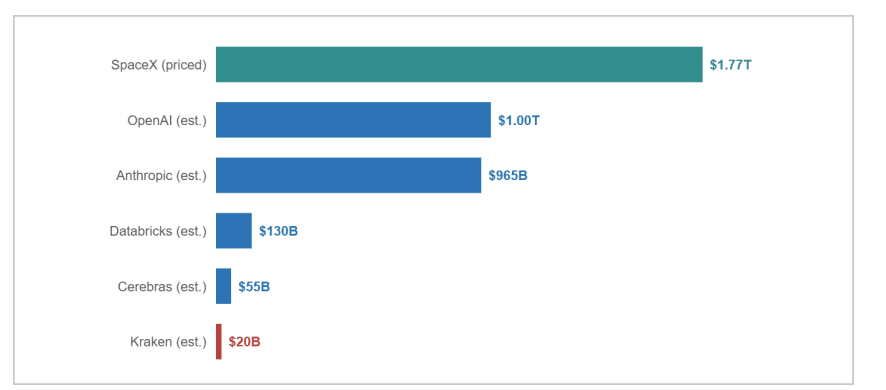
Moreover, the current issue on Wall Street is no longer whether such spending will continue, as it is now a norm. Instead, it is whether the returns could justify such an expenditure.
How stablecoins play a role
Stablecoins have become a tool for investors trying to protect themselves from high inflation and currency fluctuations.
In Q1 2026, the total supply of stablecoins had reached roughly $315-320 billion. USDT saw a loss in its market dominance down to about 58% ($184-185 billion). USDC’s share increased, though, to about $78 billion. All while transaction volumes touched record levels of $4.5 trillion-$28 trillion.
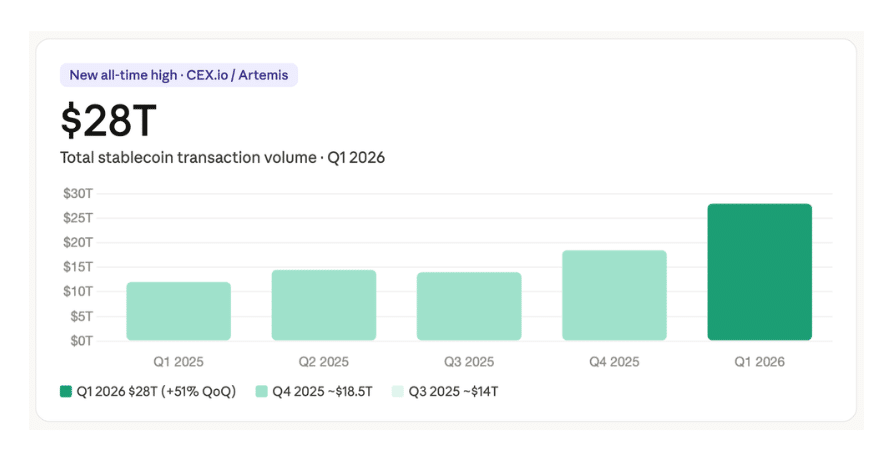
However, an AI-triggered market crash could cause panic as stablecoins are backed by traditional financial reserves like U.S Treasury bills. If these reserve assets experience a liquidity squeeze, the crypto-driven panic could spill over to the traditional world of finance.
The deleveraging effect
The kind of capital poured into AI infrastructure resembles the speculative frenzy seen in crypto’s past.
Billions of dollars are invested in data centers that might end up outpacing actual demand. This is similar to how some Bitcoin [$BTC] miners had established server farms, which eventually became obsolete. Such levels of circularity are best evidenced by how some mining companies have shifted from Bitcoin mining to building AI data centers.
BitMEX co-founder Arthur Hayes recently compared the current AI boom to 19th‑century railroad bubbles. He warned of a massive GPU loan mismatch in which five‑year loans fund hardware that becomes obsolete in just two. If cheaper Chinese models undercut Western competitors, Hayes believes this could trigger a credit event “bigger than subprime.”
So, what happens when the first cracks in the AI narrative show up?
An initial reaction will take the form of a cascade of deleveraging. When liquidity suddenly dries up, margin calls will be made against the hedge funds and NBFIs that are leveraged. This might spark a cyclic selling in both tech stocks and cryptocurrencies.
QCP Group analysts underlined this by saying,
$BTC lost the allocation competition on the way up. It would not be insulated on the way down
Since Bitcoin and large-scale Layer-1 tokens are liquid assets, they will function like ‘ATMs’ for the financial system and will be systematically dumped to cover the losses in equities. At the same time, there will be a clean-up of speculative frenzy in the market.
The hype-driven ‘AI-hybrid’ tokens and ‘memecoins’ that exist purely on the back of abundant Wall Street liquidity will vanish. This will be similar to how dot-com firms without sustainable business models took the brunt in the past.
A decoupling could follow
However, another thing that bubbles leave behind is high-value, cheap infrastructure. Like fiber optics from the dot-com era. When the deleveraging cycle ends, the next decoupling cycle will begin.
After investors move on from the wreckage left behind by the AI bubble, they will find themselves looking at a world economy where public debt levels are well above the $100 trillion-mark. Moreover, restrictive real yields and inflation will make sovereign bonds look increasingly fragile.
At this point, Bitcoin’s scarcity narrative and role as a hedge against sovereign debt debasement could take center stage. According to Arthur Hayes,
Capital will eventually exit overvalued AI stocks and banks into gold and Bitcoin.
Crypto’s ultimate test
In the end, an AI bubble is not a death knell for crypto. Instead, it will be a crucible. Until now, crypto has piggybacked on the growth of technology stories on Wall Street.
However, a bursting bubble will force digital assets to compete on their own structural merits rather than on borrowed tech hype.As QCP analysts point out,
When cash pays a compelling real return, the market needs a better reason to hold a non-yielding hedge
So, the real question isn’t whether the AI bubble will burst. It is whether crypto has evolved enough to trade on its own fundamentals, having decoupled from the tech narratives of Wall Street to become a neutral financial system.
Final Summary
- Crypto’s biggest risk may stem from Wall Street’s AI bubble, linking institutional capital across sectors.
- An AI crash could trigger deleveraging, stablecoin stress, and Bitcoin sell-offs before the scarcity narrative re‑emerges.