
All this while the CLARITY Act has typically been discussed in the context of the market structure and regulation. However, on the 16th of August, James Thorne, the Chief Market Strategist at Wellington-Altus Private Wealth, has come up with a different nuance about the bill.
According to Thorne, the delay in the passage of the CLARITY Act has raised a bigger question about the U.S. position in the future global financial system.
To explain things better, Thorne first criticized what he calls the “consensus” view and said,
Its latest error is the conviction that Team Warren, the regulators, bank incumbents, and professional crypto skeptics clustered around Washington, can permanently defeat Bitcoin and the broader digital-asset economy.
Will the U.S. lose its crypto dominance to China?
To support his national security claim, Thorne then drew comparisons with America’s experience in semiconductor manufacturing. He believes that back then the U.S. created dependencies that eventually became national security issues by allowing a good amount of strategic industrial capacity to relocate offshore.
Thorne highlights that a similar mistake could be made by digital asset infrastructure. Countries abroad may eventually set the rules governing digital assets if regulatory uncertainty forces blockchain developers, exchanges, and tokenization platforms beyond U.S. borders.
Therefore, according to Thorne, the CLARITY Act is more than just a mere piece of legislation. He noted,
The Clarity Act passing is a matter of national security. China is waiting in the wings for another US own goal.
Bitcoin’s current phase is temporary
This comes on the heels of the crypto market facing a major drop since the 2025 ATH. In fact, Bitcoin [$BTC] itself has fallen by 50% from $124,500, last seen during the market boom in October 2025.
However, Thorne argues that these short-term fluctuations and volatility do not necessarily mean that $BTC’s underlying “monetary thesis has failed.” Instead, he believes that the market is undergoing a capital rotation, with speculative capital shifting more toward prediction markets and AI stocks.
Hence, he put it best when he said,
That is what markets do when the narrative turns noisy and price stops rewarding impatience.
All in all, Thorne believes that currently the U.S. has a strategic advantage. However, given the delay and postponement, Americans could lose that advantage to China.
Warren’s criticism and waning approval odds
Senator Elizabeth Warren has always been the biggest critic of the bill and has recently called the CLARITY Act as
A ticket to sanctions evasion.
This level of pullback and the new window of approval have raised further concerns around the passage of the market structure bill.
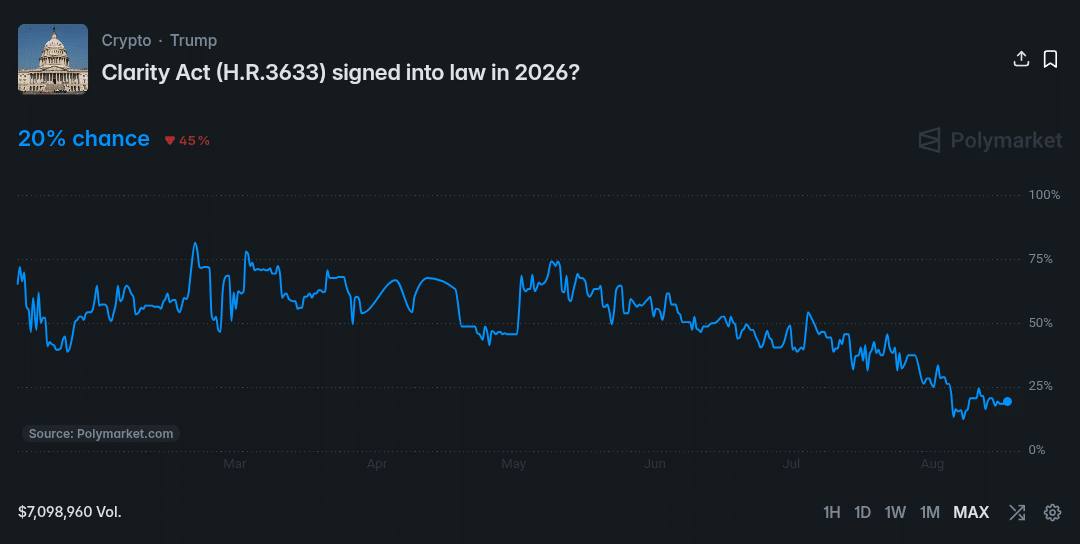
Supporting this narrative, even the Polymarket odds stood at a 20% chance at press time. This indicates that the community is less optimistic about the Act’s passage.
Final Summary
- Thorne believes that the CLARITY Act is more than just a piece of legislation.
- He blames Senator Warren the most and thinks that she will hand over digital finance to China.