
Ethereum’s on-chain activity accelerated sharply over the past three months as network usage expanded while liquid supply across exchanges continued shrinking.
New smart contracts increased by 82.3%, median transaction tips climbed more than 100%, and transfer volumes across externally owned accounts and smart contracts advanced between 50% and 80%.
Even with Ethereum remaining confined between $1,840 and $1,950, the underlying network reflected stronger utilization instead of speculative activity alone.
Meanwhile, exchange participation cooled considerably, creating a notable divergence between blockchain activity and market trading.
Such conditions historically emerged during periods when supply gradually tightened before stronger directional moves developed.
Exchange supply kept shrinking despite softer demand
Exchange liquidity continued tightening as several supply-side metrics reinforced the same trend.
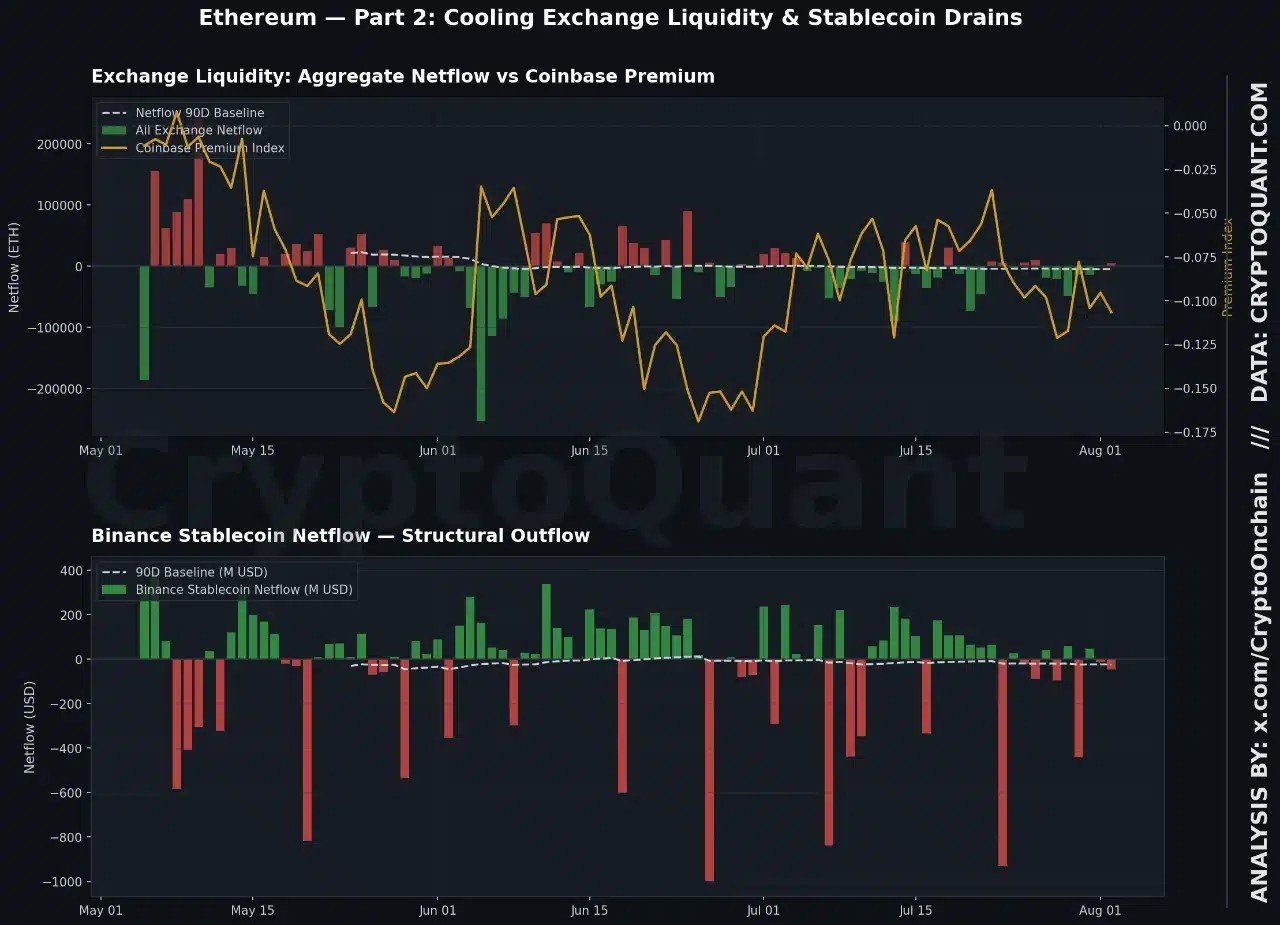
Aggregate exchange netflows shifted toward a 34% outflow bias over the previous 90 days, indicating fewer coins remained available for immediate selling.
Staking participation also climbed to 33.97%, removing an increasing share of Ethereum from liquid circulation.
Meanwhile, large-holder participation changed noticeably as the top ten inflow and outflow addresses reduced activity by almost 40% during the quarter.
However, Coinbase Premium remained negative, revealing that U.S. spot demand still lacked conviction despite the improving supply picture.
Stablecoin inflows also stayed deeply negative, averaging -120% over the previous 90 days.
As a result, supply tightened steadily, although fresh buying interest had not yet expanded enough to challenge the current trading range.
Retail gained ground as whale activity cooled
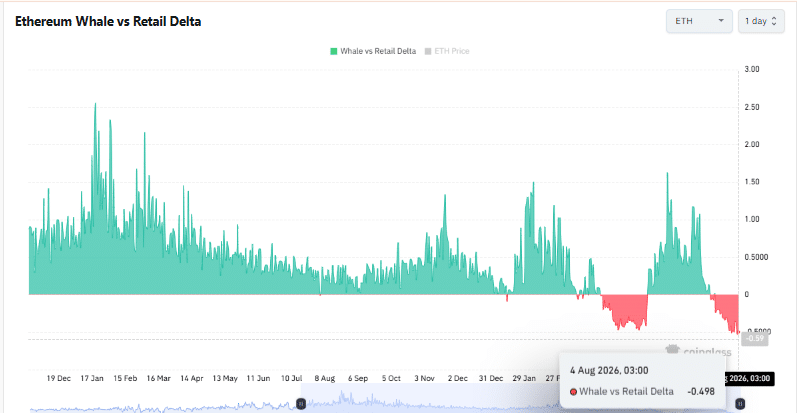
Market participation shifted further toward smaller traders after the Whale vs. Retail Delta moved to -0.498.
The indicator reflected retail participants contributing a larger share of trading activity while whales reduced their relative influence.
Earlier positive readings had pointed to stronger institutional dominance, yet recent sessions reversed that balance considerably.
However, weaker whale participation did not automatically indicate aggressive distribution because exchange outflows continued to exceed inflows across the broader market. Instead, large holders appeared less active while retail traders maintained day-to-day participation.
Such a combination often reduces the probability of sudden whale-driven volatility, although it also limits the buying strength typically required to force a decisive breakout.
Broader institutional engagement would likely need to recover before Ethereum could sustain stronger directional expansion.
Ethereum stalled below resistance as buyers hesitated
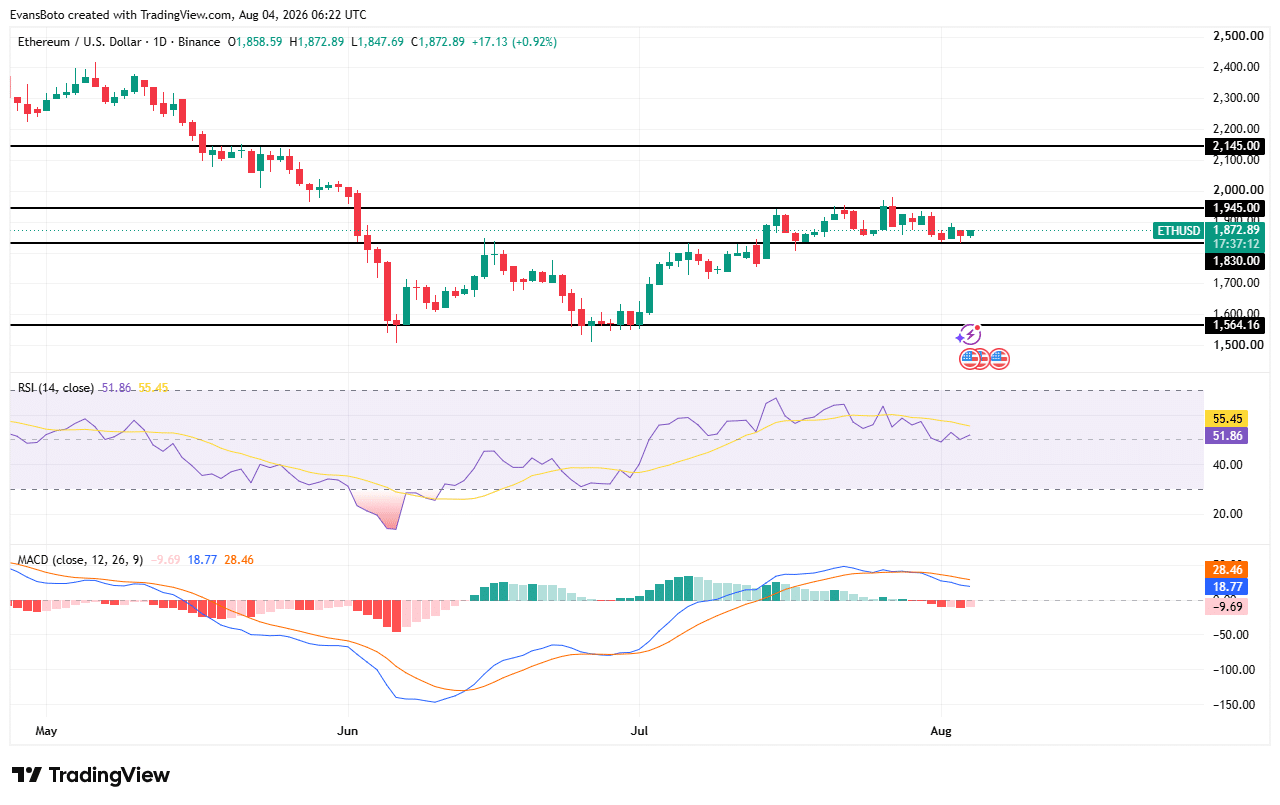
Ethereum [$ETH] remained below the $1,945 resistance after several unsuccessful attempts to establish a decisive breakout, while buyers continued defending the $1,830 support zone.
Rather than accelerating higher, the price compressed inside a narrow range, reflecting growing hesitation near resistance.
The RSI eased to 51.86, slipping below its signal line at 55.45, which reflected cooling buying strength without entering bearish territory.
Elsewhere, the MACD maintained a bullish crossover, although the shrinking positive histogram revealed that upward pressure had weakened considerably over recent sessions.
Price also continued respecting the established consolidation structure instead of extending July’s recovery.
Should buyers reclaim $1,945, Ethereum could challenge $2,145 next. However, losing $1,830 would expose the $1,564 support level as the next significant downside objective.
Final Summary
- Ethereum’s supply continues tightening while stronger network usage reinforces its long-term outlook.
- Retail activity has increased, but $ETH still needs stronger buying to clear key resistance.