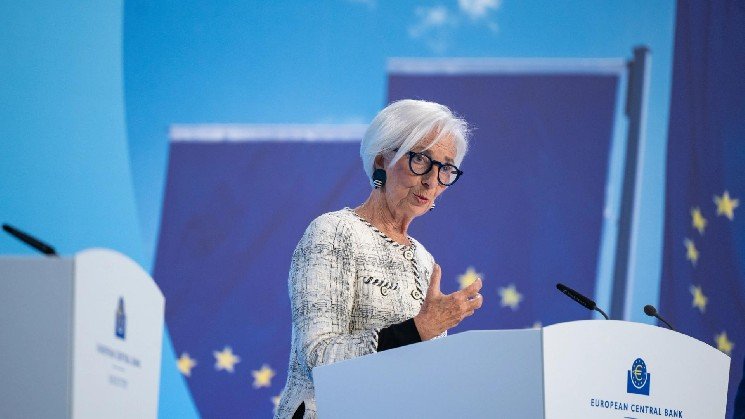
European Central Bank President Christine Lagarde personally intervened to prevent crypto exchange Binance from obtaining a Markets in Crypto-Assets (MiCA) license in Greece, according to a Wall Street Journal report that cited people familiar with the process.
A senior Greek regulator told Binance that Lagarde wanted the decision delayed until the European Securities and Markets Authority (ESMA) takes over licensing decisions for crypto exchanges under a proposed EU reform that has yet to be adopted, the Journal reported.
MiCA approval is granted by the financial regulators of individual European Union (EU) countries. Approval in one country gives the recipient a license to operate across the bloc. The ECB is influencing decisions because of concerns over stablecoins and the digital euro, the Wall Street Journal said.
Lagarde was concerned that Binance’s scale as the world's largest crypto exchange and how it could deepen the use of dollar-based stablecoins in the region, undermining the central banks' digital euro project and euro-denominated alternatives.
"We will not comment on speculation," a Binance spokesperson said. "In Europe, Binance remains committed to operating on a long-term, compliant basis under the EU’s Markets in Crypto-Assets Regulation (MiCA)."
The company said it still intended to pursue a license.
“We are actively working toward becoming MiCA-authorised and view this as an important step in providing users with a consistent, regulated, and trusted service across the European market,” the spokesperson said.
Binance withdrew its Greek application in mid-June and began winding down operations after officials at the Hellenic Capital Market Commission (HCMC) decided not to approve Binance’s MiCA license request at the last minute. The company vowed it would remain in Europe.
Gillian Lynch, Binance’s head of Europe, told CoinDesk in early July that the exchange had met all of the HCMC’s requirements.
“We were deemed to have a complete application," Lynch said. "Nothing was missing, nothing material was outstanding."
The WSJ also reported ESMA privately advised national financial regulators to reject Binance’s MiCA applications over concerns with the exchange's past compliance issues.
An ECB spokesperson declined to comment when contacted by CoinDesk. However, the source shared information that states that the ECB has no institutional role with regards to the authorising of Crypto-Asset Service Providers (CASPs). That remains the competence of national competent authorities, in this case the Hellenic Capital Market Commission (HCMC).
Changpeng "CZ" Zhao, the founder of Binance, pleaded guilty in the U.S. in 2023 to violating the Bank Secrecy Act (BSA) and agreed to pay $4.3 billion in fines. He served a four-month prison sentence in California in 2024 and was pardoned by President Donald Trump in October 2025.