
Hi readers,
Welcome to our institutional newsletter, Crypto Long & Short. This week:
- Markets rarely break because capital is scarce, but rather when it is trapped in the wrong place, writes Jenna Wright of LMAX Group.
- Top headlines institutions should pay attention to by Francisco Rodrigues
- “$ENA's funding sensitivity has structurally faded ” in Chart of the Week
Thanks for joining us!
- Kim Klembella
When capital can’t move fast enough, markets pay the price
by Jenna Wright, managing director, digital assets, LMAX Group
Markets rarely break down because there is too little capital in circulation. More often, they come under strain because capital is in the wrong place at the wrong time. Recent volatility driven by geopolitical tensions has reinforced that lesson. Institutions had money, collateral and balance-sheet capacity available, but too much of it was trapped in systems still governed by batch processing, cut-off times and settlement cycles. Risk was repricing by the minute; collateral was not.
This mismatch is no longer a back-office inconvenience; it is a market-structure problem. When institutions cannot mobilise collateral quickly enough to support their positions, liquidity thins, spreads widen and price moves become unnecessarily sharp. The problem is not volatility alone, but market infrastructure that has failed to keep pace with the markets it serves.
Markets are always on — infrastructure is not
The shift is already visible. Digital assets trade around the clock. FX and derivatives markets are moving steadily towards more continuous activity. Investors increasingly want instant access and an instant response. Yet much of the infrastructure that supports institutional trading was designed for a world of fixed market hours and end-of-day processes.
That gap matters most when markets are under stress. Collateral is still split across venues, custodians, asset classes and jurisdictions. Companies still pre-position capital because settlement may take one or two days. They still manage exposure around operational cut-offs that make little sense in markets that move continuously.
We saw the consequences in January. LMAX Group processed more than $300 billion in total volume in a single week, including $60 billion in gold products alone. Across the wider market, some institutions were forced out of positions overnight because they could not move assets out of equity or bond portfolios quickly enough to fund their gold or energy exposure. The collateral was there. It simply could not move fast enough.
Headlines of the Week
By Francisco Rodrigues
This week's headlines show institutional crypto shifting further into regulated financial infrastructure. Coinbase and Wintermute kept securing regulatory victories, while Wells Fargo joined a major race in the sector.
- Wells Fargo joins the race to tokenize Wall Street's settlement rails: The bank will introduce tokenized deposits this fall for select corporate and commercial clients, starting with round-the-clock U.S. dollar-to-British pound transactions and expanding to more clients, countries and currencies in 2027.
- Wintermute lands U.S. broker-dealer status in Wall Street push: The market maker's U.S. arm registered with the SEC and joined FINRA, allowing it to trade stocks and options, provide ETF liquidity and act as an authorized participant for crypto-linked funds.
- Coinbase picks Abu Dhabi for its global tokenized-asset push: The exchange secured permission from Abu Dhabi Global Market's regulator to arrange investment deals and custody tokenized securities, with plans to issue digital securities backed by shares.
- Senate starts Clarity Act floor process ahead of September test: Majority Leader John Thune filed a motion to proceed, positioning the bill for an initial vote after the August recess, but it still needs 60 votes and agreements on ethics, enforcement and stablecoin rewards.
- U.K. FCA drafts tokenized-gold rules for wholesale markets: The regulator is consulting financial institutions on using tokenized bullion as wholesale collateral as London defends a market accounting for 70% of global notional gold trading volume.
Chart of the Week
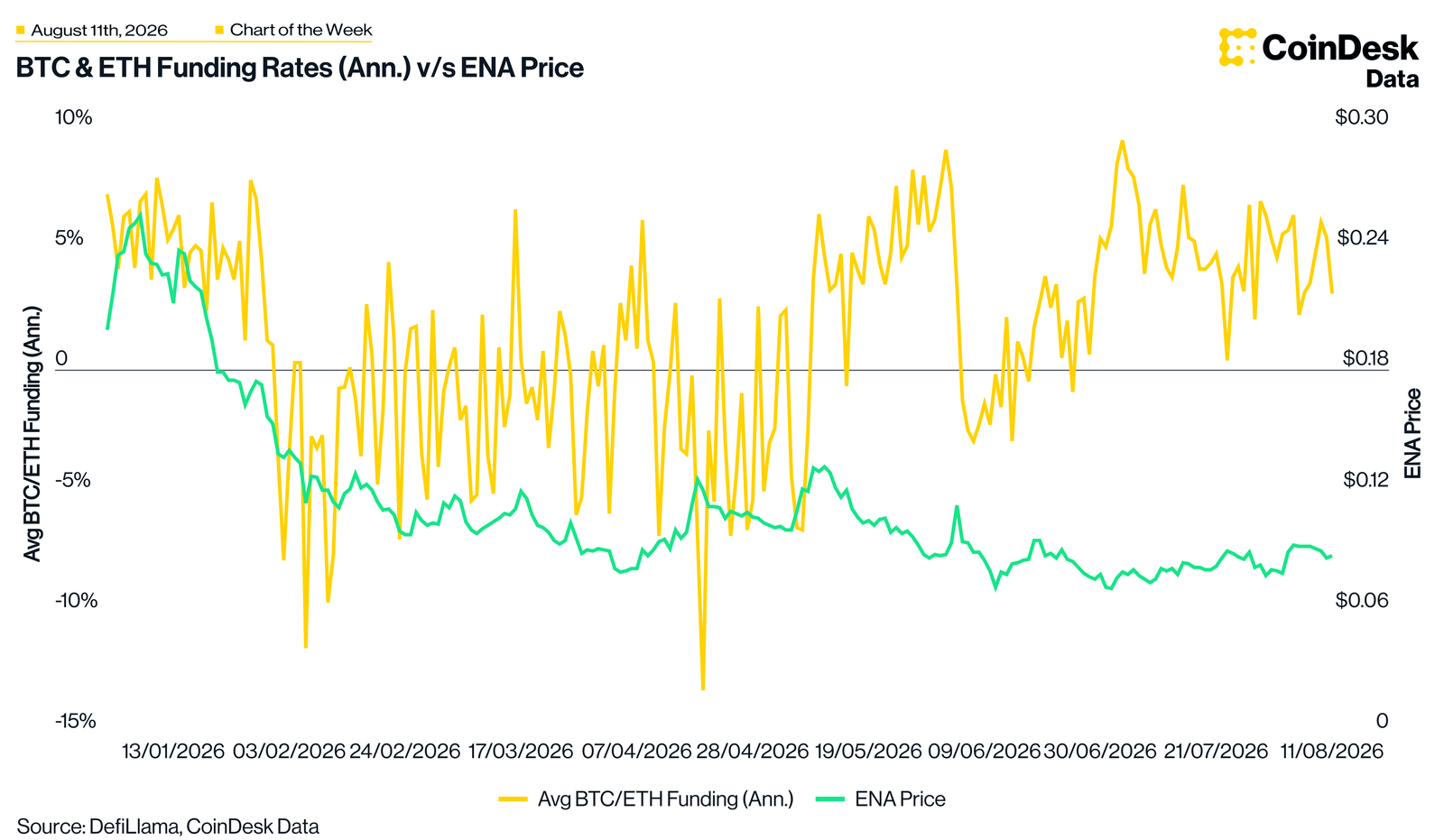
Average BTC/ETH funding has crept back to ~5% annualized, now above the 3 million T-bill (~3.8%) — yet Ethena ($ENA) has barely reacted. The disconnect is structural: crypto basis is down to ~1.5% of $ENA’s backing, so the token's funding sensitivity has all but faded.
 Latest Crypto News
- 1 Miden bets on privacy stablecoins with introduction of USDCx9 min ago
- 2 Smart contract blockchain Solana nearly froze Wednesday, Marinade Finance says1 hr ago
- 3 Standard Chartered-led Anchorpoint launches Hong Kong dollar stablecoin1 hr ago
- 4 America doesn’t need a second-class payments system 2 hrs ago
- 5 U.S. CPI inflation slows to 3.4% as expected, bitcoin holds near $64,0002 hrs ago
- 6 FlightAware drops Kalshi lawsuit over a market niche that data shows it never took off 3 hrs ago
- 7 Russia moves to restrict retail crypto trading to bitcoin, ether and USDT3 hrs ago
- 8 XRP trading could get spicy after CPI report as futures bets hit highest since October3 hrs ago
- 9 Bitcoin holds near $64,000 as U.S. inflation data looms, Harmony exploit rattles altcoins4 hrs ago
- 10 Bank of England to test stablecoin, digital currency use in cross-border finance4 hrs ago
 Latest Research
Building the Zcash Machine: Tachyon and Quantum Readiness

Building the Zcash Machine: Tachyon and Quantum Readiness
Zcash’s Tachyon upgrade aims to scale shielded payments, improve quantum readiness, and test whether its funding, security, and governance can hold.
By CoinDesk Research Jun 30, 2026 Commissioned byGenZcashZcash’s Tachyon upgrade aims to scale shielded payments, improve quantum readiness, and test whether its funding, security, and governance can hold.
Why it matters:
Zcash’s Tachyon upgrade aims to scale shielded payments, improve quantum readiness, and test whether its funding, security, and governance can hold.
View Full Report More From CoinDesk Indices
Crypto for Advisors: Europe's crypto rules, U.S. Preview

Crypto Long & Short: Putting the bitcoin sizing question to the test

Crypto for Advisors: Is the Clarity Act dead?
More From Bitcoin
Miden bets on privacy stablecoins with introduction of USDCx
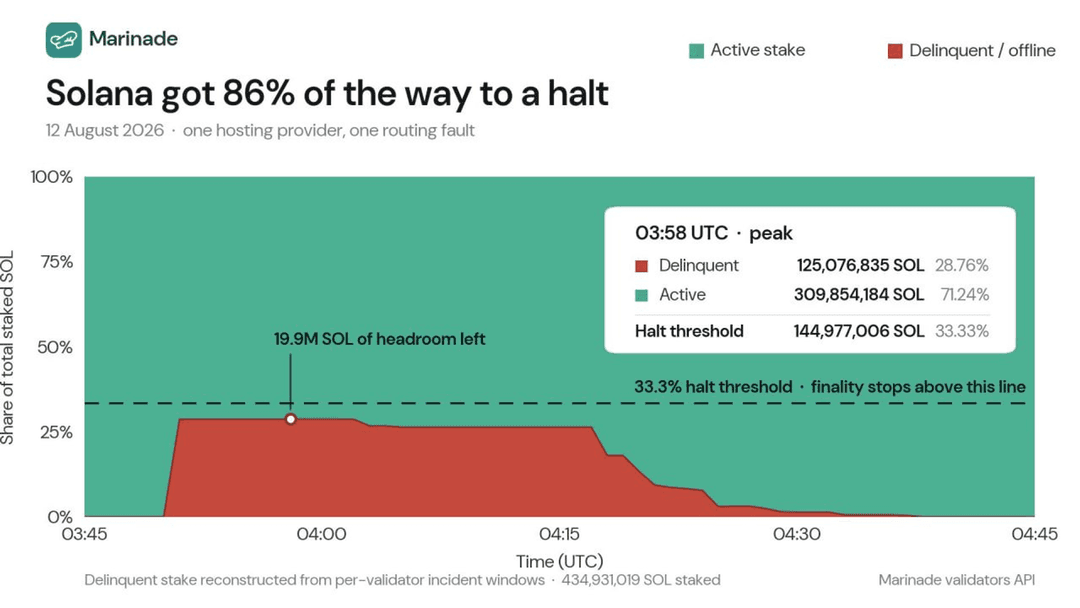
Smart contract blockchain Solana nearly froze Wednesday, Marinade Finance says