The crypto industry has become famous for its spending on elections and boasts an array of expensive booster organizations, but it also sought to convert almost $8 million into political results this year through direct lobbying on its central pursuit: getting a law to regulate the U.S. digital assets markets.
In the first half of 2026, the sector's paid advocates swarmed Capitol Hill as the U.S. Senate worked on the Digital Asset Market Clarity Act. About half of those registered lobbyists work as direct crypto firm employees and the rest came from outside shops or the industry's trade associations. That expensive army has so far failed to accomplish its mission.
In a CoinDesk analysis of federal lobbyist disclosures, the industry spent more than $13 million on lobbying in that six-month period. Most of that — $8 million — was linked to the market structure legislation in Congress, though the filings don't detail how much attention was also paid to other issues that might have been pursued alongside it.
This is not crypto's mountain of more than $100 million in campaign funds meant to steer friendly politicians into Congress. Nor is it the tens of millions the industry spends each year on its many advocacy groups, such as the Digital Chamber, Blockchain Association, Crypto Council for Innovation and others, (though some of those groups' membership fees do go toward this cause). This is a separate campaign of straight-up lobbying, which is a narrowly defined field of experts who represent client interests in meetings with the federal officials writing legislation and policy.
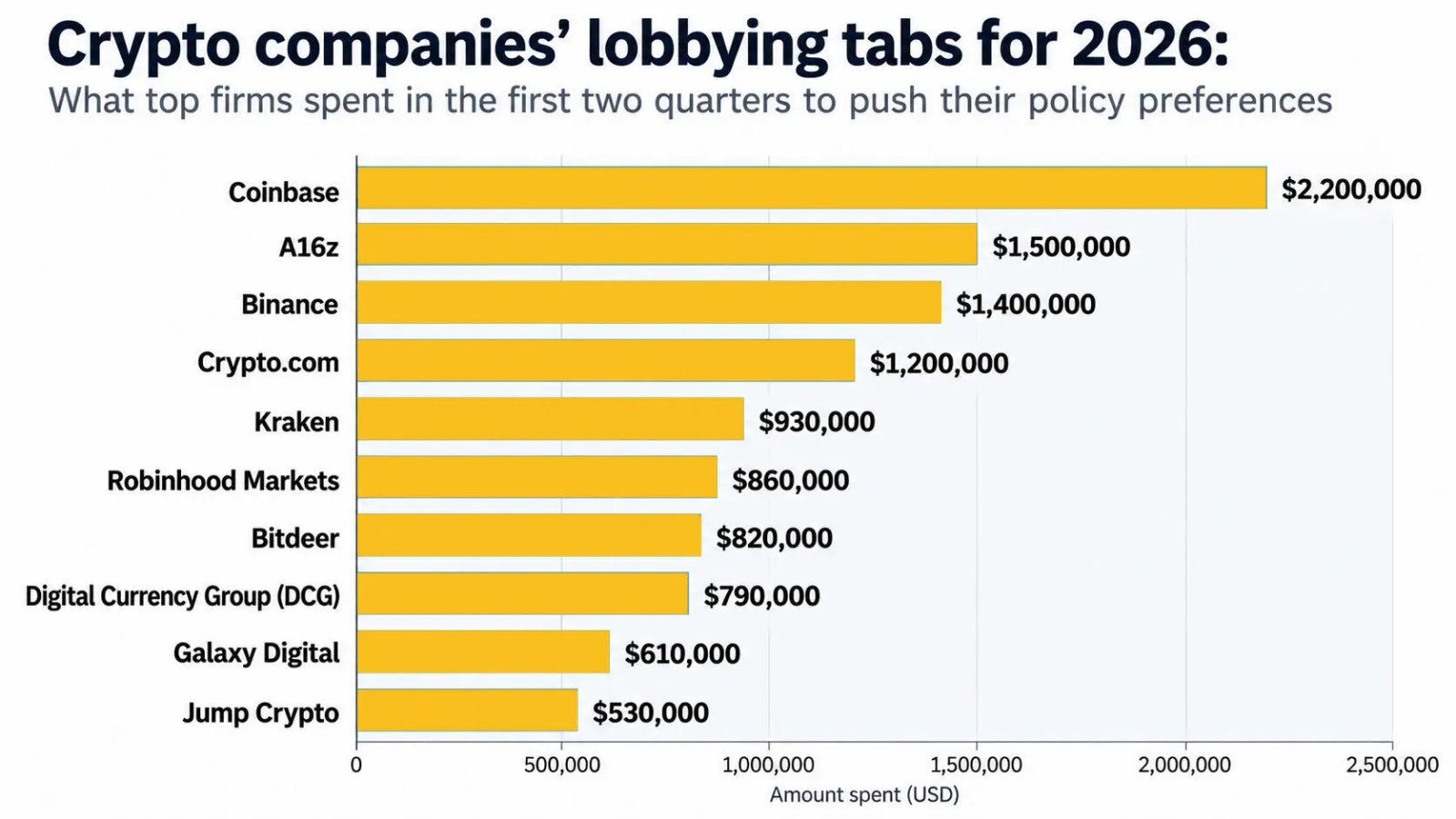
In its push for the Clarity Act, the industry spent about $2.4 million on guns for hire — the third-party lobbying firms that stalk the corridors of power full-time pushing whatever causes they're paid to represent. And its dollars supported another $2.1 million for captive lobbyists who work as employees of the trade associations. The rest of the $8 million funded crypto companies' own influence operations.
The lobbying efforts and goals aren't consistently described in filings, but disclosures reviewed by CoinDesk related to the $8 million legislative push made at least some mention of Congress' effort to enact a crypto oversight regime in the U.S. Some of the remaining $5.4 million the crypto sector spent on lobbying (for which disclosures didn't link explicitly to the Clarity Act) could actually have been devoted in part to that same cause, under vague descriptions like "issues relating to cryptocurrency" or "financial services." Some of the funds, though, were more clearly identified as going toward influencing tax legislation, digital mining issues or making the industry's case to the U.S. regulators who are writing crypto rules.
Know when your
coins move
Alerts, real-time prices, and market news — all in one app
4.8 based on 40K reviews in the App Store and Google Play
But lobbying isn't necessarily a binary proposition. While the industry failed to convince the U.S. Senate to pass the Clarity Act — and even the most optimistic are uncertain whether it can get another shot in the brief, end-of-the-year period known as the lame duck session — there are other points of progress to note.
The crypto industry's consolation for not getting a new crypto law: The legislation had never progressed this far before, and it could provide some foundation for the next effort, especially where it secured some hard-fought bipartisan agreement. Also, more lawmakers know a lot more about crypto now than they did last year.
The lobbying workload continues as the U.S. markets regulators make crypto policy moves, including proposing complex new regulations, and crypto lobbyists are in the agency's offices, just as they were with Senate meeting rooms during Clarity negotiations.
"Following this month's Senate vote on Clarity, we're taking stock of where things stand and making sure our time and resources line up with our members’ priorities," said Blockchain Association's Fraser, and a component of that will be "deepening our work with the SEC and CFTC."
As Coinbase's Krieger remarked, "Washington is a long game."
RegulationClarity ActCoinbase Latest Crypto News
- 1 Open USD takes on Tether, Circle with a different stablecoin model that's 'building money'1 hour ago
- 2 U.S. CFTC seeks event contract definitions that may defy states' gambling claims2 hours ago
- 3 Crypto Long & Short: What will the AI agents run on? 2 hours ago
- 4 Clock's ticking: UK's crypto regulatory application window opens with February deadline3 hours ago
- 5 Cardano tapped by Brazil’s state oil giant to track cleaner jet fuel and diesel4 hours ago
- 6 A stronger dollar is a weaker threat to bitcoin than traders think6 hours ago
- 7 Bitget hackers move $4 million into Zcash’s private pool, making funds harder to trace6 hours ago
- 8 The SEC Is finally modernizing transfer-agent rules. Wall Street must not repeat the ‘paperwork crisis’6 hours ago
- 9 OpenAI, Google and Meta pledge independent AI safety audits under voluntary White House deal6 hours ago
- 10 Metaplanet directors push back against shareholder fury over a controversial executive payout plan6 hours ago
 Latest Research
The Definitive Stablecoin Landscape Series: Asia Pacific

The Definitive Stablecoin Landscape Series: Asia Pacific
As stablecoins move into regulated finance, APAC is becoming a key proving ground. This report maps the region’s rules, use cases, and $RLUSD’s role.
By CoinDesk Research Sep 15, 2026 Commissioned byRippleAs stablecoins move into regulated finance, APAC is becoming a key proving ground. This report maps the region’s rules, use cases, and $RLUSD’s role.
Why it matters:
As stablecoins move into regulated finance, APAC is becoming a key proving ground. This report maps the region’s rules, use cases, and $RLUSD’s role.
View Full Report More From News Analysis
How months of work on the Clarity Act all fell apart
Crypto political group plans to spend $30 million against Sherrod Brown's Senate bid