Circle Internet Group’s [CRCL] stock price is playing catch-up. Investors are reassessing $USDC’s regulatory progress alongside rising competition and pressure on Circle’s distribution model.
Here’s what you need to know.
A recovery near the $65 level
At the time of writing, CRCL was at $65.68, having gained 3.89% for the session. However, 2026 hasn’t been kind to the stablecoin issuer.
The stock has fallen approx. 21% from earlier in the year, well below its March and May peaks above $130.
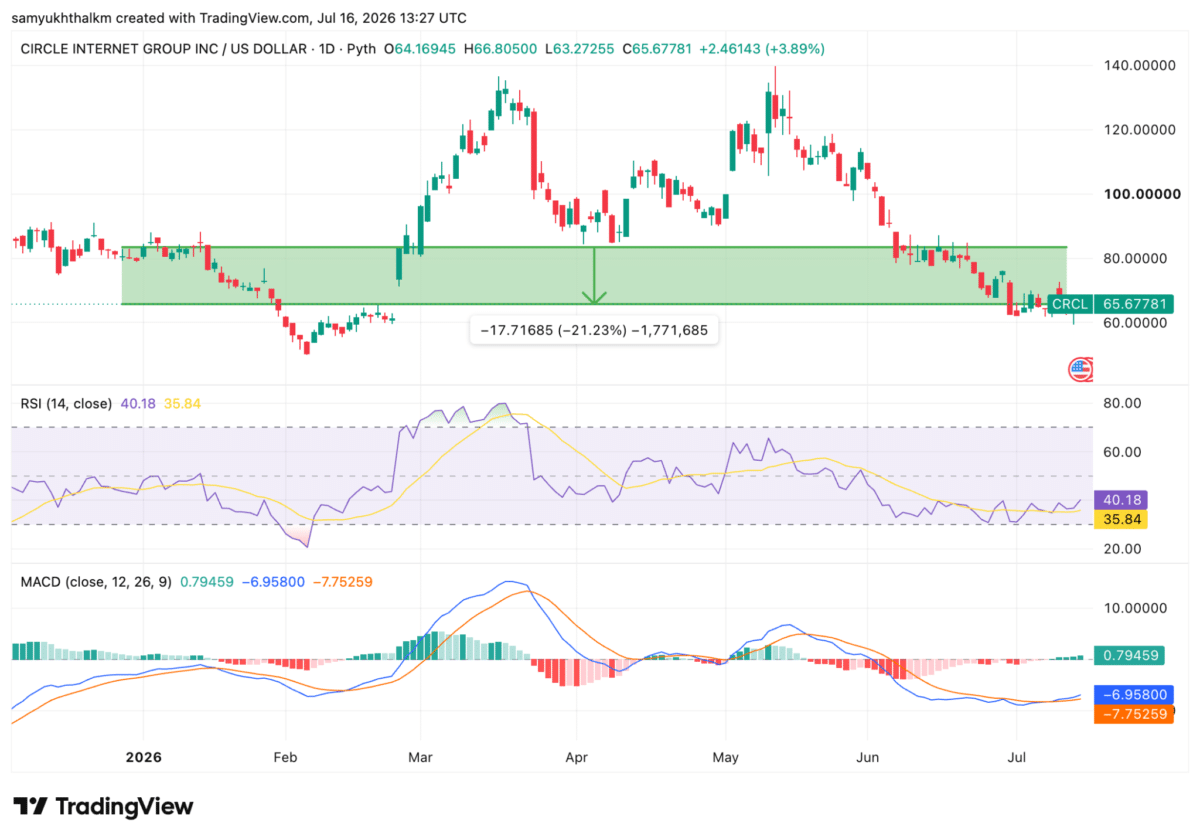
The price has been forming lower highs since May, so sellers are still in control. While CRCL is attempting to stabilize in the $60s range, there isn’t enough evidence to claim support.
There’s a modest improvement in pace though. The RSI was up from near-oversold territory, but still below the neutral level of 50. The MACD line has moved above its signal line, with a slightly positive histogram.
The fall downward is softening, even if MACD lines are below zero.
The pressure is on
This weakness comes after Mizuho’s recent price-target reduction from $85 to $50, and its assessment that Circle is set to ‘underperform.’
The main concern is Open USD, a stablecoin backed by more than 140 companies, including Coinbase, BlackRock, Mastercard, Stripe, and Visa.
Unlike Circle, which retains the yield generated by $USDC reserves, OUSD plans to share reserve income with partners. That could potentially push Circle to offer better economics to distributors and reduce its profitability.
Coinbase is particularly important because it is Circle’s largest $USDC distribution partner. With revenue-sharing negotiations approaching, OUSD may give Coinbase a bit of leverage.
Interestingly, Baird also reduced its CRCL target from $138 to $100, although they maintained an ‘outperform’ rating.
Looking ahead…
Bulls would be looking at Circle’s OCC approval for First National Digital Currency Bank, its strength in the stablecoin market and reported June volume of $1.21 trillion. August earnings and the Coinbase agreement could also boost things.
The bear case is that $USDC could lose market share while OUSD competes in fees and distribution costs. Circle is also dependent on interest earned from reserves, leaving revenue exposed to rate changes and market activity.
Final Summary
- CRCL has stabilized in the short term, but its broader trend remains under pressure.
- OUSD competition and Coinbase talks pose risks.