AI company CoreWeave has lost one-third of its value since the day it joined the Nasdaq 100 index, despite doubling revenue in the second quarter and boasting of $100 billion in backlogged revenue.
As common shareholders have suffered, insiders have been steadily selling.
Since Nasdaq 100 indexation became effective on June 22, 2026 and forced retirement savers to passively buy CoreWeave shares through hundreds of Nasdaq 100-linked funds around the world, executives and board members at the company have dumped over $600 million worth of stock.
- CEO Michael Intrator has liquidated over $320 million
- Co-founder Brannin McBee has sold $220 million
- Kristen McVeety, general counsel and corporate secretary, has sold over $22 million
- The company’s CSO, CFO, COO, and CAO have sold a combined $36 million
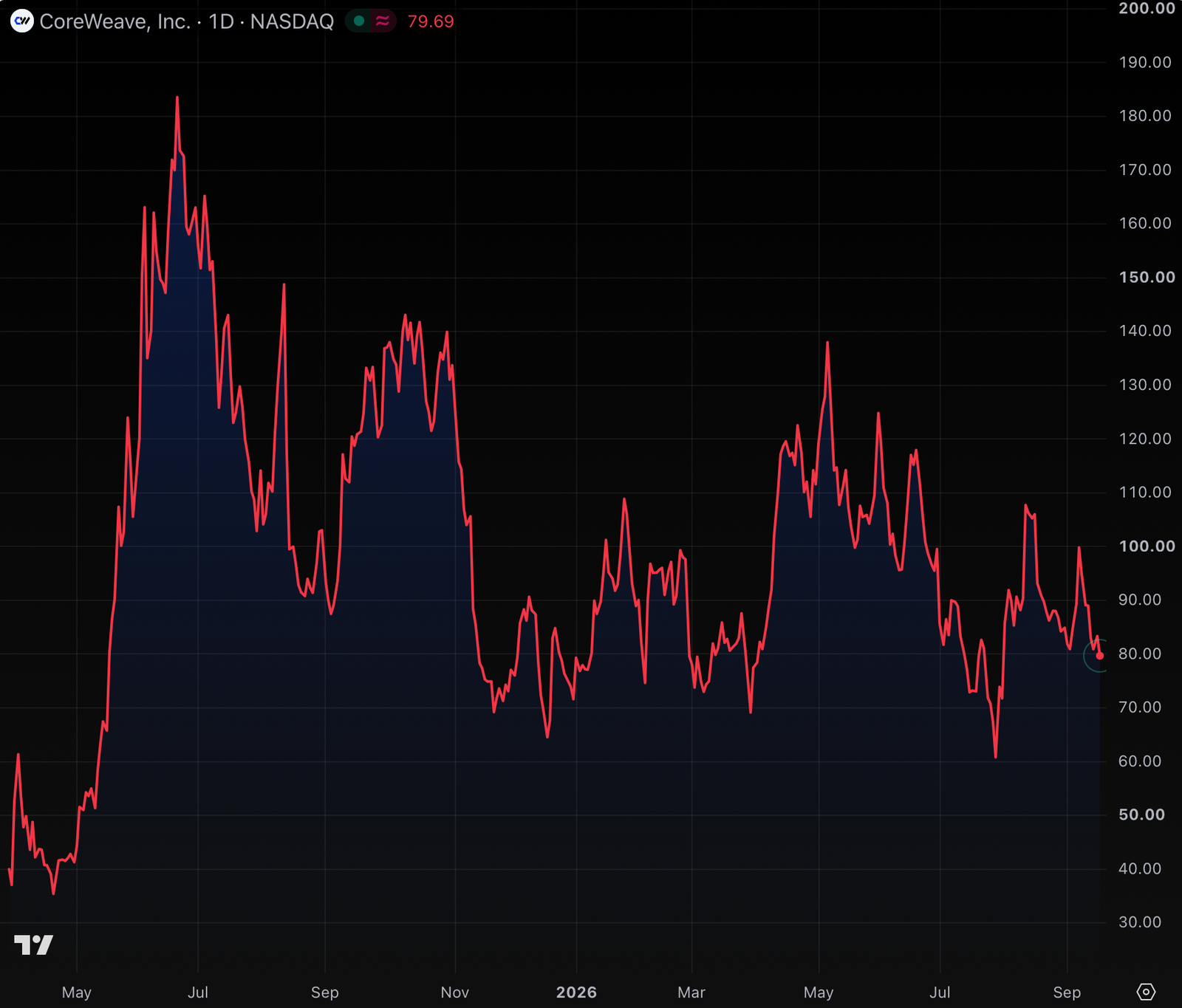
CoreWeave’s stock hit its all-time high of $187 on June 20, 2025, almost a year before it became a constituent of the Nasdaq 100. However, it’s been declining for 15 months, including double-digit losses for retirees who waited for Nasdaq committee members’ de facto blessing this summer.
Nasdaq announced its rebalance favoring CoreWeave on June 11, 2026, effective June 22. The stock opened that day above $119, yet it trades near $80 today.
Nasdaq 100 tapped CoreWeave to lose retirement savings
The company satisfied all of the technical criteria for entry, and seemed to be a decent choice from a fundamental perspective.
It claimed to have contracted revenue with a backlog reaching $104 billion, with billions of dollars in fresh commitments that have arrived since July.
With this seemingly enviable business, CoreWeave houses racks of Nvidia GPUs in leased data centers and sells computational capacity to Meta, OpenAI, and other AI labs.
There is just one problem. Nvidia’s chips lose value fast amid high heat operation and, more importantly, endless waves of new models from fabricators. CoreWeave must account for depreciation, which has a devastating drag on its profitability.
Leopold Aschenbrenner is back to losing money in AI stocks
Earnings before depreciation
In the second quarter alone, depreciation and amortization of its AI equipment exceeded $1.3 billion, a staggering 54% of revenue. Worse, the heavily indebted company had to pay interest on its debt pile of $640 million, up from $267 million a year earlier.
Those two accounting lines consumed more than three-quarters of every dollar the company generated.
The company is also spending far more than it generates. Full year capital expenditure guidance sits at $35-39 billion — far higher than CoreWeave’s revenue guidance of $12.4-13.2 billion.
In other words, the fast-growing, cutting-edge company plans to spend roughly $3 for every $1 it plans to earn.
Free cash flow in the second quarter came in at negative $5.7 billion.
CoreWeave’s buildout has been financed almost entirely with borrowed money. Total indebtedness grew from $7.9 billion to $21.4 billion by the end of 2025, and now exceeds $35.6 billion.
The business isn’t short of demand for its services. It seems to be short of a business that can transform that demand into profit faster than Nvidia’s chips lose value and its lenders collect interest.
As the stock has declined for over 15 months, the people running the company have kept selling.