
An artificial intelligence model has helped disprove a mathematical conjecture that had gone unsolved for 87 years, and the answer was confirmed within a day because anyone can now check it by hand.
Levent Alpöge, a number theorist who works at Anthropic and previously held a fellowship at Harvard, posted the result on X on Sunday night, crediting the company's Claude Fable 5 model.
The problem, called the Jacobian conjecture, had been open since 1939 and sits on mathematician Stephen Smale's influential list of unsolved problems for the century.
hello there the jacobian conjecture is false thanx to my close friend akhil for asking about it and my other close friend fable for working during the world cup final
— levent (@__alpoge__) July 20, 2026
((1+xy)^3 z + y^2 (1+xy) (4+3xy), y + 3 x (1+xy)^2 z + 3 x y^2 (4+3xy), 2 x - 3 x^2 y - x^3 z): \C^3\to \C^3,…
That an AI produced original mathematics of this difficulty is the kind of capability leap that now moves markets, crypto among them. Bitcoin has spent months trading on a narrative about artificial intelligence, moving with chipmakers and memory stocks rather than any catalyst of its own.
It fell hard last Friday when Chinese lab Moonshot AI released a model that rattled the semiconductor industry, and it recovered this week as those stocks bounced.
Part of that link is direct. Bitcoin's biggest holders, its miners, have rebuilt themselves into AI>
But the larger pull is simpler: AI is where the speculative money and investors’ attention are now going. The capital that once chased crypto is now chasing compute, chips and model builders, and every leap in what these systems can do widens that appeal.
Each result like Fable’s finding of the Jacobian conjecture strengthens the case for pouring capital into AI, and poses a difficult conundrum for crypto investors: Why hold a token that trades as a sidecar to the AI cycle when someone can own the vehicle itself?
AI’s capability curve is steep, and the steeper it gets, the more of the market's risk appetite it draws away from everything else, crypto included.
What the problem actually was
Think of a machine that takes two numbers and gives back two new numbers, using only adding and multiplying. The question, first asked in 1939, was whether the machine can always be run backward: given only its answer, can the original two numbers be recovered every time?
Mathematicians had a quick way to check whether a machine looked reversible. The Jacobian conjecture said that if a machine passed that check, it should always be reversible.
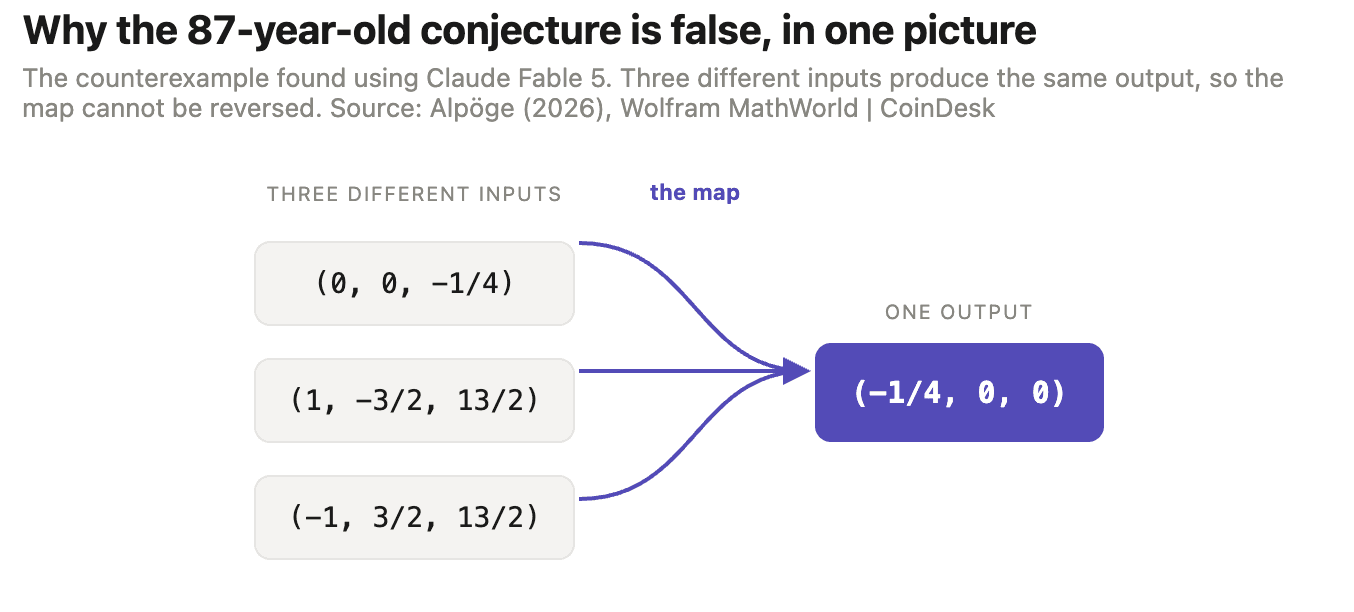
For 87 years, nobody could prove it was true, and nobody could find a machine that broke the rule.