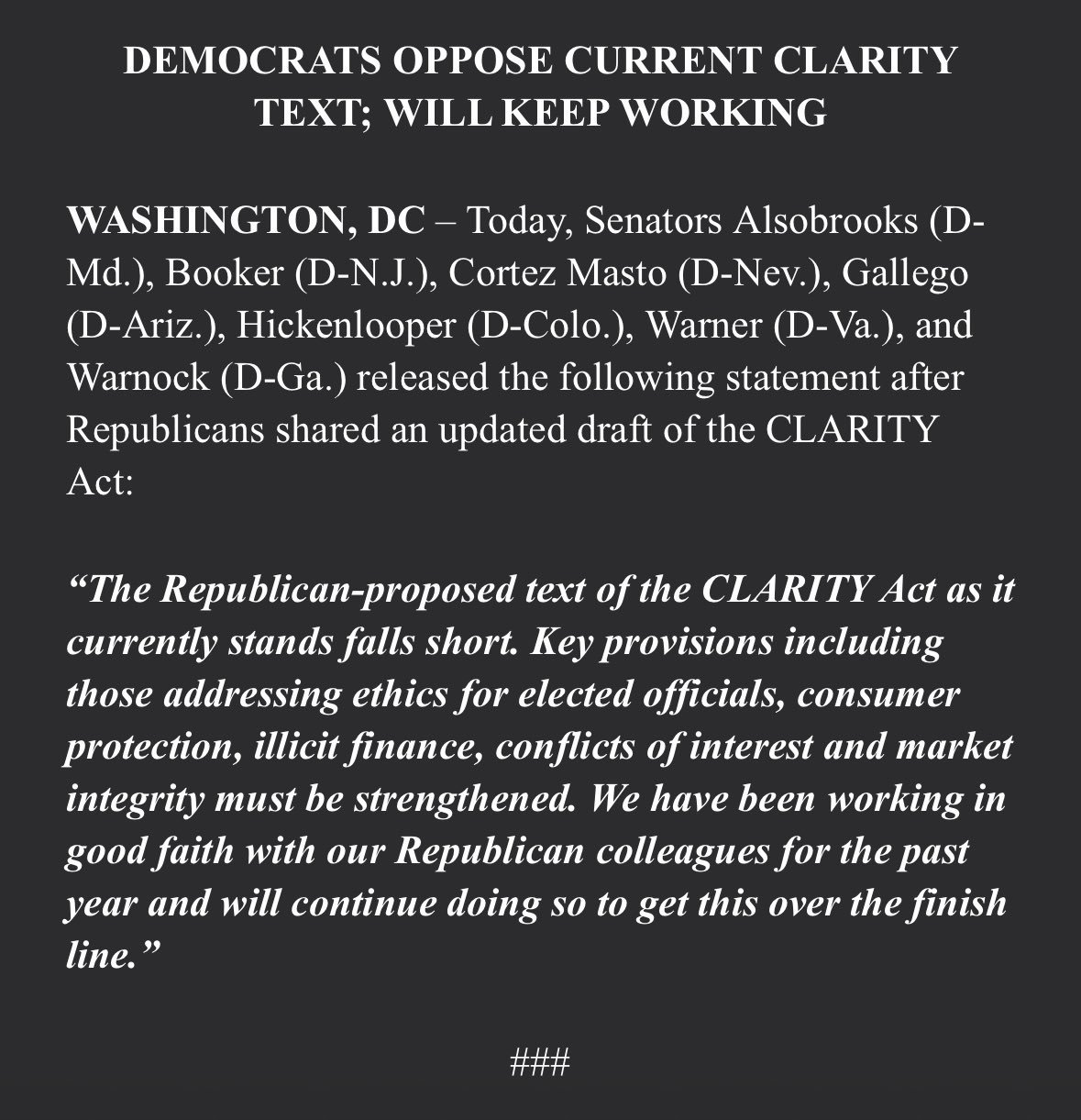
Seven Democratic Senators issued a joint statement on Tuesday afternoon opposing the current text of the CLARITY Act, the Senate’s crypto market structure bill, telling Republicans the draft falls short on key provisions including “ethics for elected officials, consumer protection, illicit finance, conflicts of interest and market integrity.”
The statement was signed by Sens. Angela Alsobrooks of Maryland, Cory Booker of New Jersey, Catherine Cortez Masto of Nevada, Ruben Gallego of Arizona, John Hickenlooper of Colorado, Mark Warner of Virginia, and Raphael Warnock of Georgia.
Republicans released a revised draft the same day that includes an ethics provision sunsetting in 2029, the Blockchain Regulatory Certainty Act, updated stablecoin provisions, and law enforcement measures.
The dispute on ethics is not new. Democrats have already voiced their doubts concerning a possible conflict of interest a year ago during Senate negotiations on the GENIUS Act stablecoin bill.
Key pro-crypto Democrats reject the current CLARITY draft
Gallego and Alsobrooks were the only two Democrats who voted to advance the CLARITY Act from the Senate Banking Committee in the 15-9 vote on May 14, 2026. Their signatures on today’s statement mean the pro-crypto center of the Senate Democratic caucus has moved into public opposition on the current text.
Without Gallego and Alsobrooks, Republicans would need to find eight Democratic votes elsewhere to reach the 60-vote threshold. That was already a difficult path with Senator Chris Murphy, Chris Van Hollen, and Jeff Merkley leading the ethics-focused opposition. It is now even tougher since Alsobrooks, Booker, Cortez Masto, Gallego, Hickenlooper, Warner, and Warnock have all decided to hold back their support.
As Cryptopolitan earlier reported, Sen. Gallego had already called Trump’s July 20 ethics language “very weak” within hours of its distribution to Senate Republicans. The ethics issue is tied directly to Trump’s crypto exposure. He recorded about $1.4 billion of income tied to crypto, $636 million of which was linked to his memecoin, and Democrats say that the current version of the CLARITY Act doesn’t do enough to address such conflicts.
Giancarlo says agencies can carry crypto policy without Congress
Roughly 30 minutes before the seven-Democrat statement dropped, former CFTC Chairman J. Christopher Giancarlo told Eleanor Terrett at The Tie Out East Summit that he sees a greater than 50% chance the CLARITY Act does not pass and added, “that’s okay.”
🚨NEW: Former @CFTC Chairman @giancarloMKTS told me he thinks there’s a greater than 50% chance the Clarity Act does not pass and “that’s okay.” He says innovation will continue under the regulatory frameworks put in place at the SEC and CFTC, and that a future hostile… pic.twitter.com/mww0WAyZJL
— Eleanor Terrett (@EleanorTerrett) July 22, 2026
Giancarlo, former chairman of the CFTC in the Trump administration, nicknamed “CryptoDad,” believes that the sector can continue to progress through the regulatory frameworks that are being put in place at the SEC and CFTC, regardless of the failure of Congress to pass the CLARITY Act.
He also argued that a future anti-crypto administration would struggle to reverse the progress made over the next two years. Giancarlo’s comments matter because they show how some pro-crypto Republicans are already thinking about a fallback plan if the Senate does not move.
As things stand now, the SEC/CFTC Interpretive Guidance of March 17, 2026, is still the primary framework of law at the federal level. Regulation Crypto is being drafted by Paul Atkins, the Chairman of the SEC, to be implemented in July 2026. Michael Selig, the Chairman of the CFTC, has used his emergency power in the Kalshi Michigan trade cancellation case.
Lummis backs ethics language as Democrats revolt
Trump agreed to updated ethics language on July 20, and Republicans distributed the text to Senate GOP members the same day. Sen. Cynthia Lummis publicly backed the agreement Wednesday on X and urged Congress to pass the CLARITY Act without further delay, saying it bans all federal officials including the president from issuing or sponsoring a digital asset for profit.
It's time to pass the Clarity Act 🇺🇲
After years of bipartisan work, the U.S. is closer than ever to establishing clear rules for the digital asset industry.
Regulatory clarity fosters innovation, protects consumers, & helps establish America as the crypto capital of the world. pic.twitter.com/bU4IeCpbPC
— Chainlink (@chainlink) July 22, 2026
The Democratic critique targets the same provision from the opposite angle: the ethics rule sunsets in 2029, the enforcement authority sits with the Department of Justice rather than state attorneys general, and both design choices make the constraint temporary and, in the Democrats’ framing, non-durable. Alsobrooks had already called the DOJ-only enforcement version “an unserious offer” in earlier negotiations.
Senate Majority Leader John Thune’s office said on Wednesday that Thune is still planning to move ahead with the bill in the coming days despite the pushback.
The August recess is roughly two weeks away. If the bill does not clear the Senate before then, it would likely slip into 2027, when midterm politics could make a bipartisan crypto deal harder to reach.
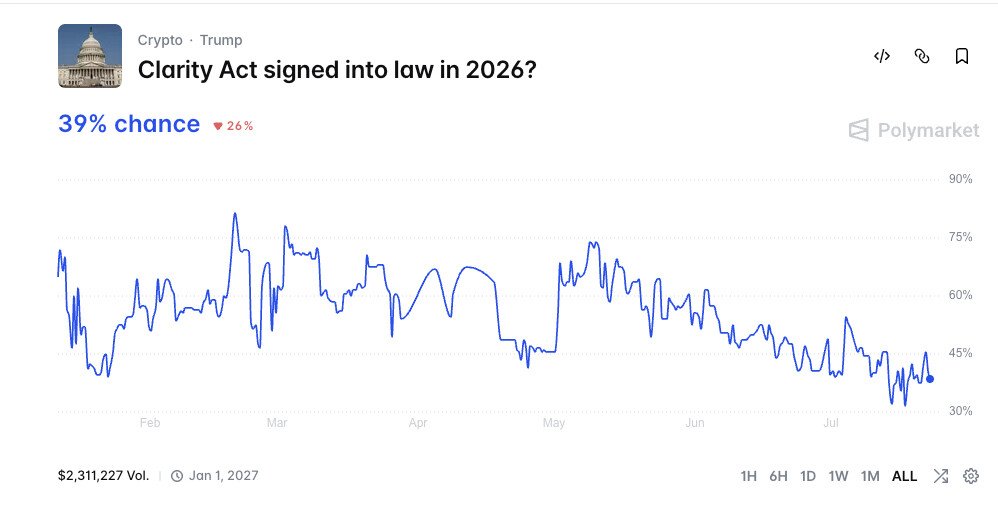
In the meantime, Polymarket’s contract on the CLARITY Act being signed into law in 2026 sat at 39% on Wednesday with $2.3 million in cumulative volume, off a February peak above 75% and continuing its slide from a mid-May reading of roughly 60%.