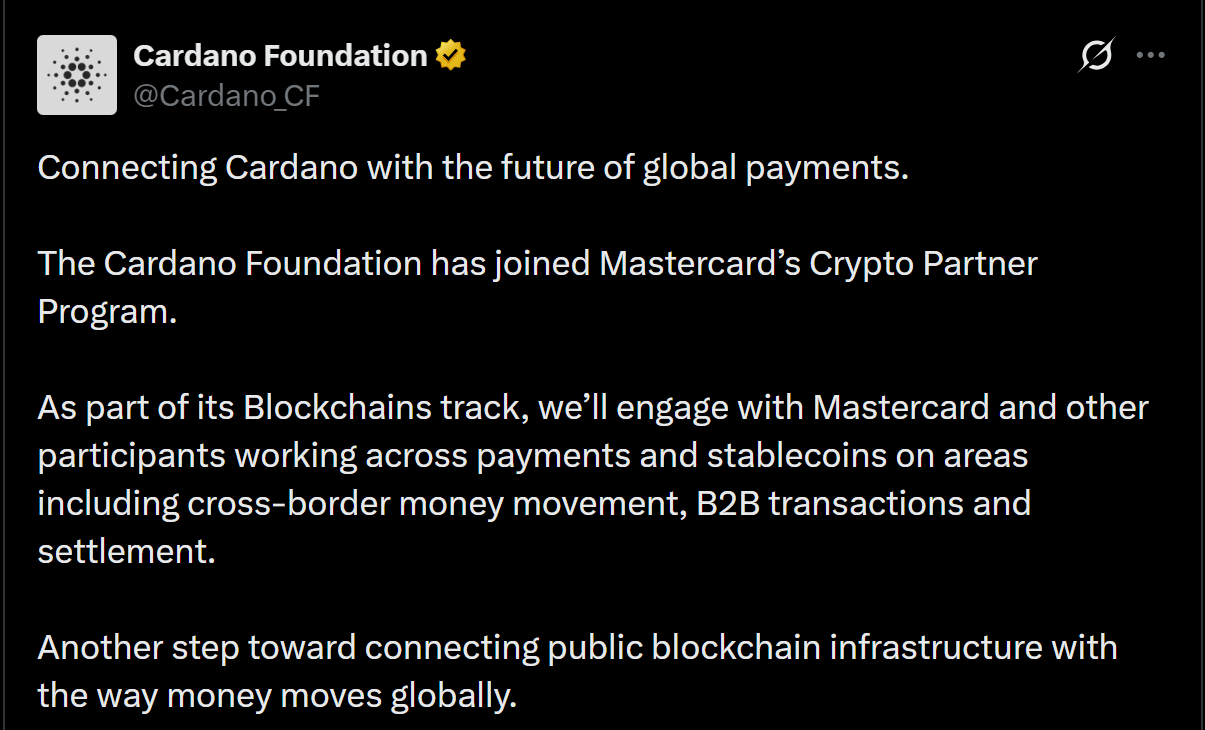
Cardano [$ADA] is getting closer to the traditional payment systems after forming a new partnership with Mastercard. Its Foundation has joined Mastercard’s Crypto Partner Program, placing it alongside firms exploring blockchain payment applications.
The terms of this agreement include developing and enhancing cross-border payments, business-to-business transactions, stablecoins, and settlement.
As a result, it provides Cardano a platform to work with well-established participants in the global payment space to determine how they can utilize Cardano’s network.
However, the move does not suggest that Mastercard is using Cardano as a direct component of their payment platform. Instead, it suggests there will be avenues for collaboration and potential future use cases and additional uses in the future.
If those discussions lead to actual payment applications, then Cardano would have gained some level of institutional recognition. Until that point, however, this represents opportunities, not an established relationship.
Cardano’s stablecoin base faces a key test
Cardano’s next challenge is building enough stablecoin liquidity for real payment use. Its stablecoin market holds about $60 million. However, at least $43 million of this is comprised of USDCx.
This means that USDCx accounts for over 70% of the total dollar-denominated assets available to users of the Cardano network.
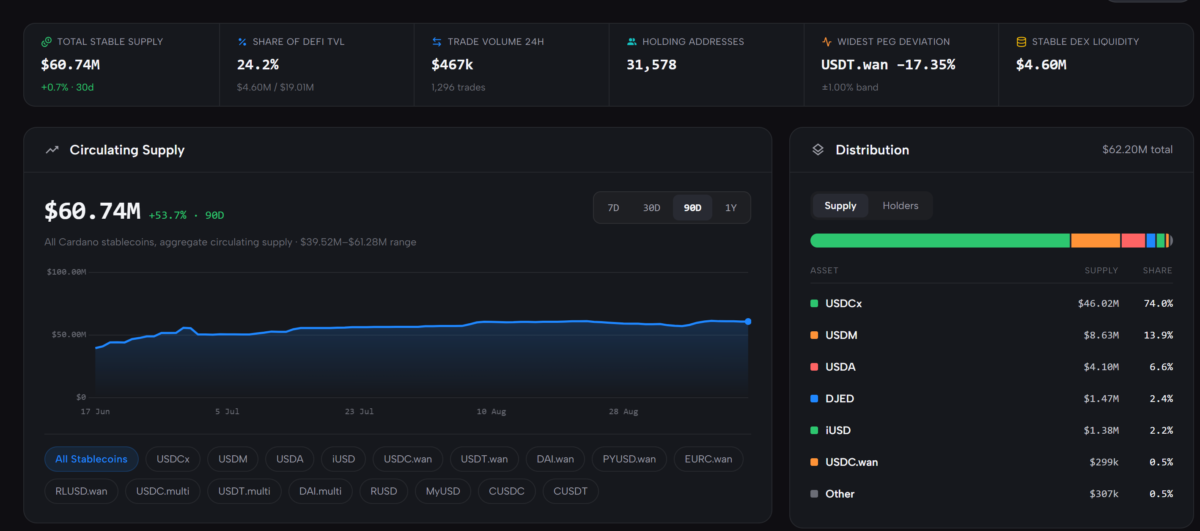
Still, the majority of the activity is coming from DeFi applications, rather than being used for real-world payments. This matters because Mastercard’s program targets cross-border transfers, B2B payments, and settlement.
Despite Cardano offering low fees, the current lack of liquidity limits the ability to process larger amounts of flow through its rails. As such, an increase in USDCx in circulation, active user wallets, and overall transfer volumes will demonstrate stronger payment demand.
Growth in these areas could turn Cardano’s payment potential into real-world use.
Can Cardano scale for global payments?
The potential to use Cardano for this payment option will be tested through a user adoption process. According to Token Terminal data, daily active users sit near 10,000.
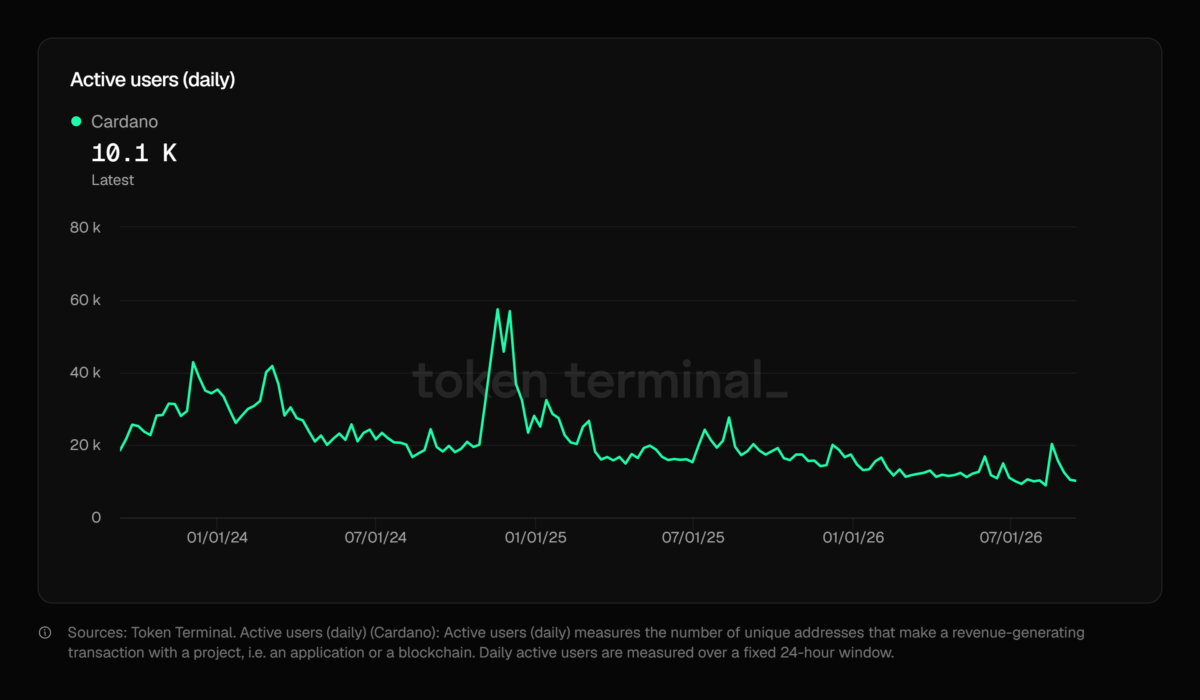
The number of monthly active accounts reached 323,600, indicating the large majority of users have access to the account and can continue to interact with it even though they do not make transactions each day.
As well, Cardano has very low transaction fees at an average cost of $0.06, which supports making small, high-volume cross-border transfers on the network.
However, the bigger issue is whether users are actually using stablecoins for payments. If daily activity remains low, its payment capacity could remain largely theoretical.
Rising stablecoin transfers, payment wallets, and transaction frequency would instead show growing demand and give Mastercard’s partnership real practical significance.
Final Summary
- Cardano gains a new route into institutional payments through Mastercard’s Crypto Partner Program.
- Still, $ADA needs deeper stablecoin liquidity and payment activity to turn the partnership into real-world adoption.