Japan’s central bank held interest rates steady at 1.0% on Friday after a reported major intervention in the yen.
Key points:
- Japan holds interest rates at 1.0%, following market expectations.
- Both Japan and South Korea’s central banks reportedly engage in currency interventions, as the JPY briefly gains 3.5% overnight.
- Bank of Japan warns of incoming CPI inflation headwinds in the second half of the year.
Yen rises up to 3.5% as Korea joins intervention
In its latest statement, the Bank of Japan (BoJ) revealed broad consensus among officials for holding rates at current levels — an outcome that markets had anticipated in advance.
“The Bank will encourage the uncollateralized overnight call rate to remain at around 1.0 percent,” it confirmed.
Eight out of nine members of the bank’s Policy Board voted for the outcome, with only Hajime Takata proposing a 0.25% rate hike.
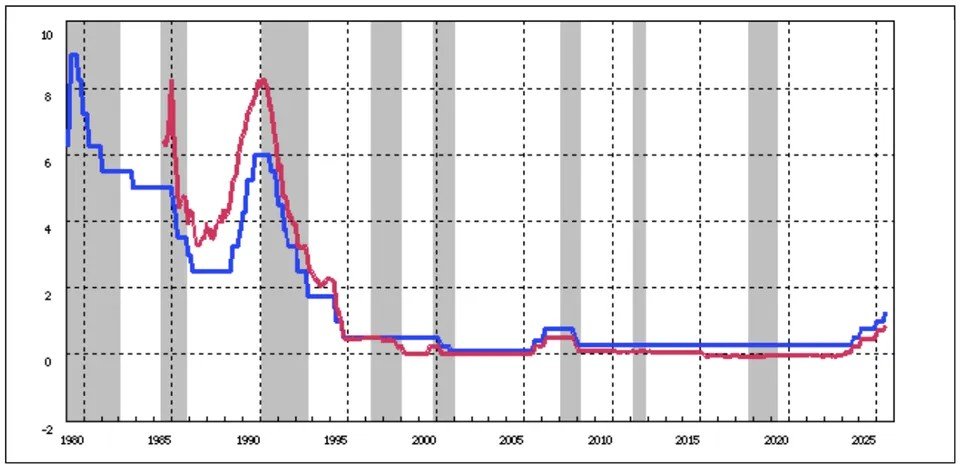
Japan benchmark interest rate (screenshot). Source: BoJ
Japan’s benchmark rate remains at its highest levels since 1995, with the BoJ meeting result coming just hours after the yen saw snap volatility. Against the US dollar, the currency rose by as much as 3.5% on Thursday, per data from TradingView, in a move that has widely been attributed to central bank intervention
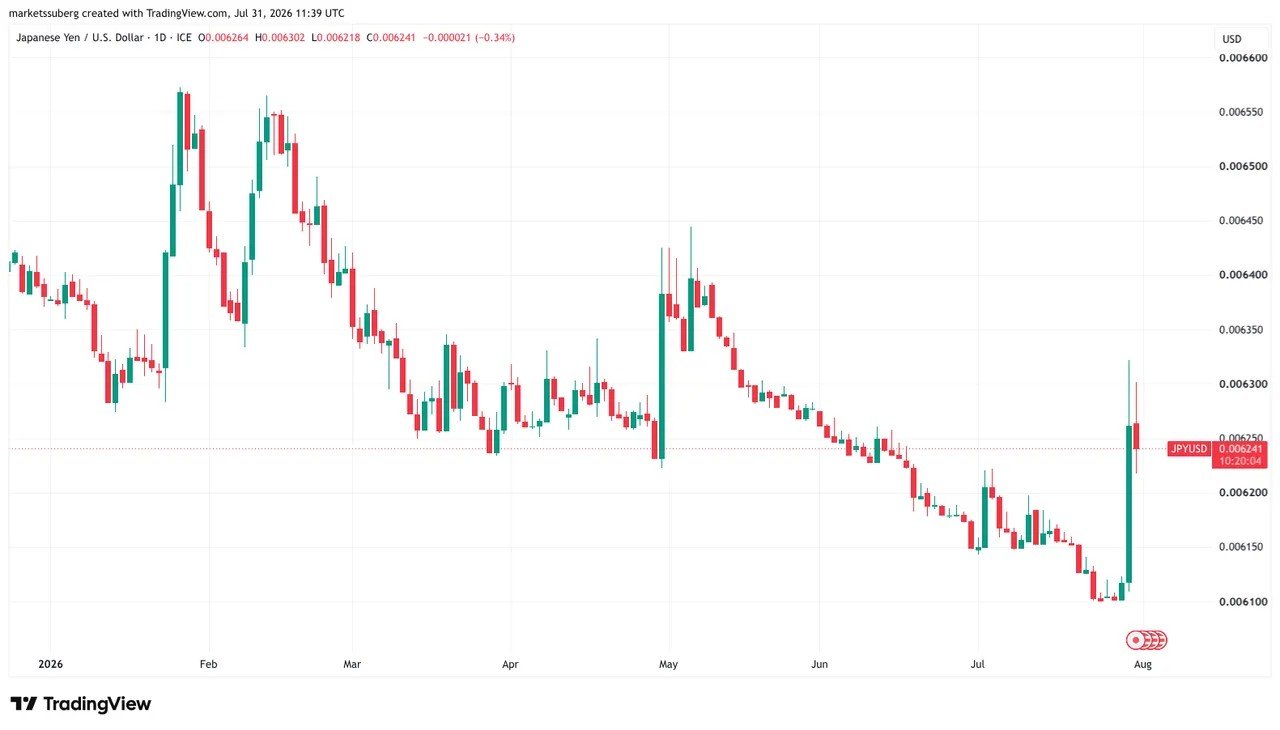
JPY/USD one-day chart. Source: Cointelegraph/TradingView
The BoJ did not officially comment on the latest moves, which coincided with a significant rebound in the South Korean stock market after days of heavy selling concentrated on semiconductor stocks. The Korean won was up by around 1% at the time of writing amid reports of a joint intervention between the BoJ and Korea’s central bank. Analysts referenced “tightly aligned” mutual interests of the two countries as facilitating the joint move.
“The interests of each country aligned. For Korea-Japan cooperation, the won and the yen are so tightly coupled that a joint intervention could double the impact,” Lee Min-hyuk, an analyst at KB Kookmin Bank, commented to local media outlet Straits Times.
The Nikkei newspaper earlier noted that the US had engaged in rate checks — a form of soft intervention which can precede a more pronounced operation — during Thursday’s trading session, resulting in speculation over a three-way coordinated move.
“The key signal from last night’s move is that MOF remains uncomfortable with excessive yen weakness. The line in the sand is probably better viewed as a zone around 162-165 rather than a specific level,” Masahiko Loo, senior fixed income strategist at asset manager State Street Investment Management, told CNBC.
BoJ sees CPI inflation headwinds increasing in 2026
As the yen came off its highest levels against the dollar since 1986, the BoJ warned of future upside in the Consumer Price Index (CPI) inflation.
Related: Rate path still divides investors: Five things to know in Bitcoin this week
“The year-on-year rate of increase in the consumer price index [...] is likely to accelerate to a level clearly above 2 percent from the second half of fiscal 2026,” it stated in its latest quarterly Outlook for Economic Activity and Prices report.
In addition to rising prices of durable goods, the report referenced “waning of the effects of high crude oil prices” due to the ongoing US-Iran war and closure of the Strait of Hormuz oil-transit route.
Gyrations in the yen have remained an important consideration in crypto trading circles ever since the “unwinding” of the yen carry trade sparked major Bitcoin and altcoin downside pressure in August 2024.
Earlier this year, Arthur Hayes, former CEO of crypto exchange BitMEX, suggested that the combination of a weak yen and rising Japanese bond yields may cause investors to move away from low-yielding US bond allocations. He linked central bank liquidity interventions to positive moves in crypto markets.
“This discussion of Japanese financial markets is important because for Bitcoin to exit its sideways funk, it needs a healthy dose of money printing,” he wrote in a blog post.
In December 2025, Hayes predicted that USD/JPY could rise as high as 200.