
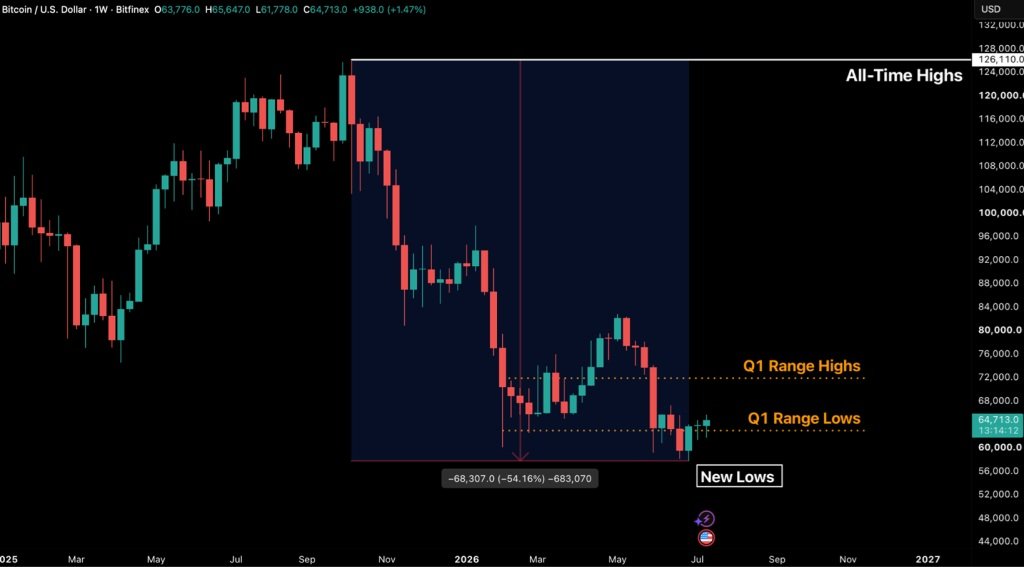
- Bitfinex reports that Bitcoin closed three consecutive weeks in the green and is consolidating support above $61,360, with a key resistance level at $68,000.
- Flows into U.S. spot bitcoin ETFs have stabilized, though demand is concentrated almost exclusively in BlackRock’s IBIT fund.
- U.S. inflation fell in June for the first time in six years, but underlying pressures keep the Fed in an extended pause.
Bitfinex published its weekly executive summary on market conditions for bitcoin, identifying a constructive but fragile scenario. According to the report, BTC recorded its third consecutive positive weekly close and continued consolidating a base above the demand zone located at $61,360.
However, Bitfinex warns that the next decisive test is approaching: the short-term holders’ cost basis and other key resistance levels have converged near $68,000, forming a threshold that the market will need to break through convincingly to reinforce the narrative of a recovery path.
A sustained move above that range, backed by genuine demand in the spot market, would strengthen the bullish case. A potential rejection at that level, on the other hand, could expose Bitcoin to a fresh test of its recent lows.
Bitcoin ETFs Have Stabilized
On the institutional side, flows into spot bitcoin ETFs in the United States have stabilized after a period of persistent redemptions, though demand continues to flow mostly into BlackRock’s IBIT fund rather than being distributed evenly across the available vehicles.
The Bitfinex report also highlights that bitcoin’s growing dominance in trading volume reflects a defensive rotation away from altcoins among large capital players, but does not yet represent a broadly widespread risk-on sentiment.
Bitfinex Turns Its Eye to Macro Conditions
The macroeconomic backdrop offers some support, though, according to Bitfinex, it is not linear. Consumer prices in the United States fell in June for the first time in six years, driven primarily by declining energy costs. However, producer price and import data showed upward pressure stemming from artificial intelligence infrastructure, defense spending, and tariffs, particularly in computing equipment and capital goods.

These factors weigh on the market and leave the Federal Reserve with no room to declare victory over inflation nor to tighten monetary policy without causing further damage. The real estate sector is already feeling that deterioration: elevated mortgage rates, weak builder confidence, declining permits, and high inventory all point to a deep slowdown.
Private consumption, by contrast, shows some resilience, and business investment helped sustain second-quarter growth estimates near 2.5%. For bitcoin, the Fed’s paralysis represents a potential tailwind, though rising real yields and pressure on energy prices are the most concrete headwinds on the horizon.