Over the past 18 months, the vast majority of publicly traded companies that pivoted to a $BTC treasury strategy have lost money since their initial purchase announcement.
Globally, nearly 200 public companies hold $BTC, according to monitoring service Bitcoin Treasuries, although most have small market capitalizations.
Many adopted their digital asset treasury DAT during a brief mania in the summer of 2025.
By late July 2025, every new $BTC treasury stock was trading below its highest price of the year, and the median drawdown was -52%. Things have only deteriorated since.
Many stocks have now declined more than 90% to date, and some are even delisted from trading entirely.
Even Protos’ generous analysis below, charting the 20 largest $BTC treasury stocks which have disproportionate positive performance among their far more numerous peers, shows 12 losses.
The top 20 bitcoin treasury stocks since March 2025
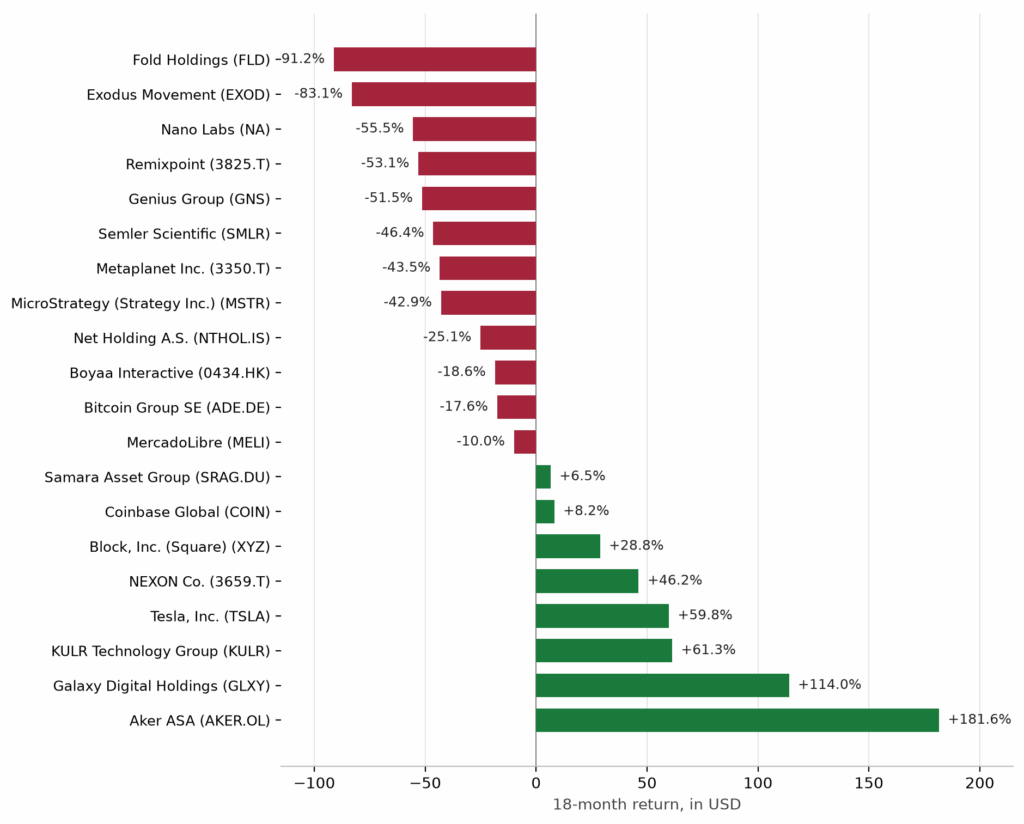
Relative to 18 months ago, the majority of non-mining $BTC treasury stocks have negative returns. Mining stocks are excluded here due to their continuous acquisition of $BTC through energy-intensive operations and consistent sales of $BTC to pay for their power, infrastructure, and personnel.
The price of $BTC itself is roughly flat, up less than 3% over the same time span, which allows the chart to speak for itself.
The median 18-month return of this cohort of 20 stocks is roughly -18%.
Five of the 20 have lost more than half their starting value, including several nearly “pure play” $BTC treasuries like Remixpoint and Genius Group that planned minimal business operations aside from $BTC acquisition during their initial optimism.
If someone had invested an equal amount of money into all 20 stocks 18 months ago, their portfolio would be worth less than its starting value today.
Pure play $BTC treasuries
Worse, the returns would be even more negative for pure play $BTC stocks, given that the best performers of the cohort — Tesla (+59.8%), Galaxy Digital (+114%), and Norwegian industrial conglomerate Aker (+181%) — have diversified business operations that aided their outperformance for reasons unrelated to $BTC.
As a general rule, the more the company-focused on $BTC, the worse the stock performed.
Heavily $BTC-focused companies like Fold Holdings lost 91% since March 2025, Exodus Movement lost 83%, and Strategy, Semler, Metaplanet, Remixpoint, and Genius Group each lost more than 40%.
Even Michael Saylor’s $85 billion Strategy, the market leader, has shed half of its common stock price over the past year.
The biggest winner over the past 18 months, Aker ASA, is up 182% despite its $BTC unit, Seetee, holding just 0.4% of Aker’s total assets.
Bitcoin treasury Nakamoto down 98% — still pays David Bailey lavishly
Recalculating since initial announcement is (slightly) better
When Protos zoomed out to personalize the returns according to the date each of the 20 companies initially announced their first $BTC buy, the picture tilted slightly more positive.
MicroStrategy (now Strategy) started the trend six years ago on August 11, 2020, with a $250 million $BTC purchase.
Its common stock hit a split-adjusted high of $14.54 that day, and is up over 1,000% since, the group’s largest winner.
Boyaa Interactive disclosed its first 1,100-$BTC purchase on January 26, 2024, and its stock up 456% in dollar terms since.
Over in Japan, hotel operator Metaplanet approved a $BTC pivot in April 2024, and its stock is up 476% in dollar terms since.
Of the 20 largest stocks, the post-announcement math splits almost evenly once currencies are converted. Exactly half of the 20 stocks have positive returns, and the median return is -15% across the cohort.
In summary, buying $BTC with borrowed money and hoping the stock market would bid up the stock price has not proven to be a reliable strategy.
Although early rallies from Strategy and Metaplanet proved that there’s some speculative interest, most imitators have not been able to replicate their performances.
Protos has previously found that most new 2025 $BTC treasury stocks were already down at least 50% within a few weeks of their initial announcements. The premium investors pay for these stocks has continued to fall over the past 18 months.