
When a Bitcoin treasury trades for less than the Bitcoin it holds, the cheapest way to increase gross Bitcoin exposure per share may be to buy back its own stock.
UK-listed B HODL Plc tested that inversion during its first week of repurchases. It paid about £37,985 before fees to retire 823,400 shares, generating about 24% more gross sats-per-share accretion per pound than using the same cash to buy Bitcoin at the comparison price.
That 24% edge is before fees, and the numbers stop short of showing a full NAV-per-share gain.
B HODL's official dashboard on July 19 showed 166.487 $BTC, a 5.25 pence share price and a £7.385 million market capitalization. At the displayed Bitcoin price of £48,237, the holdings were worth about £8.031 million, leaving a roughly £646,000 gap.
Applying the latest announced post-cancellation share count at the same stock price puts the equity value at about £7.378 million, roughly £652,000 or 8.1% below the Bitcoin value. Both sides of the comparison move continuously.
Why buying shares beat buying Bitcoin
B HODL's £100,000 buyback authorization took effect July 9. Disclosures covering purchases on July 9, July 10, July 13, July 15, and July 16 total 823,400 shares at a calculated weighted average of 4.613 pence. The purchases used about 38% of the authorization before fees.
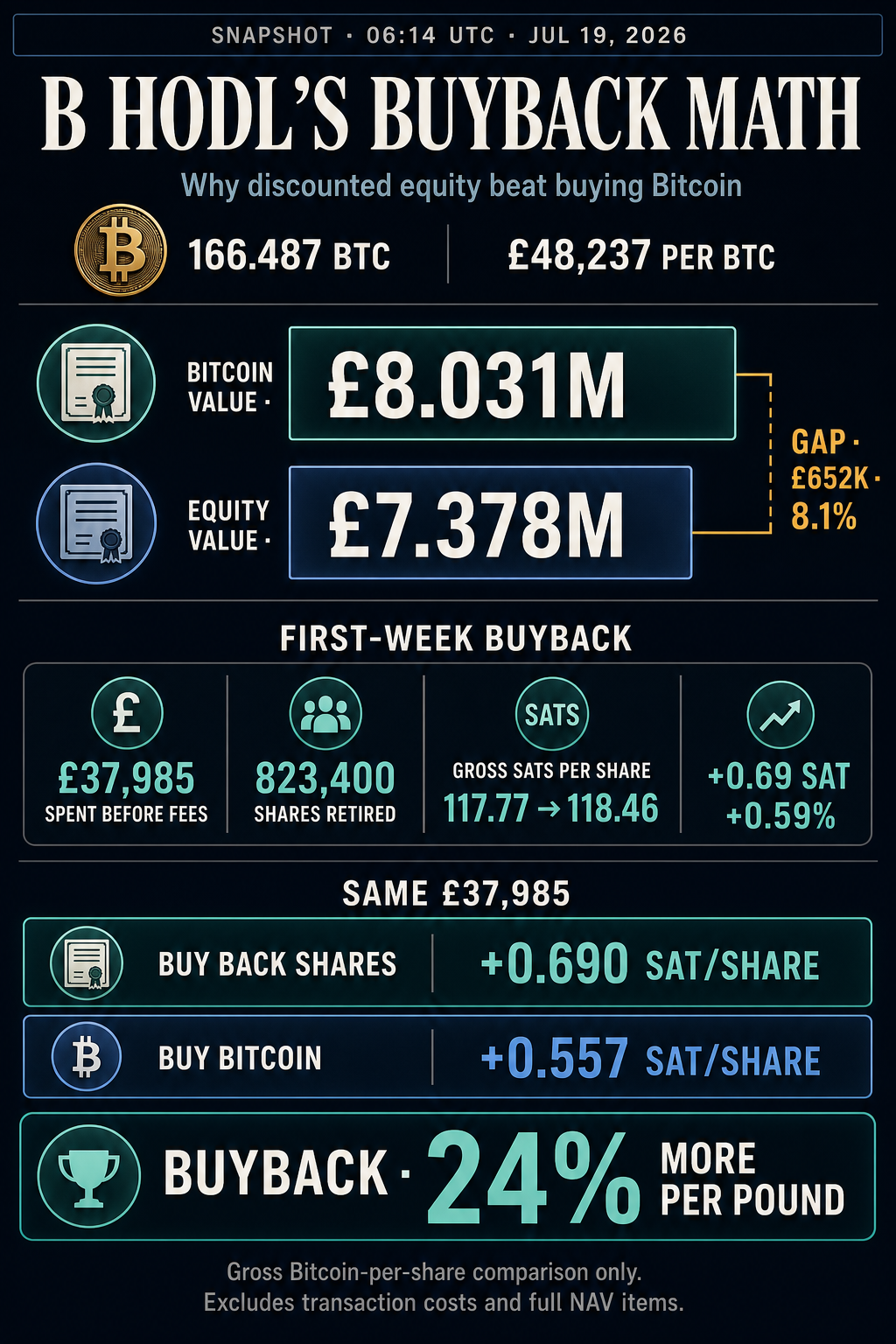
After the announced cancellations, the share count falls from 141,366,091 to 140,542,691. Holding 166.487 $BTC constant, gross Bitcoin per share rises from 117.77 to 118.46 sats, an increase of 0.69 sat or 0.59%.
At the same £48,237 Bitcoin price, £37,985 would buy about 0.787 $BTC. Spreading that purchase across the original share count would add about 0.557 sat per share, compared with the buyback's 0.690-sat lift. On those matched assumptions, retiring the equity was about 24% more accretive per pound.
Why B HODL can buy and sell its stock
B HODL is keeping its at-the-market issuance program open alongside the buyback. Its ATM permits share sales only when they are accretive under the company's Bitcoin-mNAV framework.
Together, the tools create a capital-allocation switch: issue equity when doing so can increase Bitcoin per share, then retire equity when the shares themselves offer cheaper Bitcoin exposure.
Still, a market capitalization below gross Bitcoin holdings is not the same as a discount to full NAV. Full NAV also depends on cash, liabilities, operating assets, costs, and the value of B HODL's Lightning Network business.
The company's latest interim balance sheet is historical, so the first week demonstrates gross sats-per-share accretion under the stated assumptions, not current NAV-per-share accretion.
For other Bitcoin treasuries trading below their per-share $BTC value, the implication is conditional but clear.
Issuing more discounted stock can dilute Bitcoin exposure, while repurchasing it can outperform a direct $BTC purchase.
Whether that is the right move still depends on cash runway, debt, trading liquidity and operating needs, a discipline increasingly shaping the broader treasury sector.