Bitcoin
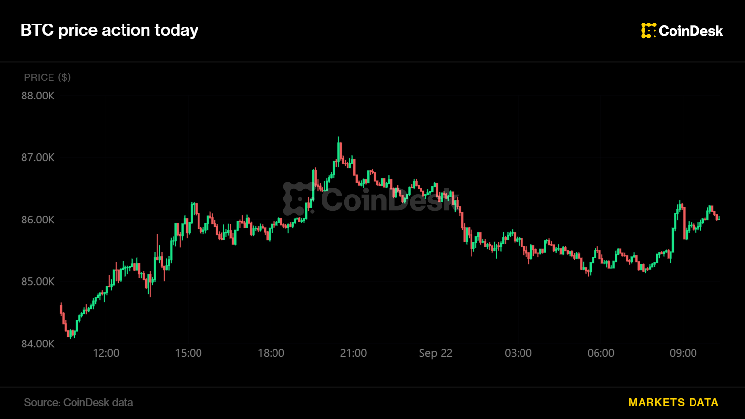
$BTC$85,927.41 remains in the hunt for further gains as falling oil prices join a growing list of tailwinds supporting the cryptocurrency.The largest cryptocurrency recently traded near $86,000 after recovering from Asian-session lows of around $85,000. Prices convincingly broke above the May high on Monday, reinforcing the bullish trend. The CoinDesk 20 Index (CD20) rose 2.2% over 24 hours.
U.S.-listed spot bitcoin ETFs attracted nearly $1 billion in inflows on Monday, their largest single-day haul since October last year.
WTI crude futures fell more than 2% to below $90 a barrel, extending their retreat from a recent high of $106. The decline followed a Kyodo report that Iran was willing to reopen the Strait of Hormuz within seven days if the U.S. eased its blockade.
Lower oil prices could help ease inflationary pressures and weaken the case for additional Federal Reserve interest-rate increases in the coming months.
“The crypto market gained ground against the backdrop of a sharp rise in the Nasdaq index. Falling oil prices and US government bond yields, rising global stock markets and optimism regarding US-China negotiations supported risk appetite,” Alex Kuptsikevich, chief market analyst at The FxPro said in an email.
The broader cryptocurrency market also remained buoyant, with smaller tokens posting strong gains as bitcoin paused. PEPE, $DOGE and SHIB are among the 10 best-performing cryptocurrencies over the past 24 hours. Sharp rallies in memecoins are often viewed as a sign of heightened speculative appetite.
Derivatives positioning
- Futures volume outpaces open interest: Total crypto futures volume jumped 38% to $292 billion in the past 24 hours, while open interest (OI) rose just 1% to $157 billion, pushing the volume-to-OI ratio to nearly 2. Combined with $768 million in liquidations, mostly shorts, this suggests a short squeeze rather than fresh, conviction-driven positioning.
- $BTC open interest inches higher: Bitcoin's futures OI is climbing alongside the price rally, hinting at a build-up of long positions. The tally stands at 716,000 $BTC, the most since Aug. 25, though it remains well below the roughly 750,000 $BTC average seen from April to July.
- $ETH and $SOL traders stay leverage-shy: Ether has outperformed bitcoin this quarter, yet its futures OI remains in a downtrend that began in May, a sign traders remain averse to leverage. The same is true for $SOL.
- $XRP sees a leverage jump too: $XRP's OI rose to 2.46 billion tokens from 2.2 billion in 24 hours, a build-up similar in direction to bitcoin's, though on a smaller base.
- Whale bias diverges by asset: Coinglass data show the 24-hour whale bias is bearish on $XRP, $DOGE and gold, extremely bullish on $BTC and bullish on $ETH and $SOL. That split helps explain bitcoin's outperformance versus $XRP, $DOGE and gold over the period, though whale positioning is only one input among several driving price.
- Cumulative volume delta stays negative across majors: $BTC, $ETH, $XRP and $SOL each carry a negative 24-hour OI-adjusted cumulative volume delta (CVD), meaning aggressive sell-side taker flow in futures has outpaced aggressive buy-side flow even as prices rose. That’s also true for most of the major cryptocurrencies, with TRX among the exceptions. That is consistent with the earlier point that this move looks more like short-covering pushing prices higher rather than a build-up of fresh, conviction-driven long positioning. Note, however, that CVD is a noisy, exchange-dependent metric and shouldn't be read in isolation.
- Dogecoin's leverage build stands out: $DOGE's OI surged 10% in a day, the biggest jump among the top-10 coins. That’s worth watching because a consistent rise in meme-token leverage often signals speculative fervor, a pattern that has historically appeared near interim market tops.
- Volatility gauges stay contained: Despite the pace of $BTC and $ETH's rally, the 30-day annualized implied volatility indexes, BVIV and EVIV, are still trading within recent ranges and remain well short of the peaks hit in February and early June, suggesting traders see current conditions as orderly.
- Volatility curve flattens as correlation flips positive: According to Laser Digital, the options-based volatility curve has been flattening since last week as realized volatility picked up and spot-vol correlation turned firmly positive.
- Risk reversals swing toward calls, then ease: Deribit's front-end risk reversals flipped strongly in favor of $BTC and $ETH calls late Monday as bitcoin’s price topped $85,000, though the call bias has weakened somewhat since. Calls offer upside exposure in the underlying asset; puts protect against declines.
- Most active options trades target higher strikes: The busiest $BTC options bets of the past 24 hours were calls at the $95,000 and $90,000 strikes, alongside $ETH calls spanning $2,500 to $3,000.