One of the crypto market's most paradoxical yet persistent signals has just flashed again. Bitcoin rose by nearly $2,500 only a few days after longtime CNBC Mad Money host Jim Cramer announced that he was completely exiting the asset because of the so-called quantum threat.
While Cramer was protecting his capital, Bitcoin rebounded from a local bottom at $62,200, moved higher and reclaimed the psychologically important $65,000 level. On social media and in trading chats, the move has already been described as another triumph of the "Inverse Cramer" strategy.
Jim Cramer gets scared of supercomputers
Cramer's radical decision was prompted by an interview with IBM CEO Arvind Krishna, who casually remarked that, within three to four years, advances in quantum computing could become a real threat to existing encryption methods.
The television host took the comment as a call to action. Citing CoinDesk sources, media reports said that Cramer had liquidated all of his BTC holdings, deciding not to wait for quantum processors to crack the blockchain.
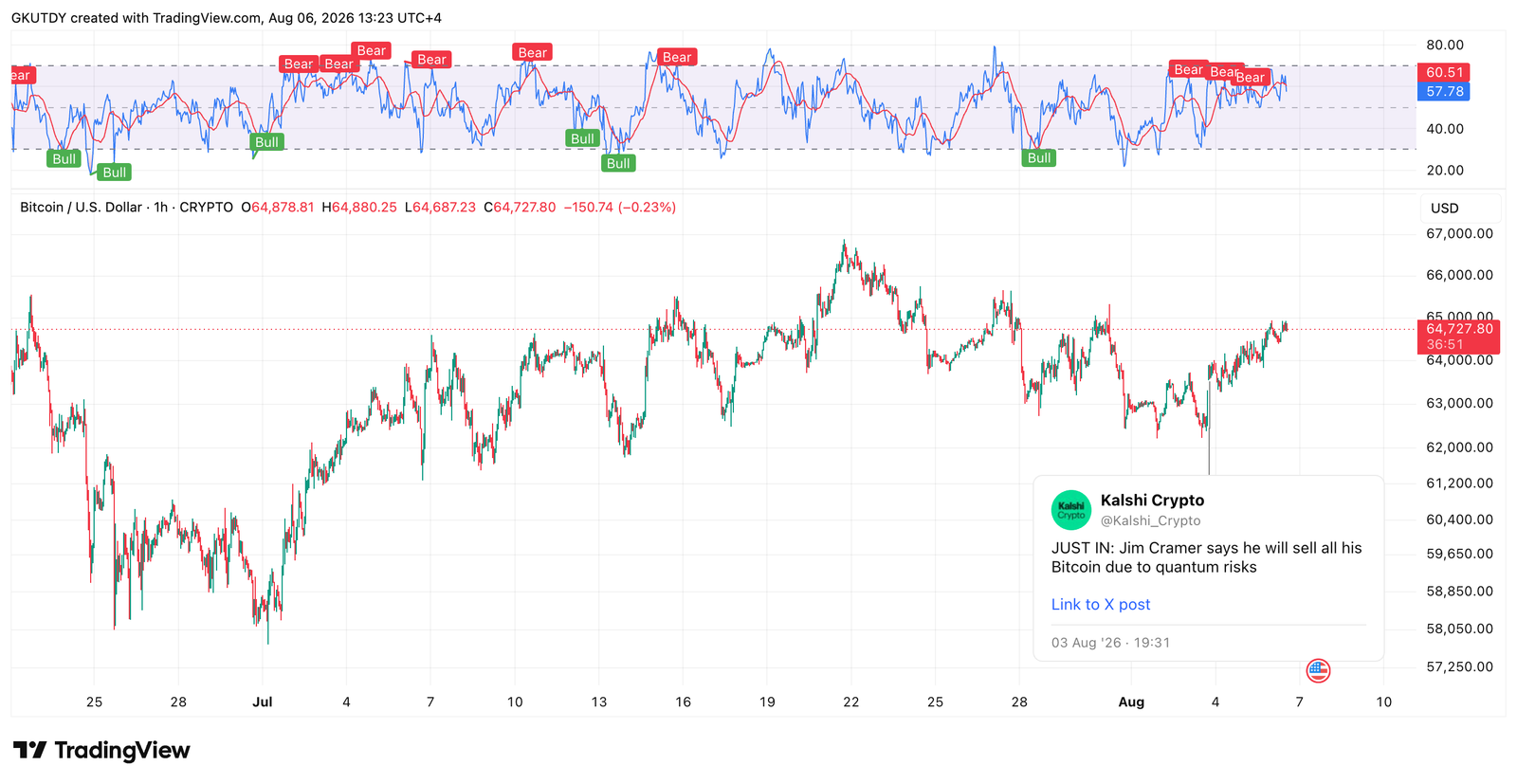
The crypto community responded to the news not with panic, but with relief and memes. Historically, Cramer's high-profile sales or bearish forecasts have surprisingly often coincided with a local price bottom, followed by a recovery. The same thing happened this time, as the market completely dismissed the host's concerns.
As for the quantum threat, market participants considered the risks to be greatly exaggerated. Actual supercomputers capable of breaking modern cryptography are expected by some engineers to emerge only in 10 to 20 years, rather than within three years.
In addition, Bitcoin developers are already working on network upgrades and the implementation of post-quantum cryptography.
Finally, if such a breach ever becomes possible, Bitcoin would not be the first target. The entire global banking system and government databases would also be at risk.
In the end, one person's "quantum panic" turned into a short-term rally for everyone else. The market once again demonstrated that theoretical future threats still lose out to the classic rule: buy when capitulation is announced on television.