
Bitcoin recovered above $63,000 on Tuesday, Aug. 4, after falling to an intraday low near $62,227.
The asset reached $64,117 before easing toward $63,545, leaving it about 1.6% higher over 24 hours at the latest market reading.
The rebound came despite fresh selling disclosures from Strategy and another suspected wave of Coldcard wallet sweeps. BNB and Dogecoin were also higher, while an earlier Asian session snapshot showed Ether as the only major token still negative over seven days.
Bitcoin price rebounds, but the trend remains fragile
The recovery returned Bitcoin to the middle of the range that has contained trading since the sharp June decline. Buyers have repeatedly defended the area around $60,000, but the price has struggled to establish a sustained break above $65,000 to $66,500.
The daily chart still shows weak momentum. Stochastic RSI readings near 22 and 14 place the indicator close to its lower range. MACD remains below its signal line with a negative histogram, suggesting the latest bounce has not yet confirmed a wider trend reversal.
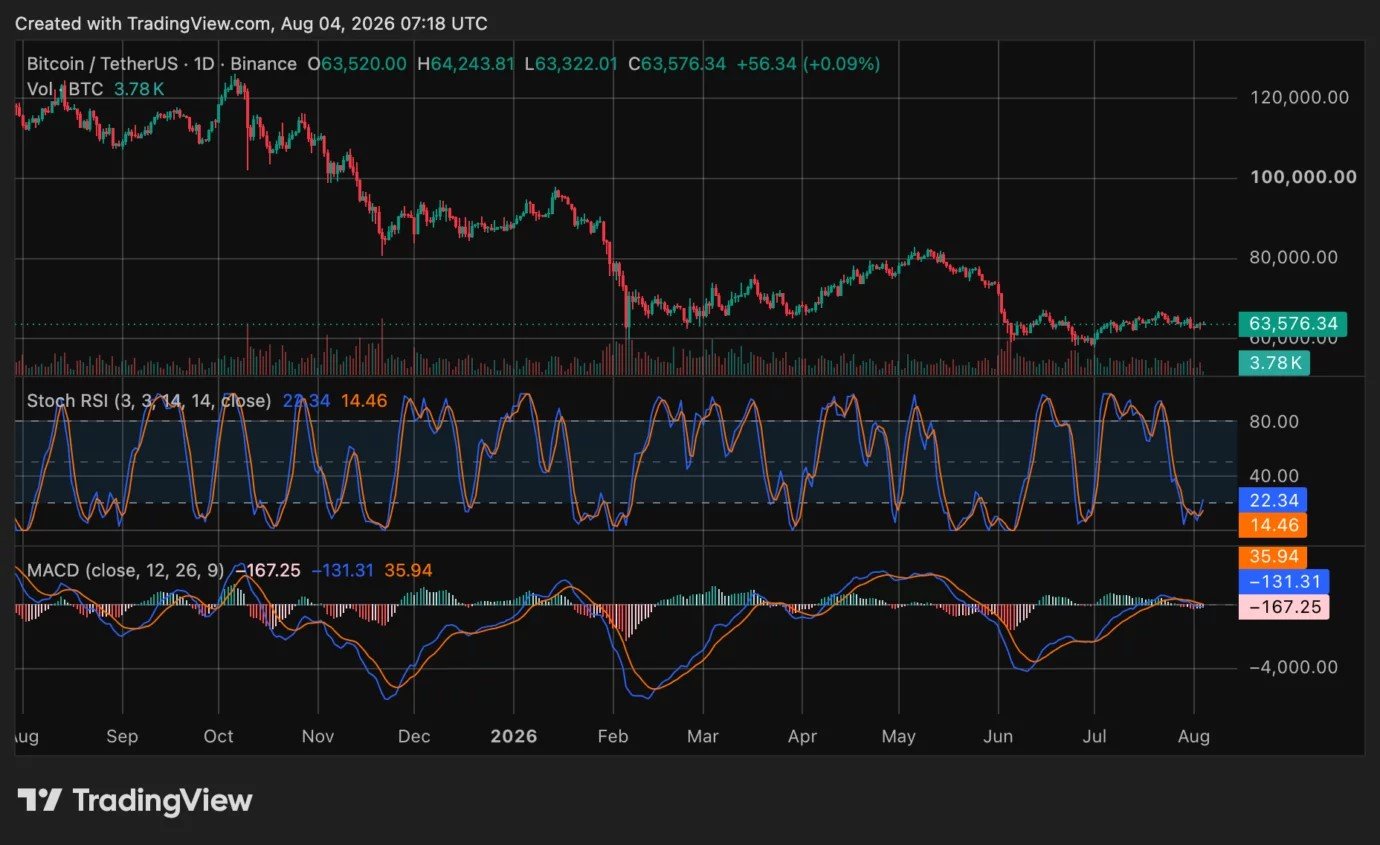
Broader markets offered a mixed backdrop. Asian equities moved unevenly, while oil rose as traders assessed conflicting signals around U.S. and Iranian negotiations. Bitcoin held near $63,800 during that session, suggesting it was absorbing crypto specific selling without a larger risk market retreat.
Strategy sale adds $104.7 million in corporate supply
Strategy disclosed in an Aug. 3 SEC filing that it sold 1,638 $BTC between July 27 and Aug. 2 for $104.73 million. The average sale price was $63,957, compared with the company’s $75,419 average acquisition cost across its remaining holdings.
The company directed $52.4 million of the proceeds toward preferred stock dividends and $52.3 million toward STRC repurchases. Strategy now holds 842,138 $BTC acquired for about $63.51 billion. The filing also showed $290.6 million in MSTR share sale proceeds, including $250 million added to its U.S. dollar reserve.
As crypto.news reported, the transaction was Strategy’s third disclosed Bitcoin sale of 2026. It followed a revised capital plan that permits sales for dividends, security repurchases and reserve management.
Executive Chairman Michael Saylor later said, “Strategy is a public company, not my wallet,” separating the corporate decision from his personal Bitcoin position.
When I say “Never Sell Your Bitcoin,” I speak as one saver to another. I have never sold mine. Not one satoshi. Strategy is a public company, not my wallet. Since 2020, it has disclosed it may buy or sell $BTC to manage capital. Our shared conviction in Bitcoin remains unchanged.
— Michael Saylor (@saylor) August 3, 2026
Strategy shares traded near $94.86, up about 1.6% at the time of writing. The move does not prove investors welcomed the Bitcoin sale, but it shows the filing did not trigger an immediate equity selloff.
Coldcard flows look more like migration than capitulation
Galaxy Research head Alex Thorn linked Monday’s activity to a fourth suspected Coldcard attack wave. His revised estimate covered 448.7 $BTC moving from 709 possible victim addresses. Thorn called them “likely Coldcard victims,” wording that reflects blockchain pattern analysis rather than confirmed device records or law enforcement attribution.
Adding the fourth estimate to the earlier mapped waves produces roughly 1,815.75 $BTC across 5,294 addresses, assuming no overlap. Coinkite has not confirmed that total or established whether one operator controlled every wave. Crypto.news reported that the estimate remains based on Galaxy’s blockchain analysis.
Coinkite said fixed firmware now protects newly generated seeds. However, updating a device does not repair a seed created under vulnerable firmware. Users must generate a completely new seed and transfer their remaining Bitcoin to addresses controlled by it.
CryptoQuant data lends some support to the custody migration explanation. Transfers below 1 $BTC reached 39,600 $BTC on Friday, their highest daily total since the FTX collapse in November 2022. Large transfers do not automatically mean those coins were sold. Some holders may have moved funds to new wallets or exchanges while responding to the security warning.
The fourth Coldcard wave also included transactions that opted into Replace by Fee, according to Thorn. A user who detects an unconfirmed malicious transfer may be able to replace it with a higher fee transaction directing the funds to a secure wallet. That option disappears after the malicious transaction confirms and is not guaranteed to succeed.
$60,000 and $66,500 define Bitcoin’s next move
Analyst Ali Martinez said a retest of $60,000 “could actually be bullish” if it completes the right shoulder of a potential inverse head and shoulders pattern. Under that reading, $66,500 is the neckline. A confirmed breakout could place $71,000 and $76,000 back in view.
This is why a move to $60,000 could actually be bullish for Bitcoin $BTC. https://t.co/ClNx5sz5iO pic.twitter.com/EhOdTVelsD
— Ali Charts (@alicharts) August 3, 2026
The pattern remains conditional. A decisive loss of $60,000 would weaken the proposed reversal and return attention to support near $56,000. The daily indicators also show that buyers need stronger momentum before treating the rebound as a confirmed breakout.
Martinez separately estimated that miners sold about 1,774 $BTC, worth roughly $112 million, over the past week. His post did not publish a full methodology, so the figure should be treated as an analyst estimate rather than an audited miner total.
The next test is whether Bitcoin can hold above $63,000 through the U.S. session and then clear the $65,000 to $66,500 resistance band. Failure to retain $63,000 would leave the market vulnerable to another test of $62,250 and possibly $60,000. A clean move through the neckline would provide stronger evidence that buyers have absorbed the Strategy sale, miner distribution and Coldcard related transfers.