A rare on-chain signal has appeared in the cryptocurrency market that, at first glance, looks like a deep crisis but has historically foreshadowed the end of a prolonged decline and a global trend reversal.
According to 'Crypto Dan' from analytics platform CryptoQuant, even the most resilient large investors have begun selling Bitcoin at a loss en masse amid a critical decline in public interest in the industry.
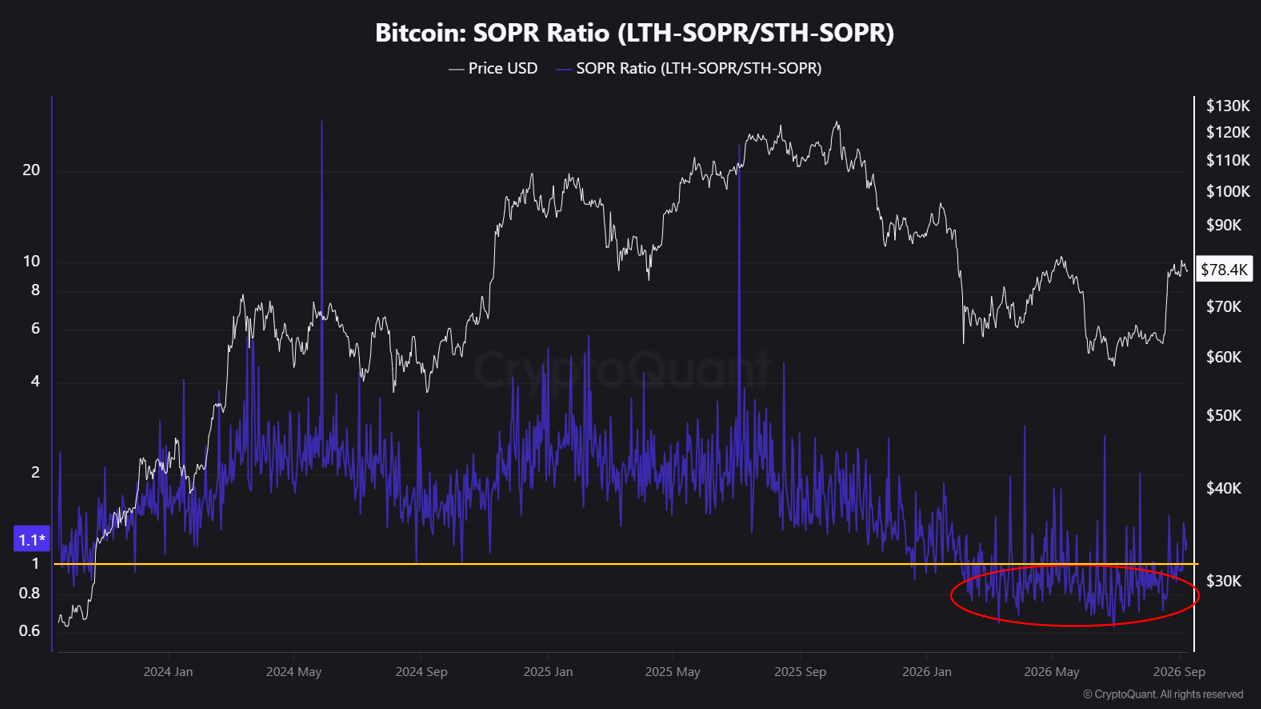
The essence of this paradox lies in a key on-chain indicator: the SOPR Ratio, which measures the profitability of long-term holders relative to short-term holders.
It has fallen below the psychological threshold of 1.0. In previous market cycles, a drop in this metric below the signal line has always marked the final stage of clearing speculators from the market and the formation of a global macro bottom.
Bitcoin's current consolidation around $78,400 has trapped market participants in a state of uncertainty. After a prolonged correction from previous highs, investors who had held their coins for years began to lose their nerve.
A drop in the ratio below one literally means that "old money" is now realizing deeper losses relative to its purchase price than recent buyers.
CryptoQuant analysts emphasize that periods in which even mid- to long-term investors keep selling Bitcoin at a loss have historically proved to be excellent entry points. The current situation is unique because the capitulation of large investors is occurring just as market participants' interest hits rock bottom.
Such a combination of factors — panic among market veterans and complete indifference from the crowd — comes around only once every few years. Experts conclude that even at its current levels, Bitcoin still looks cheap.
How this "bottom" works and when the rebound will begin
For the average observer, large investors selling at a loss looks like a reason to panic, but institutional investors view the situation differently. The capitulation phase among long-term holders traditionally coincides with the formation of a market bottom for two reasons:
Complete lack of hype: The market has been fully cleared of casual participants, while panic selling among retail traders has stopped, removing additional pressure on the price.
Transfer of coins into strong hands: While short-term participants dispose of their assets during local price fluctuations, large addresses, or "whales," use the lull to quietly absorb the available supply at relatively low prices.
Despite the strong bullish potential of this paradox, analysts urge investors to wait for confirmation. For the trend to be decisively broken, the SOPR Ratio must not simply find a bottom but return above 1.0 and remain there consistently. This would prove that the market is ready to sustain new price levels and return to steady growth.