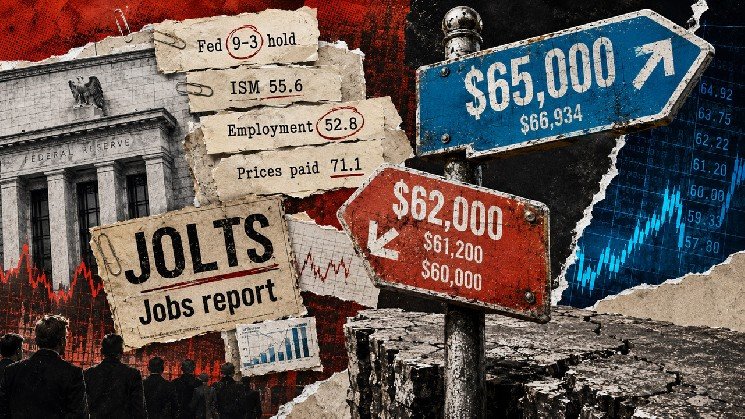
Bitcoin and jobs data are on a collision course this week, with the price pinned between $62,200 and $65,000 after the first economic release worked against the bulls.
The ISM Manufacturing PMI printed 55.6 on Aug. 3, beating the 54.0 consensus and rising from June's 53.3 to its highest reading since May 2022. New orders climbed to 56.7, and employment entered expansion for the first time in 33 months at 52.8.
Prices paid held at 71.1, a level that keeps the inflation case alive even as growth accelerates.
Bitcoin traded near $63,755 when the report landed, inside a session range of $62,227 to $64,059. That puts the price between the floor traders have defended since Aug. 1 and the ceiling that has rejected every rally attempt since July's high near $66,934.
That range means more this week because the Federal Reserve's July 29 hold came apart at the seams. The Federal Open Market Committee kept the target range at 3.50% to 3.75%, but the vote split 9-3, with Beth Hammack, Neel Kashkari and Lorie Logan wanting a 25-basis-point hike immediately.
Three dissents on a rate decision are rare, and they turn this week's strong economic data into ammunition for officials who already wanted to tighten.
Signal Latest reading Normal risk-asset read Why it hurts Bitcoin this week ISM Manufacturing PMI 55.6 Growth is accelerating Strong growth supports the Fed hawks Consensus estimate 54.0 Beat shows economic resilience Reduces urgency for rate relief New orders 56.7 Demand is improving Suggests momentum may continue Employment 52.8 Labor is stabilizing Weakens the “cooling jobs market” case Prices paid 71.1 Inflation pressure remains high Keeps the tightening argument alive Fed vote 9-3 hold Rates paused Three officials already wanted a hikeHow Bitcoin and jobs data could shape the week
Four data points separate Bitcoin from Friday's close. Tuesday brings June's JOLTS report at 10 a.m. Eastern, with May's openings at 7.6 million, hires at 5.2 million and quits at 3.1 million.
A rise in openings would confirm labor demand hasn't cooled and lean on the $62,200 floor, and a drop in openings alongside steady hires would fit a controlled slowdown and give Bitcoin room to test $64,000.
Workers walking away from jobs less often is the clearest early sign that confidence is cracking.
Wednesday's ISM Services report, out at 10 a.m. Eastern, covers a larger share of the economy than manufacturing and bridges directly into Friday's payrolls.
The employment component carries the most weight here, with prices paid close behind. A strong reading alongside elevated prices closes off any hope of a dovish surprise, and a soft employment print, even with headline strength intact, opens a path back toward $65,000.
Thursday brings preliminary second-quarter productivity and labor-cost figures at 8:30 a.m. Eastern, along with weekly jobless claims. Productivity rarely moves markets on its own, but it explains how wage growth turns into inflation.
Strong productivity lets output and pay climb without feeding prices, while weak productivity paired with high unit labor costs feeds straight into prices and hands the Fed's hawks another data point to cite before Friday.
Bitcoin and jobs data converge at 8:30 a.m. Eastern on Friday, when the July Employment Situation report decides the week. June's report showed payrolls up by only 57,000, unemployment at 4.2% and participation down to 61.5%.
A repeat of that softness, meaning moderate hiring, no wage acceleration and no upward revisions to prior months, gives Bitcoin its cleanest run at $65,000.
A beat on payrolls, firm wage growth, and upward revisions to May and June would confirm the labor market never slowed enough to justify a pause. That outcome favors the officials who already voted to hike.
Date Event Bullish $BTC signal Bearish $BTC signal Bitcoin level to watch Tuesday JOLTS Openings soften while hires hold Openings rise or remain elevated $62,200 floor Wednesday ISM Services Employment weakens, prices ease Strong employment and sticky prices $64,000–$65,000 resistance Thursday Productivity + labor costs Productivity strong, labor costs contained Weak productivity, high unit labor costs $62,000 confirmation line Friday Jobs report Moderate hiring, softer wages, no upward revisions Strong payrolls, firm wages, upward revisions $65,000 breakout or $61,200 downsideThe levels on both sides of the range show what a break means, with $62,200 to $62,500 as the immediate floor, matching the Aug. 1 low and Monday's intraday low. A sustained close under $62,000 would expose $61,200, the next visible reference set by the July 3 low near $61,239.
A confirmed close under $60,000 pulls Bitcoin out of range-trade territory entirely, putting the 52-week low near $57,800 back in play.
On the upside, $64,000 marks the upper boundary of the resistance zone, but $65,000 is the decisive level. Bitcoin needs a close above $65,000 that holds through the next session, since several intraday pokes above that level in July failed to hold.
Clearing that bar with conviction puts July's high near $66,934 back in play.
Potential outcomes until Friday
The bull case runs on a labor market that cools without breaking. JOLTS openings soften, ISM Services employment weakens even as headline activity holds, and Friday's payrolls land near June's pace with no wage surprise.
That combination lowers the odds of a September hike without triggering recession fears, and it pushes Bitcoin toward $65,000 and $66,900.
The bear case runs the other way, with JOLTS openings staying elevated, ISM Services employment firming alongside sticky prices, and Friday's payrolls beating expectations, with wages climbing and prior months revised higher.
That outcome validates Hammack, Kashkari and Logan's case for tightening, and it sends Bitcoin through $62,000 toward $61,200, with $60,000 next in line.
Two other markets are giving Bitcoin room it hasn't used. Equities recovered late last week on earnings from Microsoft and Amazon, while Bitcoin failed to follow.
That split shows Bitcoin is trading on its macro drivers right now, separate from equities.
Oil fell roughly 5% on Monday, with President Donald Trump holding off a fresh strike on Iran and OPEC+ approving a September output increase of about 188,000 barrels a day. That's a cushion against inflation, but Monday's 71.1 prices-paid reading shows it hasn't fully worked yet.
Scenario Macro setup Fed implication Bitcoin path Bull case JOLTS cools, services employment softens, payrolls moderate September hike risk fades Break above $65,000, retest $66,900 Base case Data are mixed, with no clean labor slowdown Fed stays hawkish but not forced Range holds between $62,200 and $65,000 Bear case Openings stay high, services firm, payrolls and wages beat July’s hawkish dissents look validated Break below $62,000, test $61,200 and $60,000 Liquidity shock Yen stress, oil reversal, or bond volatility hits risk assets Macro pressure overwhelms labor nuance $60,000 fails, $57,800 returns to viewThe Bank of Japan held its rate at 1.0% in July in an 8-1 vote, while the yen traded near a 40-year low. Japan's finance ministry said it bought yen in coordination with the US Treasury. A disorderly move there would hit Bitcoin as a liquidity asset, independent of anything the labor data say on Friday.
The link between Bitcoin and jobs data defines the week's final test: the numbers must be soft enough to take the Fed's three dissenters off the table without spooking every other asset rallying on the assumption that growth is fine. A hot enough report Friday turns $62,000 from a floor into a trapdoor toward $60,000.