Bitcoin’s network computing power is pushing back toward record territory near one zettahash per second, but the milestone is adding pressure to miners already dealing with thinner economics and increasingly attractive alternatives in artificial intelligence infrastructure.
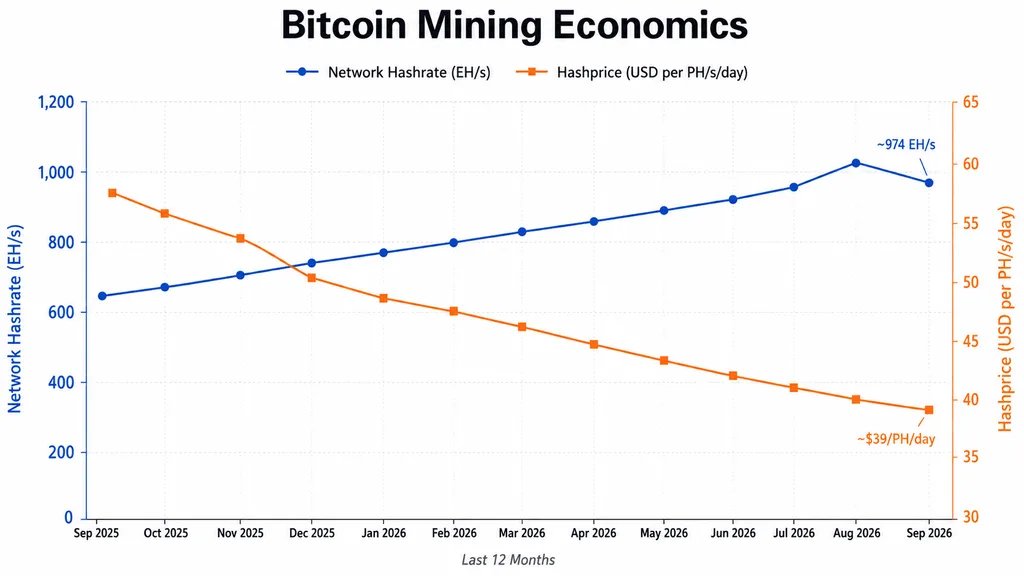
Bitcoin’s estimated network hashrate was around 974 EH/s on Sept. 1, after exceeding 1.03 ZH/s on Aug. 31 and crossing the one-zettahash threshold several times during August. Hashrate estimates fluctuate because network computing power is inferred from block production rather than directly measured in real time.
More computing power strengthens Bitcoin’s security, but it also intensifies competition among miners for essentially the same block rewards.
Rising Hashrate Pressures Bitcoin Miner Revenue
The pressure is visible in hashprice, an industry metric estimating daily mining revenue generated by a unit of computing power.
Hashrate Index recently placed Bitcoin hashprice near $39 per PH/s per day, leaving less room for miners with older machines or higher electricity costs.
As more computing power joins the network, Bitcoin’s difficulty mechanism adjusts upward to keep block production near one block every 10 minutes. A miner therefore has to keep expanding hashrate simply to maintain the same share of network rewards.
The strain is already visible in public-company results.
MARA’s energized mining hashrate rose 22% year over year to 70.3 EH/s in Q2 2026, yet quarterly revenue fell 27% to $174.9 million. The company mined 2,422 Bitcoin during the quarter while reporting purchased energy costs of roughly $38,690 per BTC at owned sites.
Those economics help explain why mining companies are increasingly treating electricity itself as the valuable asset rather than viewing Bitcoin mining as its only use.
AI Data Centers Compete for the Same Power
Artificial intelligence has created another potential buyer for miners’ power infrastructure.
Bitcoin mines and AI data centers require different hardware and operating environments, but both need large quantities of reliable electricity, grid connections and>MARA now explicitly says it can allocate power between Bitcoin mining, AI, high-performance computing and other workloads depending on economics and demand. The company controlled roughly 1.9 GW across 19 data centers at the end of June.
Coinpaper has already examined how Bitcoin mining stocks are becoming increasingly tied to AI infrastructure rather than trading purely as leveraged Bitcoin proxies.
Riot Platforms offers an even clearer example.
The company signed a 20-year lease covering 191 MW of critical IT capacity at its Rockdale campus, with the initial agreement expected to generate approximately $9.1 billion in contracted revenue.
Coinpaper recently tracked Riot’s $9.1 billion AI infrastructure deal, underscoring how quickly miners are repositioning their energy assets.
AI Is Starting to Replace Mining Revenue
IREN shows how far the transition can go.
The company generated $70.5 million from AI Cloud Services in its latest reported quarter, up from $33.6 million previously, while Bitcoin mining revenue fell to $66.7 million from $111.2 million.
IREN has said it is decommissioning Bitcoin mining hardware and reallocating power toward AI Cloud Services, with much of the transition expected to be completed before the end of 2026.
That shift does not mean Bitcoin mining is disappearing.
Instead, the competition for electricity is changing the economics.
With Bitcoin hashrate near one zettahash per second and hashprice around $39, miners increasingly need the newest ASICs, cheap power or alternative revenue streams to protect margins.
AI data centers provide that alternative.
For investors, the next phase of Bitcoin mining may therefore depend less on which company operates the most mining machines and more on which miners can earn the highest return from their scarce power capacity.