- Listed Bitcoin miners fell below aggregate cash breakeven in Q2 as hashprice reached a record low.
- Several operators are actively retiring hashrate and redirecting power toward AI and high-performance computing.
- Grid connections are becoming strategic assets as U.S. data-center projects face years-long interconnection delays.
- Investors are already paying substantially higher valuation multiples for miners with contracted AI capacity.
-
Bitcoin ended June at $58,400 against average ex-tax cash production costs of roughly $75,500 per $BTC across the listed sector. Yet the industry’s response is increasingly about reallocating power rather than simply installing more efficient mining machines. AI developers need enormous quantities of electricity, and miners already control sites connected to grids where new data centers can wait years for access.
Miners Are Paying to Remove Hashrate
Bitcoin mining economics deteriorated sharply during the quarter. June hashprice reached a record low of $27.70 per PH/s/day, while transaction fees contributed less than 1% of block rewards.
The response from some operators goes beyond slowing expansion.
Core Scientific paid $41.9 million to cancel approximately 15 EH/s of next-generation mining equipment. Its remaining self-mining operation posted a negative 56% gross margin, with some machines continuing to operate partly because power obligations remained during the conversion of sites toward AI infrastructure.
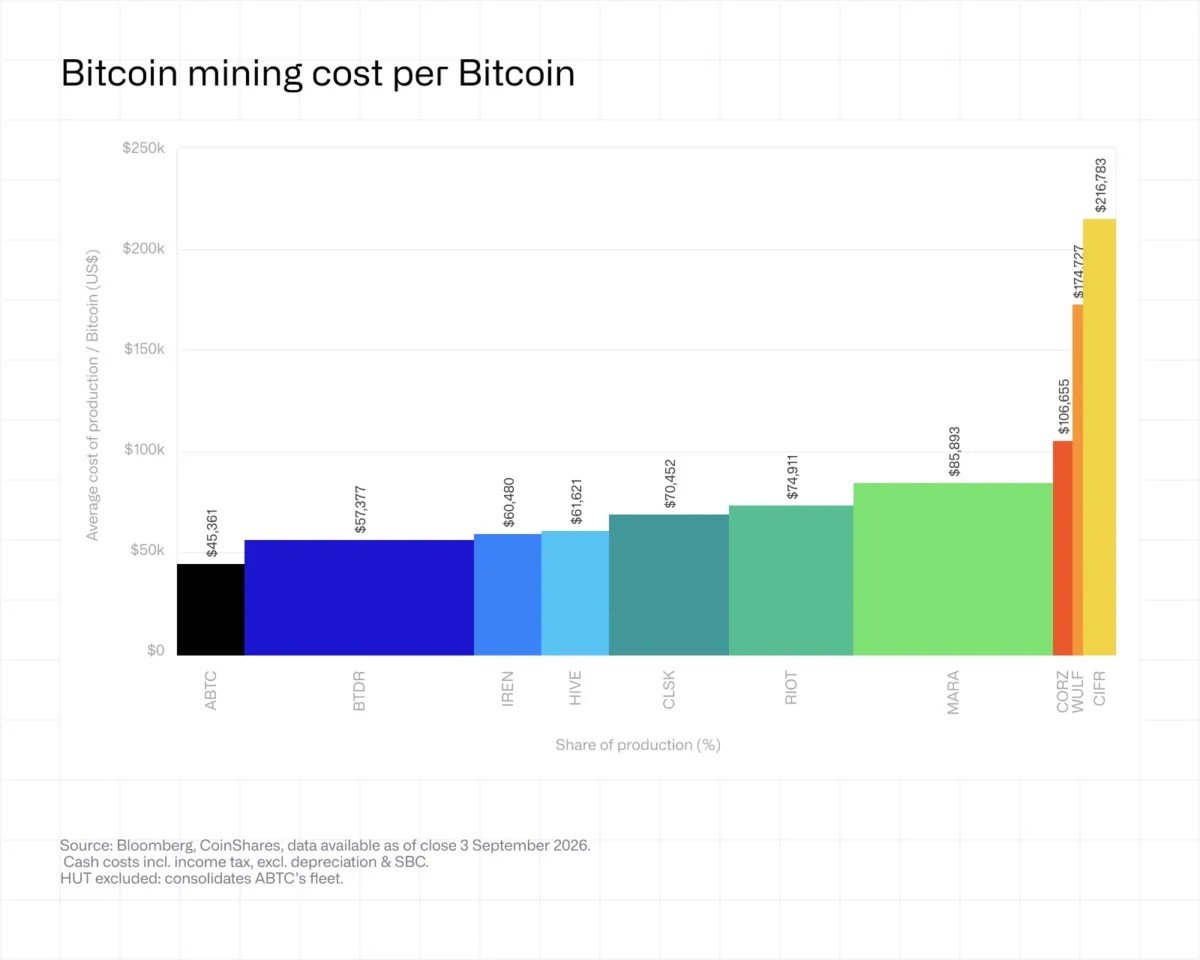
Average Bitcoin production cost among major miners, based on data available as of September 3, 2026. Keel stopped mining entirely on June 29. Cipher does not plan additional mining capex and expects mining to become immaterial by 2030. CoinShares estimates at least 35 EH/s will leave the listed-miner cohort as announced transitions proceed.
IREN provides perhaps the clearest indication of where the economics are heading. Its quarterly AI cloud revenue reached $70.5 million, exceeding $66.7 million from mining, while 71% of TeraWulf’s Q2 revenue came from HPC leases.
These companies are no longer merely diversifying away from Bitcoin. They are deciding whether an available megawatt produces a better return connected to ASICs or AI servers.
One Megawatt, Two Very Different Businesses
CoinShares estimates that current AI economics can generate approximately $1.5 million of annualized profit per MW, compared with about $500,000 from Bitcoin mining.
That comparison changes how mining infrastructure can be valued. Instead of asking only how efficiently a company converts electricity into $BTC, investors increasingly need to ask what alternative return that electricity could generate.
The Megawatt Decision What can the same power connection produce? Metric Bitcoin Mining AI / HPC Annualized profit / MW ~$500K ~$1.5M Infrastructure cost / MW ~$0.7M–$1M ~$8M–$15M Revenue exposure $BTC + hashprice Long-term contracts Key advantage $BTC upside Higher revenue visibility Indicative economics based on CoinShares Q2 2026 estimates. Actual economics vary by operator, power price, financing and contract structure.The headline advantage for AI therefore comes with a substantial qualification. Building or converting AI-grade infrastructure can require $8 million to $15 million per MW, compared with roughly $700,000 to $1 million for mining infrastructure. AI facilities require different cooling, networking, redundancy and reliability standards.
A mining campus cannot simply replace ASICs with GPUs and capture three times the profit.
Grid Access May Be More Valuable Than the Mining Equipment
The strongest part of the AI thesis is not computing hardware. It is electricity.
CoinShares identifies at least 225 rel="noopener" target="_blank">Core Scientific demonstrates the capital required. Its colocation revenue rose sharply as capacity entered service, but Q2 capital expenditure simultaneously approached $798 million.
For investors, a headline backlog figure should therefore carry less weight than the speed at which contracted megawatts become billing megawatts.
A Bitcoin Rally Could Change the Calculation Again
AI currently offers superior economics per MW, but mining retains something that long-term hosting contracts can sacrifice: direct operating leverage to Bitcoin.
Hashprice recovered from its June low toward $38 as $BTC rebounded toward $77,000, bringing most operators back above cash breakeven according to CoinShares.
A further Bitcoin rally could materially improve mining profitability without requiring years of construction or billions of dollars in conversion spending. Miners locked into long-duration AI contracts cannot simply reclaim that electricity when $BTC economics improve.
That makes flexibility valuable.
A company that converts every available megawatt to AI may secure predictable contracted cash flows but surrender upside during another highly profitable mining cycle. A pure miner retains that upside but remains exposed to Bitcoin prices, network difficulty and increasingly thin transaction-fee revenue.
The strongest infrastructure portfolios may ultimately be those capable of allocating capital selectively rather than making an all-or-nothing bet on either industry.
The New Mining Dashboard Has Three More Numbers
Hashrate, joules per terahash, power costs and $BTC production still matter. But they no longer tell investors enough about companies turning themselves into digital-infrastructure operators.
The additional metrics are energized MW, contracted MW and billing MW.
Energized capacity measures the scarce infrastructure already secured. Contracted capacity indicates potential demand. Billing capacity shows how much of that opportunity has actually become revenue.
The gap between contracted and billing megawatts may be the most revealing number during the next several quarters. It separates AI ambition from AI execution at a time when equity valuations already assume substantial success.
CoinShares expects AI/HPC revenue to accelerate through the second half of 2026 as additional capacity starts billing. Financing will matter just as much: miners are committing billions of dollars to infrastructure capable of supporting those contracts.
Bitcoin mining is therefore not simply being replaced by AI. The industry’s scarce resource is being repriced.
Electricity once mattered because it could produce Bitcoin cheaply. In an increasingly power-constrained data-center market, having that electricity available in the right location, with a viable route to AI-grade infrastructure and a customer willing to pay for it, may be considerably more valuable.
Bitcoin Miners Find Their Power Is Worth More to AI
AD SPACE · 728×90
This story is curated from crypto-news-flash.com. go to source →