May’s Boom Quickly Turned Into June’s Bust
The latest six months of mining revenue tell a story miners know all too well. Bitcoin’s price swings and bursts of onchain activity can give earnings a temporary boost, but block rewards still do almost all of the heavy lifting. Transaction fees may grab headlines during brief spikes, yet they remain a small slice of what actually keeps mining operations running month after month.
Monthly mining revenue data from Newhedge.io shows July delivered only a partial recovery after June’s punishing 23% collapse, a drop that erased May’s rally and then some. April closed with $947.26 million in mining revenue before May jumped to $1.086 billion, giving miners one of their strongest months in recent memory.
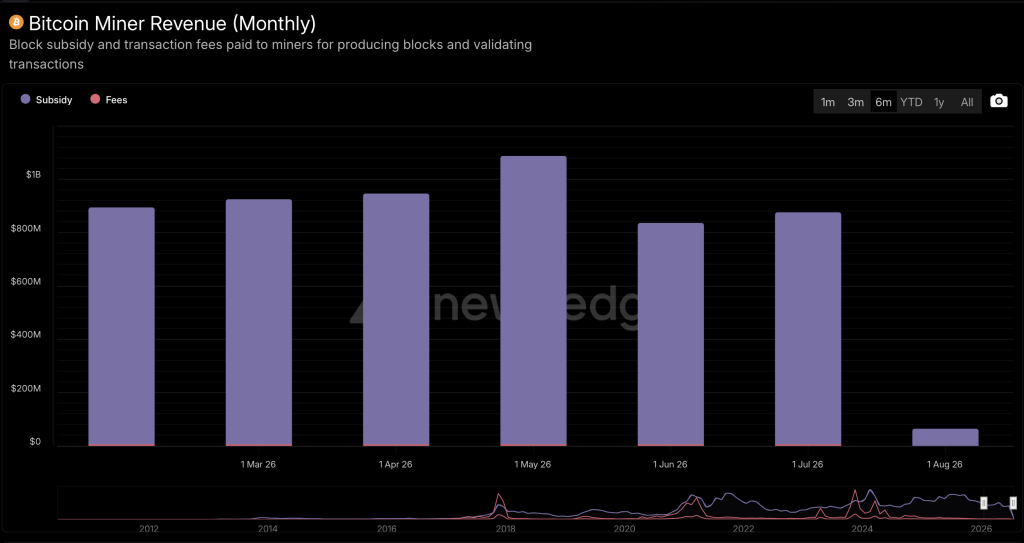
That momentum did not last. June revenue plunged to $836.41 million, a sharp reversal that quickly reminded operators how fast favorable conditions can disappear.
Bitcoin’s Price Offers a Small Lift
While $BTC has slipped 2.2% over the past two weeks, the bigger picture is less severe. Over the past 30 days, bitcoin has remained up a modest 1.6%, offering miners at least some support even as revenue conditions remain well below May’s peak.
That modest gain in bitcoin’s price translated into a little extra breathing room for miners in July. Monthly mining revenue climbed from $836.41 million in June to $875.35 million in July.
Hashprice Improves, but Margins Stay Tight
This can also be reflected in the hashprice, a term that describes the spot price of hashrate per terahash (TH/s), petahash (PH/s), exahash (EH/s), and so on. 30 days ago the spot value per a single PH/s according to stats logged by hashrateindex.com was $29.01.
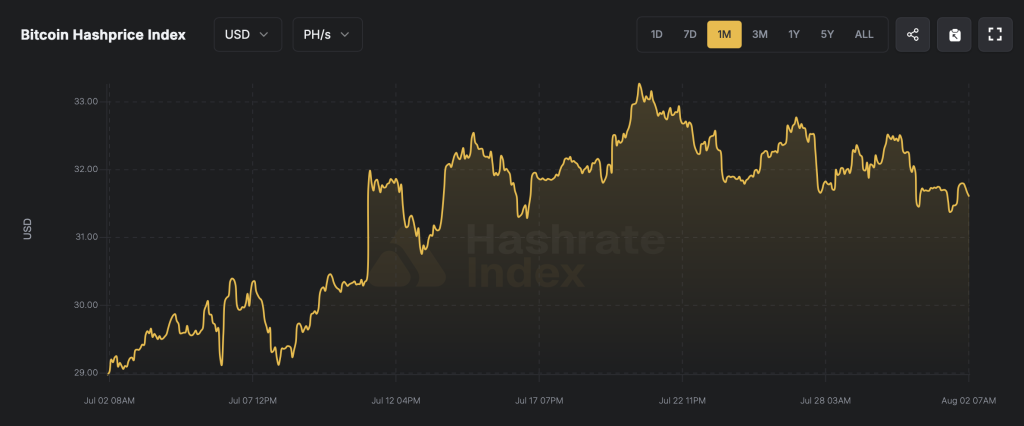
Today, hashprice sits at $31.59 per PH/s, leaving margins tight despite July’s modest recovery. August could shake things up, with two competing forks giving miners fresh incentives to rethink where they point their hashpower.
BIP-110 Meets a Difficulty Increase
BIP-110 enters its key signaling phase around Aug. 8-9, but with support still hovering near 2%, the proposal looks unlikely to lock in. That leaves miners watching for brief chain instability rather than a meaningful change to fee income. Interestingly, Bitcoin’s next difficulty adjustment is expected to land just as BIP-110 enters its signaling window, putting two closely watched events on a collision course. Current estimates point to a 1.87% difficulty increase, adding another layer of pressure as miners weigh their options.
The eCash Fork Could Shift Hashpower
Later in the month, Paul Sztorc’s eCash fork could present a more interesting tradeoff. Fresh SHA-256 chains often attract opportunistic hashpower when difficulty starts low, giving some miners a chance to chase higher short-term returns before economics pulls them back to Bitcoin. In the end, the machines will follow profitability, and any meaningful shift away from $BTC mining could leave the miners who stay behind with slightly better economics after the next adjustment.
The next few weeks should reveal where miners believe the best returns lie.